
The Jesus Prayer -#the jesus prayer #contemplation
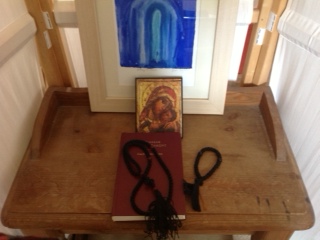
Just before my first sabbatical seven years I was stressed, anxious and near to burn-out. I hadn’t fully realised this, but just a few weeks before I was due to start the sabbatical I was lying in bed, and suddenly I felt this big ball of anxiety come out of my stomach, through my body, and out of my mouth. It was like a showing from God I was suddenly aware of the anxiety I had been holding down.
Then in a bookshop Simon Barrington Ward’s book The Jesus Prayer lept off the shelf at me. The book and the practice of the Jesus Prayer, helped me enormously, as did some conversations with Bishop Simon (formerly Bishop of Coventry), when doing some interviews for the Baptist Times. Mark’s Gospel also became a book of healing for me.
When I began to use the Jesus Prayer it acted very like some of the Celtic prayers, as a circle of protection. For a while it kept at bay the feelings of anxiety or the afflictive thoughts that were troubling me. But if you read the writings of the Desert Fathers and Mothers you find out there are some thoughts (and in the end all thoughts) that you can’t keep at bay. They called these the Eight Afflictive Thoughts, which became trivialised as the Seven Deadly Sins.
These were pride, anger, lust, gluttony, acedia, sadness, greed and vanity. At some point, as these thoughts are kept at bay for a while, we realise that we are not our thoughts, that we are bigger than our thoughts. If we are aware that we can take them captive, that relativises them – they are smaller and less powerful than we think. They are not the powers and authorities that they can become in our minds. By characterising these afflictive thoughts as demons, the Desert Fathers and Mothers achieved this observing distance from their thoughts; they relativised them in that way.
Mark tells us that one of the reasons we fail to see and hear and understand the mystery of the kingdom, the key to real living, is that we have hard hearts. Jesus asks the disciples, ‘Are your hearts hardened?’ (Mark 8:17) when they fail to understand the feeding of the 5,000. Contemplative practices like Lectio Divina and the Jesus Prayer enable us to open and soften our hearts – that is why they are so applicable to helping us become the disciples Mark wants us to be.
At some point we have to move from the Jesus Prayer acting like a protective circle, to something more like a fragile coracle in which we enter the sea of our thoughts and feelings and the wider world and God. We move out of the harbour into the open sea. The harbour is the place of experiential avoidance, the sea is where we engage with what we have been hiding from, what we have run from, what we have pushed down out of our awareness. We move from a place of narrow concentration to a place of open awareness.
From a psychological perspective, the disciples in Mark are guilty of experiential avoidance. When Jesus talks about the way of the cross and predicts His passion, Peter rebukes Him (Mark 8:32). He has to remind them twice more, in Mark 9 and 10, and then again in chapters 13 and 14. Watchfulness is facing reality, not running away from it, or pretending something else is reality – like being the greatest, saving one’ s self, or gaining the whole world.
Experiential avoidance is a psychological process that seeks to avoid what we believe will be painful feelings, thoughts, memories and bodily sensations within us. It causes us problems psychologically. For example, in times of conflict I would avoid facing the experience of my anger. I would end up with very tight neck and shoulder muscles that could go into spasm.
But when I faced the anger and the cluster of thoughts, feelings and bodily sensations with it, the anger did not seem to be such a fearful power and authority as I thought it was. I have often tried to avoid anxious feelings by keeping busy. But as the Jesus Prayer helps us to slow down and still ourselves, we become aware of what we have been avoiding.
How do we begin with the Jesus Prayer? It is important to pay attention to the body. Posture is important, and the way we sit. I find a prayer stool or a straight-backed chair where one can sit relaxed but in a good frame is important. Where we sit is also very important. Chose a place you can return to again and again that has no distractions. We can also pray the Jesus Prayer walking somewhere, or out in the world doing something else.
Traditionally in the Jesus Prayer, the first half of the sentence is prayed on the in-breath – ‘Lord Jesus Christ, Son of God,’ – and the second half of the sentence is prayed on the out-breath, ‘have mercy on me, a sinner.’ The breath is neutral, it belongs to no particular religious group. Breathing is something we all do, and we take it with us wherever we go. That makes it a useful aid in our prayer life. When we are anxious we often over-breathe, and this rhythmic use of it in the Jesus Prayer slows our breathing down.
I find that I repeat the prayer in cycles of 25, with a pause in between the cycles to offer prayers for whatever comes to mind, or simply to be in open awareness or contemplation of God’s presence. Beginning with four cycles is a good start.
It takes time to learn to move out of the harbour and experiential avoidance into the open sea, in the coracle of the simple prayer. In Mark’s gospel we are made aware of our incompleteness and need to be open to God at all times. The Jesus Prayer brings us to that point as well. Mark’s gospel teaches us perseverance – what has been called ‘deep practice’. Those who master a craft are distinguished by how much time they spend in practice, not by their innate ability. A concert pianist will have done on average 10,000 hours of practice to arrive at that level of skill. The Jesus Prayer reminds us about the need for ‘deep practice’. However, God in His grace may give us moments of epiphany that keep us praying in this way.
The best little book on The Jesus Prayer is Simon Barrington Ward’s, see the links here: http://www.amazon.co.uk/The-Jesus-Prayer-Simon-Barrington-Ward/dp/1841015881 and here http://www.brfonline.org.uk/9781841015880/
I have collected many books on The Jesus Prayer over the last few years, and will post some details in future articles. May it lead you into healing and the presence of God as it did for me. If you use the Jesus Prayer I would love to hear from you and start a dialogue, or if you are interested in using it.
Killing our children softly #consumerism
 WE ARE killing our children softly with the song of consumerism. It’s a deadly lullaby that stops us seeing the world dying around us. It weaves a shroud around us that wraps us up in a closed system of thinking. This virus that some name affluenza is more contagious than swine flu. But how does it spread?
We need to begin by washing our hands after every advert. Big business uses the applied research of consumer psychology to manipulate powerful and nonconscious psychological processes in us so that we will buy their particular products but also adopt a consumer lifestyle.
Studies show that much of consumer behaviour is automatic and unexamined. This leaves us open to being controlled, and advertising and marketing strategies try to strengthen that automatic thinking because it leads to over-consumption. It is critical and observant thinking about our patterns of consuming that breaks the unthinking patterns of over-consumption. It is here that mindfulness can have an ethical component.
As we vegetate in front of the TV information is processed on autopilot, mindlessly. Advertisers know this and seek to exploit it. It is clear that big business has been very good at reshaping us into over-consumers.
Advertising is adept at creating this closed system of thought whereby the consumer believes shopping is the only answer to his deep desire for fulfilment. Sadly many spiritual answers are also now packaged as consumer products.
One of the main ways advertisers form our preferences is through the use of exposure. I exaggerate but if you take a popular programme like The X Factor it feels like there is now 30 seconds of singing followed by 15 minutes of adverts.
The other key technique is conditioning. In conditioning the product, which might mean nothing to us, is paired with something that we do desire and the advertisers hope that we make an association between the two stimuli. For example there was an advert which appeared before the 9 p.m. watershed which had a partially naked woman advertising a product for bleeding gums. A classic piece of crude conditioning.
Consumerism is a cruel master. Beneath the promise of well-being in each advert and marketing campaign is the whisper of fear that slides through our letterboxes, creeps into our homes and heads, hearts and beds. Without this you will be nobody. Without this no one will like you.
It is for no small reason that Jesus tells us we cannot serve two masters.
The effect on our children is as bad as anything imagined by Philip Pullman in his Dark Materials trilogy, where childrens’ souls are cut away. What can we do about it?
It is important as parents to watch the TV programmes our children watch. We can teach our children to turn the sound down when adverts come on, or we can sit with them and help them deconstruct the adverts.
It is possible to retrain our minds, for example people are much more aware of ethical issues to shopping, whether it is fair trade or child labour.
As Christians Jesus tells us we can either be cross-bearers or consumers but not both. The cross is many things, but as Martin Luther said, Crux probat omnia – everything is put to the test of the cross. Only by putting our consumer patterns to the test of the cross can we break the habit within us of mindless and automatic consumption. In the same way the cross helps us develop the habit of sacrificial and generous giving and a simpler lifestyle.
It is through the cross that we reach the crown of fulfilment and life in all its fullness. Unless we address this deep desire for fulfilment and the real reasons for inner emptiness the quick fix offered by the world of advertising will continue to allure us.
As usual we often have the answer but are not aware of it. Research also shows that a sense of connectedness and belonging to a community gives a us a sense of fulfilment thereby breaking the consumer mentality that grips us.
As Paul says the hour has come for us to wake up from our slumber (Romans 13:11). If our average tithe as Christians measures our wakefulness, we are only 2 ½ % awake to God, and 97 ½ % consumers. Be aware of affluenza. Protect yourself. Protect others.
Mind and Soul – Christianity and mental health
Mind and Soul – Christianity and mental health
An interview with Rev Will Van der Hart and Rob Waller, Consultant Psychiatrist, founders of PREMIER Mind and Soul which works at the interface of the church and mental health.
Today is World Mental Health Day, particularly focusing on depression. This is an interview of hope.
miriam darlington luminous poem #poetry
miriam darlington luminous poem #poetry
Apricots luminously enfolded in words…read it and feel your mouth fill with anticipation.
Coco Open Attentive and Learning

Coco asks for bigger photo for his blog
Coco the mindful dog- part two
 We thought we would carry out the next brain-scan (no harm to dog) experiment out there in the field so to speak. The sophisticated software and scanning headgear was developed by Top Dog Neuroscience Ltd. Basically it scans the dog’s mind and translates the brain-waves into thoughts.
the big cunning dog he does put me in strange gear what will all my friends think but I do know he has ham in his pocket even though my head is humming I think it will be a day for sniffing today and rolling in things because the big cunning dog that is the master I do know that he has forgotten my ball and all my friends will be there so I have to show them that I am a big cunning dog too and the master I do love him but I do know that I wiill win the chess game and end up on his bed if I keep howling but I do know that he doesn’t know that I play chess….(at this point on the computer the thoughts translated by the software dried up. Coco was sniffing things at this point and we think that his brain had switched to pure awareness. Beautiful patterns appeared instead of thoughts. I am thinking of getting them printed and sold as Coco’s paintings. It might help to pay the vet bills….the sniffing has stopped).
If I sit and look at him now I do know that he will give me some ham which is in his left zipped pocket look in my eyes give me ham….(at this point very powerful brain waves were measured and the experiment was abandoned for the day). I felt it important to give Coco some ham as a reward.
A Mindful Experiment- read this Paul Kingsnorth poem
A Mindful Experiment- read this Paul Kingsnorth poem
In Daniel Siegel’s book The Mindful Brain the author talks about the mindful awareness induced by poetry, creating what he calls ‘a receptive presence of mind’ (p.161). By presence he says ‘I mean quite specifically the state of receptive awareness of our open minds to whatever arises as it arises’ (p.161).
Paul Kingsnorth’s poem ‘Vodadahue Mountain’ has just that impact. Follow the link to this poem, read it attentively and see what happens. Daniel Siegel argues that such poems activate the streams of awareness within us (p.162).
This poem won the 2012 Wenlock poetry prize. As I read it I had a moment of clear vision that there is, to paraphrase Luther, something important written on, trees, flowers, clouds and stars (and mountains, elephants and pumas). Something I need to track.
An eco-no to evil – the mindful tree
 In ‘The Roots of Christian Mysticism’ by Olivier Clement there is a fragment of a quote from Paul Claudel talking about the art of Japanese painters. This is in a chapter entitled The Glory of God Hidden in His Creatures and the quote says ‘for them, the visible world was a perpetual allusion to Wisdom, like that great tree which, with unutterable majesty, says No to evil for us’ (p.223).
Paul Claudel apparently had a profound conversion to Catholicism at the age of 18. I can’t be sure what great tree he is talking about, but the tree that sprung to my mind was the mysterious tree ‘of the knowledge of good and evil’ (Genesis 2:17).
What struck me about what Claudel might be helping us to understand is why this mysterious tree is there in Genesis. Maybe it is called the tree of the knowlege of good and evil, to help us say No to evil – it is an eco-No. Claudel also said in La Ville, ‘A pure eye and a fixed gaze see every object becoming transparent in front of them'(p.222, Clement).
The great tree is there in Genesis to help us say No to evil, and perhaps that embodied Wisdom is in every tree. If we looked at any tree attentively enough, we might see the ‘No’ of God written in each leaf, the No to evil.
One of the great evils, therefore, is how we treat trees and the rest of Creation. The obvious example is the continued destruction of the rain forest. It seems that the eco-No was there in the beginning. Wisdom sits in the tree, and we need to notice it.
Mindful of nature – Isaac the Syrian
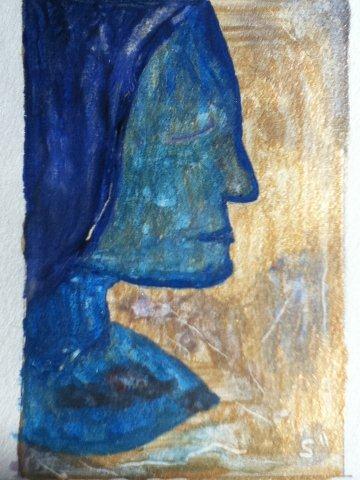 Isaac of Nineveh (The Syrian) of the seventh century was someone who who was mindful of nature. His purified heart, purified through contemplation of Scripture made him mindful of nature.
‘And what is a compassionate heart?..It is a heart that burns for all creation, for the birds, for the beasts, for the devils, for every creature. When he thinks about them, when he looks at them, his eyes fill with tears. So strong, so violent is his compassion….that his heart breaks when he sees the pain and the suffering of the humblest creature.’ (quoted in Olivier Clement, ‘The Roots of Christian Mysticism’, p. 227).
Christians who rediscover the ancient paths of contemplation will rediscover the possibility of seeing ‘every common bush afire with God’ (Gerard Manley Hopkins). They will rediscover a heart that burns for all creation.
 shaunlambert.co.uk