
skiing is a #mindful awareness practice

skiing in Switzerland
I have learnt a lot about mindfulness from skiing. One of our most human habits is experiential or emotional avoidance. We try to avoid painful thoughts, feelings and sensations. Fear keeps our attention away from facing the reality of this inner turmoil.
When you stand at the top of a mountain for the first time with your skis on, experiential avoidance only gets you into trouble! You have to face your fears, notice them, but bring your attention back to the task of heading down the slope without your normal levels of control.
Often we put in limits to what we do, these self-limits can keep us in a little box. Skiing can help us move beyond our self-limits. It makes us aware of our negative self-talk that is usually automatic and out of our awareness…’I can’t do this’…and yet we find we can and much more.
As well as helping us become aware of our inner narratives, our narrative sense of self where we focus much of our attention, often out of our conscious control – skiing invites us to dwell in our senses – what psychologists call our experiential sense of self.
The touch of sun and wind on our faces, the smell of clean air, the taste of snow-flakes in our mouth, the sound of silence or skis on snow, the dazzling wilderness of the mountains lift our eyes.
But we have other senses according to Daniel Siegel, an interpersonal neurobiologist. Our sixth sense is being able to be aware of what is going on in our bodies. We become very aware of our bodies as we ski. The ache of muscles, the rush of exhilaration, the thrill of the body to the sensation of speed. We become acutely aware in our seventh sense of what we are thinking and feeling – perhaps even moving beyond thoughts and feelings into pure awareness.
If we are with other people we can tune in to their thoughts and feelings, our eighth sense. I also believe we have a ninth sense where we can sense the presence of God. Mountains make it possible for us to attune to our spiritual sense, our realisation of our interconnectedness with the created world around us.
When we begin we often lean back up the slope hoping this will slow us down, and of course it just makes our skis go away from us. Counter-intuitively we must lean down the slope, towards the danger. We face the slope in the same way we should turn towards our symptoms of pain, stress and anxiety.
What I found when I had skied for a week was much of my stress had left. I always wondered why. What I realise now is that when we shift out of narrative self into our experiential self, much of the stress we feel dissolves. This is what mindfulness does. This is why skiing is a mindful awareness practice. In it we get to exercise our muscle of attention, as well as all our other muscles. In it we learn how to focus our torch of attention. In it we can find a place of open awareness where we are filled with ecstasy.
Why am I writing this now? I am about to go back to the mountains for a week of community with Gold Hill Skiing and about 60 other people. Skiing is not just an individual pursuit, it is a communal one.
#mindfulness and the torch of attention
Our capacity for attention is sometimes spoken of as a torch. But what can this torch do, and who or what controls it? Let’s assume it is on all the time whether we know it or not.
The best short summary of what attention is and does is by Professor Paul Gilbert in his book Mindful Compassion, co-authored by Choden. (Paul Gilbert & Choden, Mindful Compassion (London: Robinson, 2013)
The first point they make is that attention, like a torch, can be moved, it is not fixed. I can move it intentionally to focus on my big toe but it can ‘also be taken over unintentionally by the threat and drive systems.’ (p.191) The threat and drive systems are two of our three main internal systems. So they can shine the torch where they want. In the drive and resource-seeking system we are ‘wanting, pursuing, achieving, consuming.’(p.56) In the threat-focused system (fight and flight) we are ‘threat-focused, protection and safety-seeking.’ (p.56)
So it can be moved intentionally and it can be taken over, this torch of attention.
The second ‘m’ to remember for attention is that it can magnify, ‘Attention acts like a zoom lens making some things bigger in our minds and blocking out other thoughts and feelings.’ (p.191) I can zoom in on my big toe and my torch of attention magnifies it so that it is the focus of my attention. I also have another process of open awareness that can run alongside this focused attention but that is another story.
The third ‘m’ to remember for attention is its ability to focus on our memories. What that means is that ‘Attention can have very powerful physiological effects: bringing to mind happy memories can arouse pleasant feelings and sensations, whilst dwelling on unhappy things can arouse unpleasant feelings and sensations.’(p.191) This can be done intentionally or automatically, unintentionally, out of our awareness.
Our attention can be ‘captured by our emotions without us even realising it.’(p.191)
Mindfulness practices help us to train our minds so that we can intentionally work with the torch of attention. We can notice when our attention has unintentionally switched to negative ruminative patterns. We notice those patterns and let them go. We do not avoid them or fuse with them.
Attention – it is a very important torch!
How ecstatic writing becomes ecstatic reading and #mindful moments
I have been reading Julian Hoffman’s ‘the small heart of things – being at home in a beckoning world.’ It is a book full of epiphanies, the opening up of time to insight, understanding and a sense of unity.
One such moment occurred reading his description of seeing a pod of dolphins in a chapter entitled ‘An Accumulation of Light’. An accumulation of light is a good description of an epiphany. I don’t want to quote the whole section, because I want you to buy the whole book. But I do want to share two sentences which brings to an ecstatic climax the writer’s epiphany, but which also became an epiphany for me.
As he watches the dolphins he says, ‘I later realised how time had dissolved while we watched the dolphins. Past and future, and all the weight they carry, had folded into one clear, immeasurable moment.’
In the moment that I read this, and the moment still resonates with me, I was aware of the thoughts and feelings I was carrying, rooted in the past and the future, and how heavy those thoughts and feeling were. And then I realised I could let them go. This was an intuitively natural mindful moment.
To become aware how heavy the thoughts and feelings can be that are ruminating or worrying about the past and future is a great gift. Because then we can put them down. The lightness of being is in the present moment.
In poetic terms what Julian writes is what Edward Thomas, the nature poet, would call a ‘thought-moment.’ Edward Thomas was once called an ‘ecstatic walker.’ Julian Hoffman gets his inspiration from ecstatic walking, and in a mysterious process of alchemy, his nature writing becomes ecstatic writing. Ecstatic writing can become ecstatic reading.
speaking #mindfully in pencil and not in indelible ink

I like the requirement in the reading rooms of the British Library to write only in pencil, in order to protect the precious books. Ink marks the books and is indelible. It stains and cannot be removed.
When we speak to each other we should speak in pencil, kindly, compassionately and gently, as one learner might talk to another, as one beggar might share bread with another.
We should not talk to each other in indelible ink, as know-it-all’s speak to know-nothings, as angry, and self-righteous – believing there is only one perspective, ours and that it is right.
Speaking in pencils we don’t leave angry marks on other people, who are more precious than books, but mark as easily.
The clouded windscreen of the mind and the de-icer of #mindfulness
 Early yesterday as I went outside the car was covered with sticky ice. The sort of ice that takes 10 minutes to scrape off. Often on the school run you can see cars driving along with the driver peering out of a small cleared hole in the windscreen, with the rest of the windscreen and windows still clouded with ice.
It’s a picture of how the windscreen of our mind is much of the time and how we rush around with limited perception. Rowan Williams in his beautiful little book ‘Silence and Honey Cakes – the wisdom of the desert’ talks about this inattention, ‘the failure to see what is truly there in front of us – because our own vision is clouded by self-obsession or self-satisfaction.’ (p.26)
We rush along in the icy morning without clear vision, and we do the same in life. If we pay attention to the ice, truly pay attention to it with a de-icer we can clear the windscreen of our car. If we pay attention mindfully to the sticky cloud of self-obsession or self-satisfaction, or any other ruminative pattern that stops us seeing clearly, this mindfulness de-ices the windscreen of our mind.
Then we begin to see clearly.
#mindfully choosing the palette of colour you paint with..
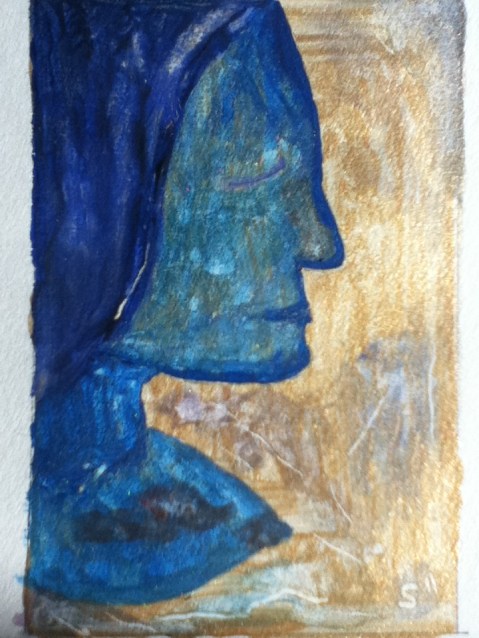
I was leading a retreat at Worth Abbey on watchfulness over the weekend. On the Sunday morning I got up early and walked to the Abbey Church at 6.15. There is very little light pollution and the night sky was very open.
The stars beckoned me to look at them, stopping me in my tracks. Their beautiful silence brought tears to my eyes. I have always liked the Don McLean song Vincent (starry, starry night) about Van Gogh. The opening lyrics came into my head as a refrain:
‘Starry, starry night,
Paint your palette blue and gold…’
The rational part of my brain said, ‘the words are not right’. The actual words are:
‘Starry, starry night,
Paint your palette blue and GREY..’
But a voice came back to me saying, ‘no, you paint your palette blue and gold.’
It felt like a message from the stars for the New Year.
For me blue speaks of faithfulness and stability and sticking with people, God, the way of watchfulness and mindfulness. Gold speaks of the brightness of hope.
What mindfulness has taught me is that I can choose the palette of colours I paint my life with. Each thought and feeling has its own colour. Sometimes I have painted with grey, allowed depressed thoughts to become a ruminative pattern in my mind. I have learnt that they are passing events in my mind, that they are not me and that I can let them go.
As I have noticed them and let them go, blue and gold thoughts have sprung up. The message of hope came as a gift from the stars, ‘paint your palette blue and gold…’ I can mindfully choose the palette of colour I paint with. And so can you.
#mindfulness and the selfie
An early 21st century word in the news recently is selfie. The Oxford Dictionary defines it as follows:
‘a photograph that one has taken of oneself, typically one taken with a smartphone or webcam and uploaded to a social media website.’
It is often perceived to be narcissistic, a photo taken with the lens of the ego. But it is not a new phenomenon, it is an outer reflection of something that happens internally all the time. We are constantly taking ‘selfies’ in our minds. But we don’t just take them with the lens of the ego.
Acceptance and Commitment Therapy (ACT), a mindfulness incorporating therapy talks about cognitive fusion, where we look at life from our thoughts. Each thought can be a little selfie. Here are some examples from Steven C. Hayes book Get Out of Your Mind & Into Your Life (p.57):
- I am so depressed
- I am so anxious
- I am so tired of being in constant pain
The problem with this as Steven Hayes points out is ‘Cognitive fusion means you are taking these statements as literal truths and, eventually you begin to believe that you, in fact, are your pain.’ (p.57).
The antidote is to look at your thoughts rather than look at life from your thoughts. This is cognitive defusion. If we look at our thoughts and say ‘I am having the feeling of sadness’ (p.75), this is a more accurate picture of reality than the fused selfie ‘I am sad.’
As we step back and observe our thoughts we disarm them and they begin to dissolve. This is part of being mindful. The central insight of mindfulness, from the perspective of secular psychology, Buddhism or Christianity is the realisation that I am not my thoughts, that I am bigger than my thoughts, that my thoughts are just passing events in the mind.
So we can say the following:
- mindfulness is not a selfie taken through the lens of ego it is a reperceiving of the self taken through the lens of awareness
- mindfulness is not a selfie taken through the lens of self-hatred it is a reperceiving of the self taken through the lens of mindful compassion
- mindfulness is not a selfie taken through the lens of anxiety it is a reperceiving of the self taken through the lens of cognitive defusion
Our culture’s current preoccupation with selfies is a sign that we need mindfulness and mindful awareness practices.
The four steps in the dance of #mindful attention
In a little article on the Mindful website recently Daniel Goleman highlighted the dance steps of the mind in most meditations: focusing our attention, the mind wandering, noticing that the mind has wandered and what it has wandered to, and removing it from where it has got attached and returning to your focus of attention. Daniiel Goleman points out that there are four things going on in this dance : focused attention, mind wandering, meta-awareness which notices your mind has wandered and detaching from where the mind has wandered and bringing it back.
I noticed that the four steps of the dance began with four letters that make a mnemonic of two parts, F.M. & M.D.
- Focused Attention
- Mind wandering
- Meta-Awareness which notices your mind has wandered
- Detaching from where the mind has wandered and bringing it back
I don’t know what these two sets of initials bring to mind for you? Reflect on them a moment. What they bring to mind for me is this.
F.M. I associate with radio stations and tuning in to them. So the steps of Focused Attention and Mind Wandering are about tuning in and out from the frequency of our focus. What is fascinating about Daniel Goleman’s article is that he points out each of these steps involves a different circuitry in our brain.
M.D. I associate with Doctors and healing, a Doctor of Medicine. The healing of our minds and re-sculpting of our brains occurs through these steps of the dance of attention.
The point of the mnemonic is simply to help us remember the four steps of the healing dance of attention. Launch that boat of attention and begin to dance in the sea of awareness.

The Summoner and the Wordseer – from a tale of mind lore II
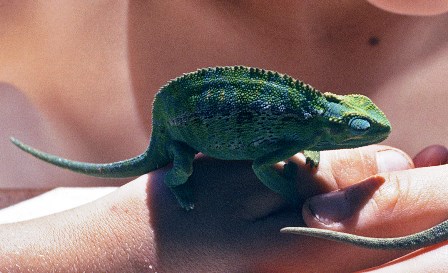
The summoner saw the boy through the leaves. She looked at him until the boy looked at him. She summoned the boy over, moving so slowly it was as though time had no hold on her.
The boy’s eyes suddenly saw the summoner. He too slowed down and stepped out of time. The summoner stepped on to his hand. He felt the tight grip on his thumb and fingers.
In the moment the boy saw that the chameleon was made of many little moving words. He watched transfixed as the words moved into a story. A window opened in his soul and a wordseer was born.
The chameleon stepped back onto the branch and disappeared in an instant among the leaves. She was looking for someone else to summon. The boy began to see pictures as words.
(From a tale of mind lore II, how a gift found Hudor…)
Threshold to Wonder – #mindful of the way of beauty

A friend of mine Bruce Thompson posted this photo on Facebook. I was immediately taken to a place of wonder as I looked at it.
Alister McGrath in his beautiful book ‘C S Lewis A Life – Eccentric Genius, Reluctant Prophet’ writes:
‘A central theme in the Chronicles of Narnia is that of a door into another world – a threshold that can be crossed, allowing us to enter a wonderful new realm and explore it.’ (p.269)
Each moment of our life is a threshold to different possibilities, including possibilities of wonder. Sometimes we need a photo, a painting, a poem, a story, a face, a beautiful view to remind us of this, to fill us again with hope.
This coming Friday is the 50th anniversary of the death of C S Lewis. Perhaps you could find the thresholds of wonder in your life by re-visiting, or visiting for the first time his stories.
 shaunlambert.co.uk