
Therapeutic #Lindisfarne dragon takes shape
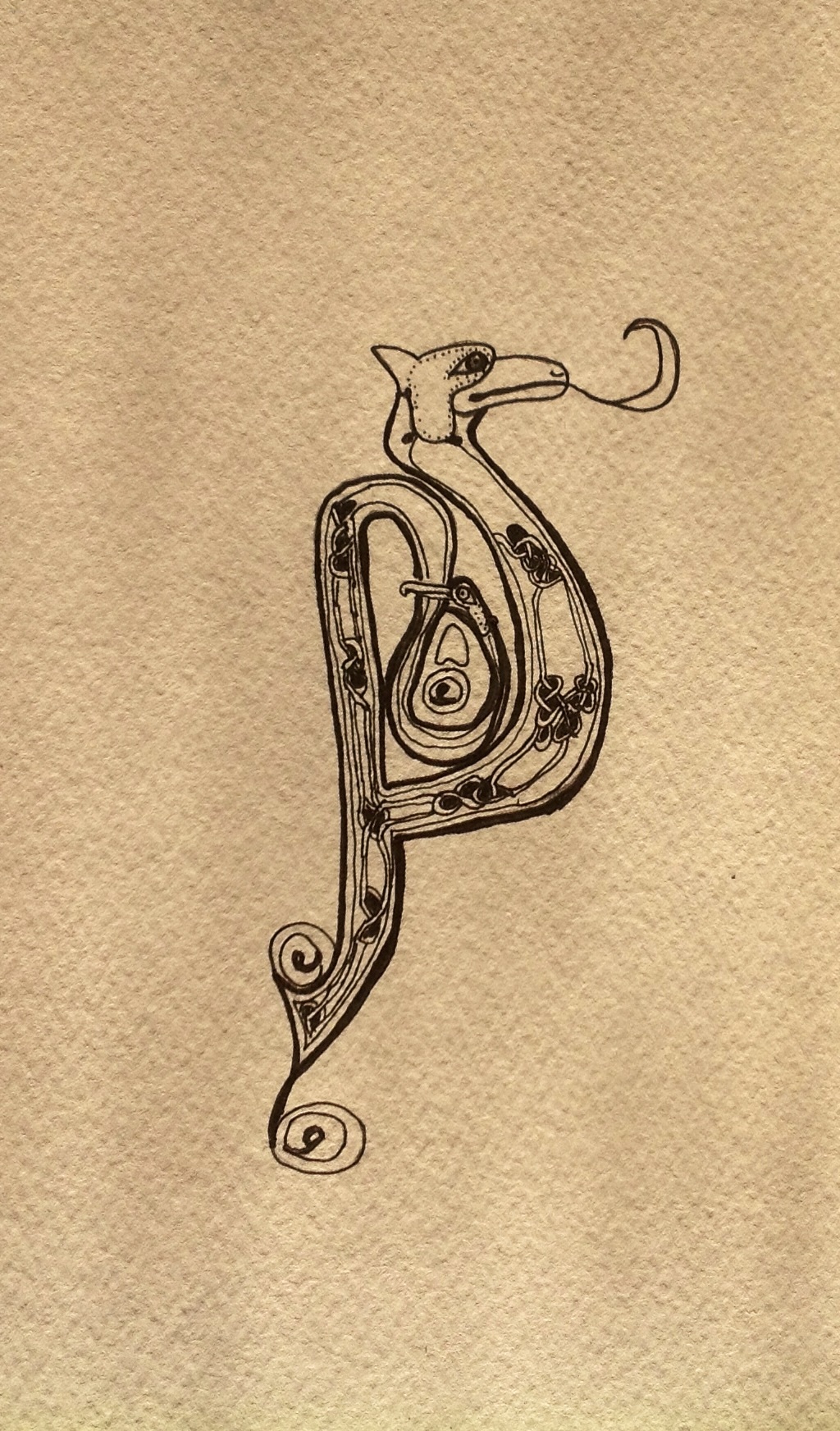
Plaited interlace and spiral work requires sustained attention. Drawing a mindful practice for a wandering mind.
Facing the dragons of difficult emotions #mindfully
 I have been running a course looking at mindfulness from a Christian perspective for a church in Ealing. One of the important questions that has come up is, ‘what do you do when a difficult emotion, thought, sensation emerges?’
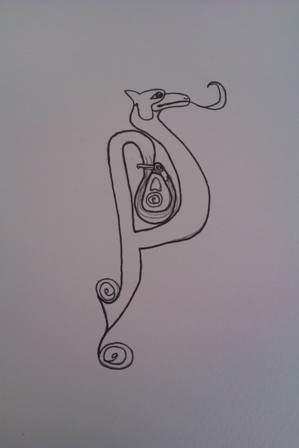
I have been looking at the Lindisfarne Gospels over the last few weeks in the British Library, before it goes to its brilliant summer exhibition in Durham. On the page that is open, within its glass case, is a letter ‘P’ shaped like a dragon.
It made me think of difficult emotions I have separated myself from, which I have imagined to be dragons. I have kept myself from experiencing them with a glass wall of separation. Mindfulness helps to bring down that glass wall of separation, whether it is our body, thoughts, or emotions that we have separated ourselves from.
One of the other things that kept me trapped was the thought that I had to be strong, and not show vulnerability and so it was hard for me to tell someone else I was struggling. But as I practiced mindfulness I had to face the difficulties and experiences I was keen to avoid. That can seem overwhelming.
At that moment it is really helpful to let someone else in, a wise friend, a doctor, a counsellor. When I did that I was able to face the difficult thoughts and emotions and begin to name them and draw them accurately. They began to lose their power, and began to dissolve.
I am trying to draw this Lindisfarne dragon. It has such complex plaited interlace, initially I think I can’t recreate it. But the more I pay attention to it, the more its pattern begins to make sense and not seem overwhelming and beyond my mapping.
I believe we can do a lot to help ourselves. But the most important lesson I have learnt is to let others in to help us with our vulnerability. The dragon drawing isn’t finished yet.
the ego – a concretization of God-forgetfulness and a #mindful remedy
Dorothee Soelle has a beautiful phrase, ‘the ego is a concretization of God-forgetfulness.’ Not only that the ego is a concretization of other-forgetfulness, of creation-forgetfulness. We live in an ego-dominated world.
Whether it is what Manfred Kets de Vries calls the destructive egotism of narcissism characterized by ‘self-centredness, grandiosity, lack of empathy, exploitation, exaggerated self-love, and failure to acknowledge boundaries.’ (The Leader On The Couch, p. 25)
Or whether it is the ego-driven quest of the empty consumer self, seeking to fill its emptiness with ever more possessions that are completely unnecessary, and serve only to feed the ego.
About seven years ago when I was stressed and anxious a little book called ‘The Jesus Prayer’ by Simon Barrington Ward lept off the shelf at me. The Jesus Prayer, Lord Jesus Christ Son of God have mercy on me a sinner helps us learn to sustain and switch our capacity for attention, as well as become aware of the presence of God.
At the same time as practicing this prayer I was doing some counselling and psychotherapy training at Roehampton and came across mindfulness within psychology. I felt these two different strands were related.
I then started researching one of the pioneers of the Jesus Prayer, a 5th century Bishop Diadochus of Photike – and came across an idea of his about ‘mindfulness of God.’ That phrase range me like a bell and I have been fascinated with researching it ever since.
The Greek phrase Diadochus uses which was translated mindfulness of God was mneme theou, literally the memory of God, or the remembrance of God – a living memory. This of course is the antidote to the ego as concretisation of God-forgetfulness, other-forgetfulness and creation-forgetfulness.
The practice of the memory of God helps us to remember God, remember others, remember creation, and remember our true self – made in the image and likeness of God. It releases us from the prison of the ego into a new freedom.
charged moments in ordinary time and more in being #mindful
In the stillness and silence of Easter Saturday the green blade is rising, the moments that approach the resurrection are increasingly charged until God emerges in the resurrection of Jesus of Nazereth.
It seems that silence and stillness lead to charged moments at other times as well. Christina Feldman who teaches mindfulness says that people ‘practising Buddhist mindfulness are seeing liberation in bite-size pieces.’ (quoted in ‘Mindfulness in Schools’ a dissertation by Richard Burnett, p. 23).
Terence Handley MacMath in her article in the Church Times recently writes about her experience of attending a secular mindfulness-based stress-reduction course (MBSR), and says ‘for many it became a revelation of what I would call a spiritual way of life.’ (Church Times, 22nd March 2013, p. 17)
I heard someone else say recently that meditation had led to deeper insights about reality.
In silence and stillness different insights emerge as we practice attention and awareness. Human attention and awareness are gifts from God. Meister Eckhart says this about gifts, ‘God never gives, nor did He ever give a gift, merely that man might have it and be content with it. No, all gifts which He ever gave in heaven or on earth, He gave with one sole purpose – to make one single gift: Himself.’ (quoted in The Silent Cry, Dorothee Soelle, p. 21) As Dorothee Soelle points out all gifts that are given point back to the Giver (p.21).
The gifts of attention and awareness point back to their Giver. This particular time, that stretches from Good Friday to Easter Sunday is a time to pay particular attention. It is the time that can stretch our awareness infinitely.
The Lindisfarne cat and the #mindless birds
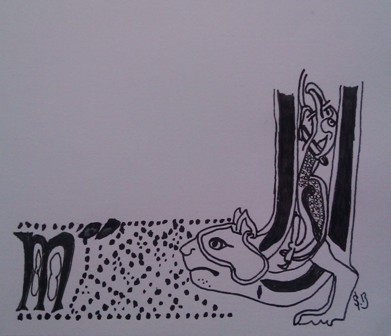
A cat forms the right-hand margin of the initial Luke page of the Lindisfarne Gospels. It’s head faces the bottom line of text, apparently attentive towards the mass of inattentive birds on the other side of the page – of which it has already swallowed eight.
A little picture showing the importance of being attentive, and the perils of being inattentive; the importance of being mindful and the dangers of living mindlessly.
ski boot of the mind #mindfulness

After wearing ski boots all day, walking back to the chalet in them and then putting on normal shoes – you suddenly feel very light-footed and almost as if you are floating.
It made me realise that very often I carry ski-boot thoughts and feelings in my mind that weigh me down unnecessarily. Becoming aware of them enables me to let them go and experience the lightness of awareness and being rather than the heavy weight of doing all the time.
You have to experience that inner freedom, to appreciate how heavy our normal way of thinking can be, and how light witnessing our thoughts rather than being a victim of them can be.
Elements of #mindfulness emerging in early Christian spirituality
Elements of mindfulness emerging in early Christian spirituality
A very rare bird from Africa, a Hoopoe was spotted by an attentive home owner in Poole recently, blown a thousand miles off course from its planned destination on the shores of the Mediterranean. It was amazing to see his photo, the last one I had seen used to land in our garden in Nairobi.
Also making the news each week is mindfulness, which some might categorize as an Eastern import blown thousands of miles off course, and not native to the West or Christianity.
However, if you look at the desert ascetics within early Christian spirituality you find elements of mindful awareness practice emerging, because mindfulness as an ability to be attentive and aware is a universal human capacity.
What are these elements?
The first is the self-regulation of attention, and in particular the ability to sustain one’s attention. This is called nepsis or watchfulness, ‘One should always stand guard at the door of one’s heart or mind..’[1]
This unceasing attentiveness is learnt through the use of the Jesus Prayer where we learn to switch our attention back to the repeated prayer and our breath when our mind wanders, ‘Lord Jesus Christ Son of God have mercy on me a sinner.’
This was all part of a consistent strategy, ‘nepsis (vigilance), watchfulness, the guarding of the heart (custodia cordis) and of the mind, prayer, especially the invocation of the name of Jesus, and so forth.’[2]
What the ascetic is guarding against is the afflictive thoughts. These early Christians developed a sophisticated psychology which mirrors that of modern cognitive psychologists.
The modern psychologists emphasise the importance of the mindful person avoiding elaborative and ruminative secondary processes in their mind. Rather than ‘getting caught up in ruminative, elaborative thought streams about one’s experience and its origins, implications, and associations, mindfulness involves a direct experience of events in the mind and body.’[3]
The early Christian ascetics differentiated between the first thought and secondary elaborative and ruminative processes:
‘There is the prosbole (suggestion in thought), which is free from blame…Next follows the syndiasmos (coupling), and inner dialogue with the suggestion (temptation), then pale or struggle against it, which may end with victory or with consent (synkatathesis), actual sin.’[4]
Through a process called exagoreusis ton logismon (revelation of thoughts) the beginning stage of the process of awareness/mindfulness is to catch the first thought before it moves into elaborative and secondary processes of thought, ‘One must crush the serpent’s head as soon as it appears.’[5]
Just as modern psychologists recognize that a thought, once it has been noticed, loses its power, so the early ascetics noticed the same thing, ‘As a serpent flees instantly as soon as it has left its hole, so an evil thought dissipates as soon as it begins to be disclosed.’[6]
Now, obviously before the thought can be disclosed to a spiritual father or mother, you need to become aware of it.[7] There was no experiential avoidance, each thought was rigourously named, each element of temptation recognized and labelled. As with any act of awareness of sustained attention it requires the ability to be aware in the present moment. There is no thought suppression, the first thoughts are disclosed to a spiritual elder immediately they are noticed. It is intentional and investigative. This mindfulness has an ethical and community dimension.
These terms – sustained attention, switching attention, self-regulation of attention, being in the present moment, elaborative and secondary processes, rumination, experiential avoidance, acceptance, intentional investigative awareness – are all terms and insights from the world of cognitive psychology.
They are also the first part of a proposed operational definition of mindfulness from a team of researchers.[8] Mindfulness as a mode of awareness that is a universal human capacity needs to be distinguished from the meditative, or mindful awareness practices, that evoke it.
Bishop et al. (2004) propose a two-component model of mindfulness: ‘
The first component involves the self-regulation of attention so that it is maintained on immediate experience, thereby allowing for increased recognition of mental events in the present moment.’[9]
Those of you familiar with mindfulness definitions will recognise the echoes of present-moment awareness, and paying attention to the streams of thoughts, feelings, ruminations, etc. within our minds.
The second component of their proposed operational definition involves adopting ‘a particular orientation towards one’s experiences in the present moment,’ which we will come back to.[10]
To continue our look at the self-regulation of attention, Bishop et al. (2004) point out the link to mindfulness. Mindfulness brings awareness ‘to current experience.’[11] What is required to maintain such an awareness are ‘skills in sustained attention.’[12]
One of the main meditative, or mindful awareness, practices is attending to your breath. This is a reality-focused, neutral practice that anyone can do. It is not religious or spiritual.
Attending to your breath develops your skills of sustained attention so that ‘thoughts, feelings, and sensations can be detected as they arise in the stream of consciousness.’[13] In mindful awareness practice the practitioner needs to ‘bring attention back to the breath once a thought, feeling or sensation has been acknowledged.’[14] This develops skills in switching attention which in turn makes our ability to be attentive more flexible.
There is another benefit to this self-regulation of attention. Bishop et al. (2004) conclude that the notion of mindfulness as a metacognitive process is implied in their operational definition because it involves monitoring and control.[15]
The monitoring element is important and involves a certain orientation to experience , including curiosity and acceptance. Acceptance is defined as ‘being experientially open to the reality of the present moment.’[16]
Acceptance is often misunderstood as passivity, but it is about ‘allowing’ current thoughts, feelings and sensations (Hayes, Strosahl, & Wilson)’.[17]
Acceptance can helpfully be seen as the opposite of thought-suppression or experiential avoidance; it is facing the reality of the thoughts, feelings and sensations we have.
As the authors argue ‘most forms of psychopathology involve, in some way or another, the intolerance of aspects of private experience, as well as patterns of experiential avoidance in an attempt to escape private experience’ (see Hayes et al., 1996, for evidence supporting this view.)[18]
A more skilful response to situations that provoke these more difficult feelings and thoughts can be cultivated through mindfulness.[19] With this orientation of curiosity and acceptance towards one’s experience, a further clarification of the definition of mindfulness can be put forth, as a ‘process of investigative awareness that involves observing the ever-changing flow of private experience.’[20]
This is an intentional effort because the client:
is instructed to make an effort to notice each object in the stream of consciousness (e.g., a feeling), to discriminate between different elements of experience (e.g., an emotional ‘feeling’ sensation from a physical ‘touch’ sensation) and observe how one experience gives rise to another (e.g., a feeling evoking a judgmental thought and then the judgemental thought heightening the unpleasantness of the feeling).[21]
This is worth quoting in full because it points out how much of this is acute observation of what actually goes on in our minds, usually out of our awareness and automatically.
This monitoring of the stream of consciousness is likely to correlate to increased emotional awareness and psychological mindedness.[22] Within this monitoring is the insight that we are not our thoughts and feelings, that these are passing events and not a direct readout of reality or necessarily inherent aspects of the self.[23]
The Desert Fathers and Mothers, and those who came after them also recognized thoughts as passing events, with some that were harder to deal with, ‘One should not ask questions about all the thoughts that are [in your mind];they are fleeting, but [ask] only about the ones that persist and wage war on man.’[24] Thoughts were also relativised, through recognizing they might have been prompted by demons, ‘One should always stand guard at the door of one’s heart or mind, and ask every suggestion that presents itself, ‘Are you one of ours, or from the opposing camp?’[25]
In summary, there are a number of things that can be said in this look at the first part of this proposed operational definition (Bishop et al., 2004)’s article. This is what they say:
we see mindfulness as a process of regulating attention in order to bring a quality of non-elaborative awareness to current experience and a quality of relating to one’s experience within an orientation of curiosity, experiential openness, and acceptance. We further see mindfulness as a process of gaining insight into the nature of one’s mind and the adoption of a de-centred perspective (Safran & Segal, 1990) on thoughts and feelings so that they can be experienced in terms of their subjectivity (versus their necessary validity) and transient nature (versus their permanence).[26]
They also summarise mindfulness as ‘a mode of awareness that is evoked when attention is regulated in the manner described.’[27] They argue that this mode, or psychological process, is only evoked and maintained whilst attention is being regulated in the manner they describe, with the open orientation to experience.[28]
There are fascinating parallels here between the proposed operational definition for mindfulness by cognitive psychologists outlined above, and the spirituality of the early Christian ascetics, which deserve to be explored further.
[1] Haussher, Irenee, (1990). Spiritual Direction in the Early Christian East (Cistercian Publications, p.225).
[2] Ibid, p.157.
[3] Teasdale, J.D., Segal, Z.V., Williams J.M.G., & Mark, G. (1995). How does cognitive therapy prevent depressive relapse and why should attentional control (mindfulness) training help? Behavior Research and Therapy, 33, 25-39, quoted in Bishop, S.R. et al. ‘Mindfulness: A Proposed Operational Definition’ (2004). Clinical Psychology: Science and Practice, 11 (232).
[4] Haussher, Irenee, (1990). Spiritual Direction in the Early Christian East (Cistercian Publications, p.157).
[5] Ibid, p.157.
[6] Ibid, p.157-158).
[7] Ibid, p.223.
[8] Bishop, S.R. et al. ‘Mindfulness: A Proposed Operational Definition’ (2004). Clinical Psychology: Science and Practice, 11 (230-241).
[9] Ibid, p. 232.
[10] Ibid, p.232.
[11] Ibid, p.232.
[12] Ibid, p.232.
[13] Ibid, p.232.
[14] Ibid, p.232.
[15] Bishop, S.R. et al. ‘Mindfulness: A Proposed Operational Definition’ (2004). Clinical Psychology: Science and Practice, 11 p.233.
[16] Roemer, L., & Orsillo, S.M. (2002), quoted in Bishop, S.R. et al. ‘Mindfulness: A Proposed Operational Definition’ (2004). Clinical Psychology: Science and Practice, 11 (233).
[17] Quoted in Bishop, S.R. et al. ‘Mindfulness: A Proposed Operational Definition’ (2004). Clinical Psychology: Science and Practice, 11 (233).
[18] Hayes, S.C., Wilson, K.G., Gifford, E.V., Follette, V.M. & Strosahl, K. (1996).’ Experiential avoidance and behavioural disorders: A functional dimensional approach to diagnosis and treatment’. Journal of Consulting and Clinical Psychology, 64(6), 1152-1168. Quoted in Bishop, S.R. et al. ‘Mindfulness: A Proposed Operational Definition’ (2004). Clinical Psychology: Science and Practice, 11 (237).
[19] Bishop, S.R. et al. ‘Mindfulness: A Proposed Operational Definition’ (2004). Clinical Psychology: Science and Practice, 11 (235).
[20] Ibid, p.234.
[21] Ibid, p. 234.
[22] Ibid, p.234.
[23] Ibid, p.234.
[24] Barsanuphius quoted in Haussher, Irenee, (1990). Spiritual Direction in the Early Christian East (Cistercian Publications, pp.227-228).
[25] Ibid, p.225.
[26] Ibid, p.234.
[27] Ibid, p.234.
[28] Ibid, p.234.
Interesting facts about the English word #’mindfulness’
The Buddhist technical term sati in Pali (or smrti in Sanskrit) was first translated with the English word mindfulness by T.W. Rhys Davids in 1881. So says Rupert Gethin in his article On some definitions of mindfulness (Contemporary Buddhism Vol. 12, No. 1, May 2011).
Previous dictionaries had translated this complex technical term with translations such as ‘remembrance, memory, reminiscence, recollection, thinking of or upon (any person or thing), calling to mind.’ (p.263)
One of the misunderstandings of the word ‘mindfulness’ is that people sometimes assume it is a Buddhist word, rather than an English word that translates a Buddhist term.
Gethin goes on to say that he is not surprised that this word is used. The OED ‘records the use of the English ‘mindfulness’ in the sense of ‘the state or quality of being mindful; attention; memory (obs.); intention, purpose (obs.).’ from 1530 A.D.’ (p.264)
Early uncertainty about how to translate the word sati gives way to mindfulness becoming ‘the only possible English translation of sati’ from 1910 with Rhys Davids influential translation of the Mahasatipatthana Sutta. (p.265) It is not surprising then, with this OED reference to the date 1530, that the King James Version of the Bible published in 1611 has the word ‘mindful’ in it a number of times.
‘What is man, that thou art mindful of him? and the son of man, that thou visitest him?’ (Psalm 8:4) Being mindful of God is becoming aware of when He ‘visitest’ us.
How can #mindfulness be secular, Buddhist, or Christian?
How can mindfulness be secular, Buddhist or Christian? Richard Burnett has written an excellent, well-researched, erudite and thought-provoking thesis called ‘Mindfulness in schools: learning lessons from the adults – secular and Buddhist (see link below). Within his thesis are important ideas that enable us to begin to answer the question above.
Firstly, mindfulness can be used in different settings because it is a universal human capacity for awareness and attention in the present-moment and must be distinguished from the meditative or mindful awareness practices that lead to this mode of awareness. In an important note on page 6 of his thesis Burnett says, ‘There is nothing ‘Buddhist’ about being mindful and paying attention to the present moment. Kabat-Zinn compares this to calling gravity ‘British’ because it was discovered by Newton.’
Secondly, it has a historical presence in Buddhism and Christianity, and in secular psychology there has also been a long focus on awareness and attention and the regulation of emotions. In other words people came across the capacity for mindfulness within different contexts, originally these contexts were religious. The other key idea, then, is to understand the context.
Richard Burnett is someone who has looked at this question of context within the setting of introducing mindfulness into schools (http://mindfulnessinschools.org/).
Thirdly, in counselling there is an important emphasis on client autonomy, respecting a person’s world view, experience and ethical values. That means boundaries are important. What is the context in which the client lives? An atheist might want to engage with a purely secular mindfulness.
This question of boundaries and client autonomy arises in mindfulness because it is a universal human capacity, and therefore appears in different contexts. These forms must be well defined and clearly articulated, although there is shared territory between the forms as well as distinctives. But a secular mindfulness course must not be ‘Buddhism by the back door.’ (p.32)
The key question is I guess: how do we ensure secular mindfulness is secular, Buddhist mindfulness is Buddhist and Christian mindfulness is Christian, for those to whom it matters? Someone looking at life through a secular lens for example.
Burnett argues, quite rightly that mindfulness in schools does not have the same objective as clinical psychology, because ‘in a classroom context we are not treating specific pathologies.’ (p. 24). Nor can it be introduced as a spiritual practice ‘as a classroom is not the place for religious instruction.’ (p.24) It can be used more generally to promote the key attitudes found in the National Framework for religious education of ‘self-awareness, respect for all, open-mindedness and appreciation and wonder.’ (p.27)
It then requires what has been called an ‘informational context’ (Feldman); or a ‘framework of understanding’ (Teasdale) or what Kabat-Zinn calls ‘scaffolding’. (p.28) Buddhist mindfulness is set within an ancient and complex scaffolding. (p.28) Helpfully, Burnettt argues that ‘The scaffolding in clinical mindfulness may be much smaller, but is very well constructed and arguably more effective in the treatment of specific conditions.’ (p.29) Mindfulness within Buddhism is set within religious or spiritual scaffolding, within clinical mindfulness it is secular (generally), although there are psychologists reframing Buddhism as a wise and ancient psychology and bringing in Buddhist insights that are psychological.
Burnett quotes from Kabat-Zinn, the pioneer of clinical mindfulness, as saying that mindfulness ‘may have to give up being Buddhism in any formal religious sense.’ (p.31)
This clear boundary around clinical mindfulness to ensure it is secular is important as Burnett outlines in a quote from Michael Chaskalson, (one of the key figures in mindfulness he has interviewed): ‘If you don’t establish clear boundaries you will exclude some people. There will be practising Christians for example, or dedicated Dawkins style atheists coming on courses and I don’t want to exclude them from conversation.’ (p.31)
So within schools Burnett argues that mindfulness should not be Buddhist (almost certainly). (p.31) If you are doing a Religious Studies A-level in Buddhism you would refer to the Buddhist scaffolding. But when taught as a practice it should be within scaffolding that is clearly secular. In that context what it can address, as a backbone for the engagement, is what Mark Williams calls ‘universal vulnerabilities.’ Although specific vulnerabilities identified in the context of schools such as ‘anxiety of exams,’ peer pressure, or mood swings, could be indicated to pupils. (p.33)
Burnett argues that mindfulness, especially in schools, brings with it ‘a sense of possibility.’ ( p.33). Burnett highlights these other possibilities, pointing out that there are a broad ‘range of potential applications’, including functional, therapeutic, to more spiritual applications when the context is appropriate. (p.33)
What I have been trying to develop, through ‘A Book of Sparks: a Study in Christian MindFullness’ and other writings, is a Christian scaffolding, drawing on biblical and historical roots for the development of mindfulness within the Christian tradition, as well as looking at the benefits of engaging with it today.
Within this setting I believe it has spiritual as well as therapeutic benefits, because of the overlaps, and shared territory, and because we are ’embodied’ people. The evidence-based research within clinical psychology suggests that it would also be appropriate to point Christians, under the holistic guidance of doctors and therapists, to secular clinical mindfulness which might address ‘specific’ vulnerabilities they might be living with. For Christians are not immune from the universal and specific vulnerabilities that afflict all human beings.
Within this research I am keen to work collaboratively with other Christians who are interested in mindfulness, both psychologically and theologically. I am grateful for the collaborative partnerships that are beginning. Space doesn’t permit a description of the scaffolding that makes mindfulness Christian, I have done that elsewhere, but I do believe that for Christians, as well, as they rediscover their contemplative roots, it has a very real ‘sense of possibility.’
 shaunlambert.co.uk