
Mindfulness short: myth – in mindfulness meditation we are trying to empty our mind
One of the biggest myths about mindfulness is that in mindfulness meditation you are trying to empty your mind. Ruby Wax who is good at answering questions people are asking answers the question this way in her book Sane New World, ‘With mindfulness the rumour is wrong that the point is to empty your mind; you need your mind to analyse, memorize, create and most importantly exist. It can never be empty while you’re alive, even in a coma your mind is still chattering away.’[1]
Why can she say this so categorically? It is all to do with what we think the mind is and how we define it. Interpersonal neurobiologist Daniel J. Siegel points out there is a lack of awareness and understanding of the mind. He defines the mind to be ‘a process that regulates the flow of energy and information.’[2] The mind is always receiving information from a great many sources. This includes sources outside of our own self and body. So it isn’t possible to empty it.
Whilst not directly addressing the question of ‘am I trying to empty my mind in mindfulness meditation?’, Mark Williams looks at mindfulness and psychological processes. He says there are two modes in which the mind operates (sometimes called being and doing), but more technically ‘conceptual (language-based) processing versus sensory-perceptual processing.’[3] Again, that’s a lot of information coming into your mind from different sources.
He goes on to say ‘In every waking moment we are receiving sights, sounds, tastes, smells, touch: stimuli from the external and internal world, but these are generally ignored in favour of spending most of our attention in conceptual mode: thinking, planning, daydreaming, analysing, remembering, comparing, judging, analysing, and so forth.’[4]
Our minds are very busy! Now in a very important and technical phrase Williams then defines what attentional training (mindfulness meditations or mindful awareness practices) is doing, ‘Attentional training in mindfulness programs cultivate the ability to shift modes as an essential first step to being able to hold all experience (sensory and conceptual) in a wider awareness that is itself neither merely sensory nor conceptual.’[5]
This is a shift from doing to being, from the narrative self (conceptual mode) to the experiential self (sensory-perceptual mode), followed by an ability to hold both in an open wider awareness. Far from trying to empty our mind we are learning how ‘to pay open-hearted attention to objects in the exterior and interior world as they unfold, moment by moment. Attention is paid not only to the objects themselves but to our reactions to them…’[6]
Why this is important is another question. But staying with the rumour or myth that in mindfulness meditation I am trying to empty my mind, it can also be addressed by approaching it from the angle of feelings and emotion.
Rimma Teper in an important article does address this question directly, ‘A common misconception about mindfulness, and meditation in general, is that it involves emptying the mind of thoughts and emotions.’[7] Mindfulness benefits executive function and emotion regulation and she asks, ‘Does mindfulness foster better executive control and emotion regulation because it eliminates emotional responding? We think not. Instead, we suggest that these effects accrue because mindfulness promotes an openness and sensitivity to subtle changes in affective states, which are essential in signalling the need for control and energizing its execution.’[8] In mindfulness your mind doesn’t work against your embodied mindful brain, but with it!
Mark Williams makes a similar point, ‘Mindfulness is not about “not feeling” or becoming detached from affect.’[9] What mindfulness enables is to see ‘something as it is, without further elaboration: for example, seeing thoughts as mental events, or seeing physical sensations as physical sensations…’[10]
So are we trying to empty our minds in mindfulness meditation? No, we are not! It may be that in switching to awareness, our minds suddenly may feel more spacious, but we are not emptying our minds – we are looking clearly at what our minds are processing. Mindfulness is seeing clearly and feeling clearly. It is an embodied, relational awareness that faces reality, not avoiding it.
[1] Ruby Wax, Sane New World (London: Hodder & Stoughton, 2013), 136.
[2] Daniel J. Siegel, The Mindful Brain New York: W.W. Norton & Company, 2007), 5.
[3] J. Mark G. Williams, “Mindfulness and Psychological Process,” Emotion 10, no.1 (2010): 2, accessed April 4 2015, http://dx.doi.org/10.1037/a0018360.
[4] Williams,2.
[5] Williams, 2.
[6] Williams, 2.
[7] Rimmer Teper, Zindel V. Segal, and Michael Inzlicht, “ Inside the Mindul Mind: How Mindfulness Enhances Emotion Regulation Through Improvements in Executive Control,” Current Directions in Psychological Science XX, no. X (2013): 1, accessed April 5 2015, http://dx.doi.org/10.1177/0963721413495869.
[8] Teper, 1.
[9] Williams, 4.
[10] Williams, 4.
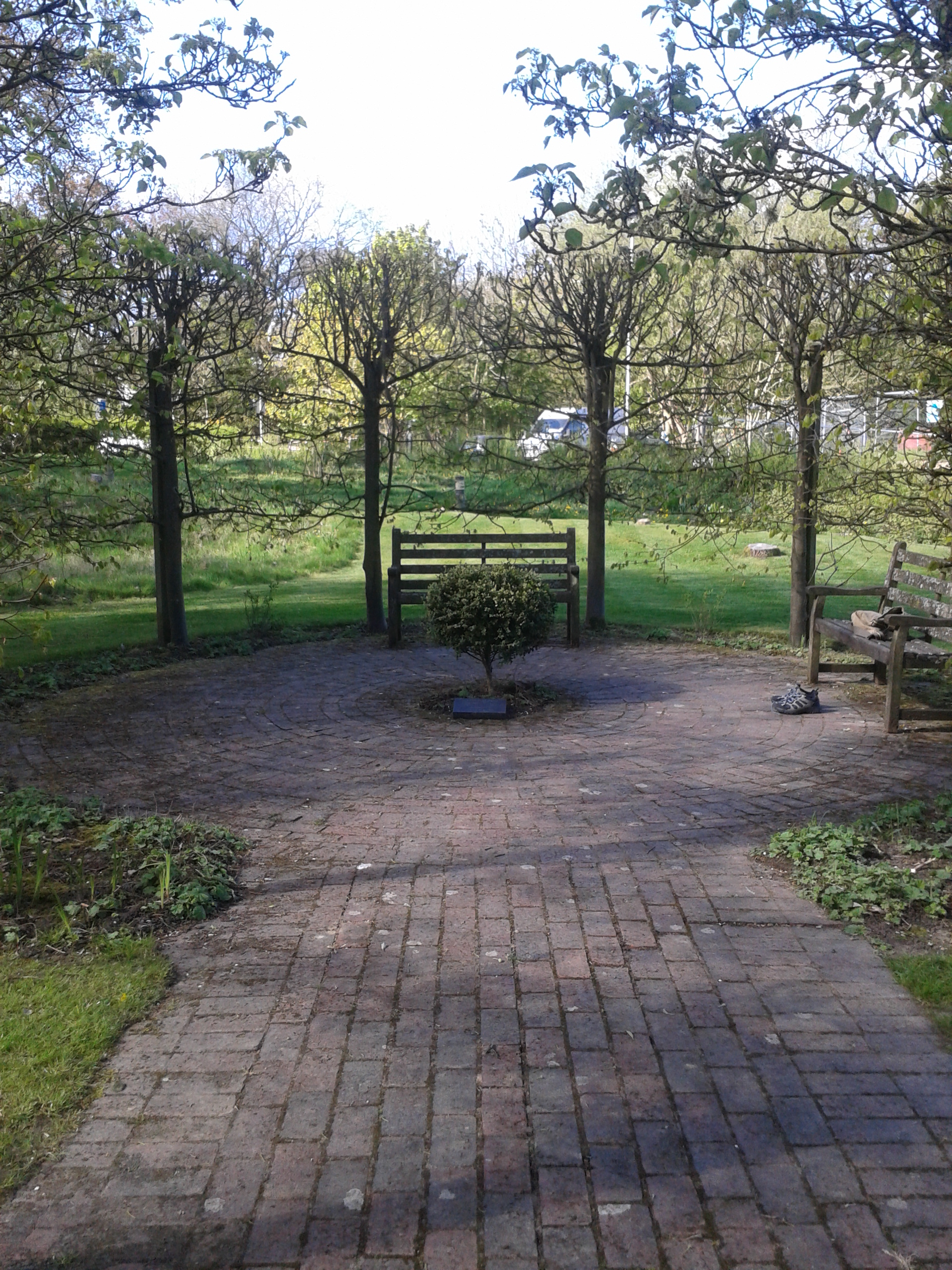
#mindfulness is the slow miracle of greening inside us that spills over into the world
I am often asked ‘what is mindfulness?’ Some people like scientific explanations (our universal capacity for awareness and attention), other people prefer more poetic ones.
Some ideas stay with you. One such idea for me is the greening power of God (viriditas), that Hildegard of Bingen (1098-1179) put forward in her works. Now when such an idea takes root you can see it in different ways, take it in directions that perhaps that the original author didn’t intend. It’s a phrase that describes mindfulness for me, in terms of what it can do.
What is greening for me? I believe it is something I have experienced in mindfulness. I see that mindfulness practices enable mindfulness as a trait to take root in us. In this way mindfulness is a slow miracle, where we begin to green inside, we experience a new freshness, a new release of creativity, a new wholeness, a new relationship with our senses, a new relationship with our own self, with others, with creation, with God.
I have experienced this through both mindfulness for health that you find in secular psychology, as well as the Christian distinctive of mindfulness of God. After all the Gospel is an embodied Gospel.
In this sense, mindfulness is the slow miracle of greening within us, where we begin to become what Irenaeus called ‘The Glory of God – a human being fully alive.’ When we practice both mindfulness for health and mindfulness of God I think we can become fully alive.
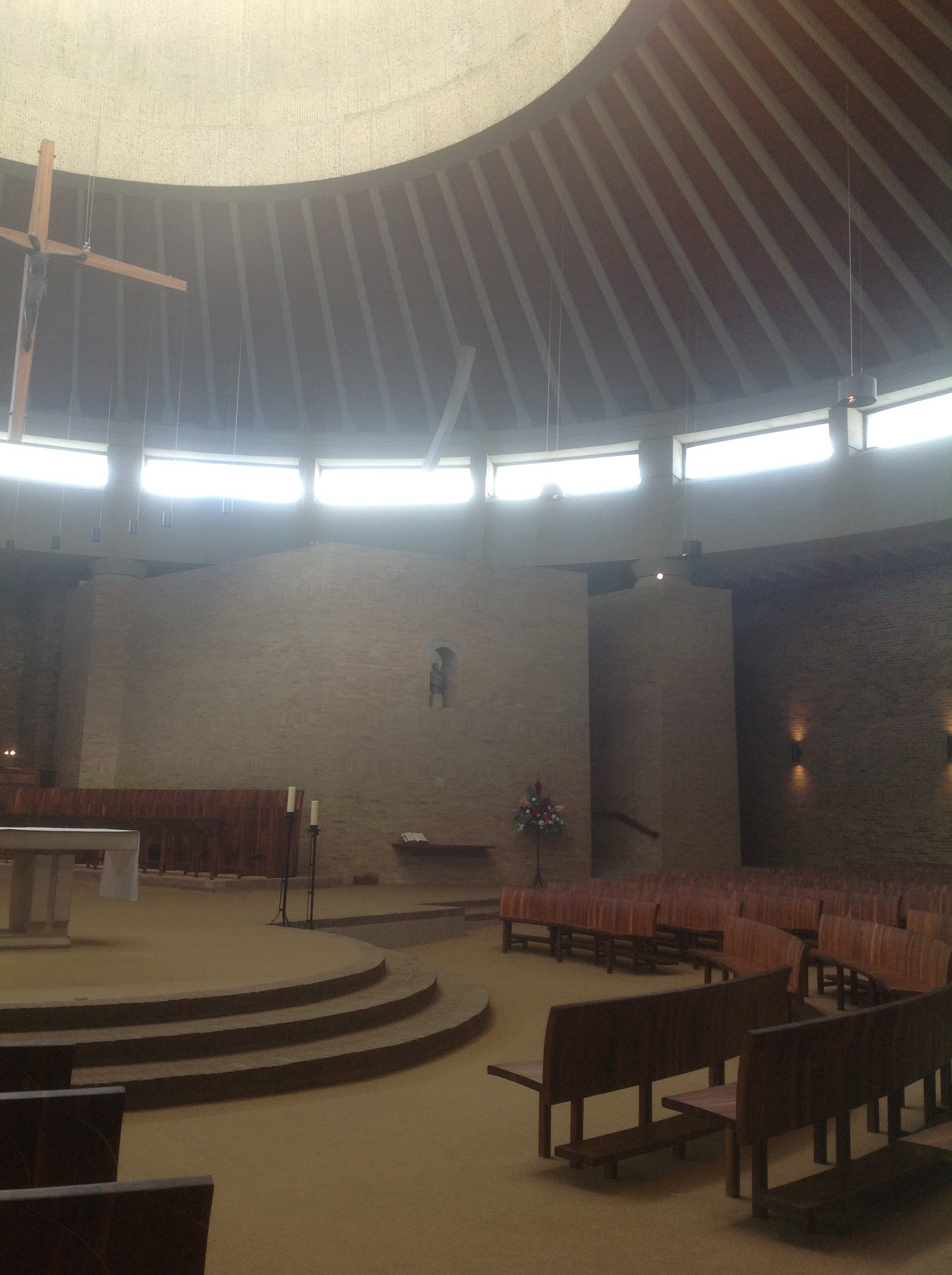
The bell that rings out silence – Worth Abbey Church #mindful

Worth Abbey Church hangs like a bell in the sky, ringing out…silence. This sense of being in a bell that is all to do with silence increases when you sit inside – even more you get a sense of a giant bell hovering above you.
Back in 2006 a phrase of 5th century Bishop, Diadochus of Photike, pioneer of the Jesus Prayer, also rang me like a bell. The energy of that phrase has stayed with me ever since, motivating and directing me. He said, ‘Let us keep our eyes always fixed on the depths of our heart with an unceasing mindfulness of God.’[1]
Within the vast bell-like space of Worth I have been inspired to cultivate that mindfulness of God. The space and the silence invite you to indwell such mindfulness in your heart.
I have just led a retreat at Worth over the weekend on watchfulness and mindfulness of God. The experience did something which one translation from the Prologue of the Rule of St Benedict calls running ‘with hearts enlarged.’ The experience made my heart bigger. It was not just the space, the silence, the rhythm of prayer – it was the people. Those who were on retreat and the monks who offered us hospitality.
Now as I am home and I believe for weeks afterwards, if previous experience is to go by, that bell church that rings out silence will still ring in my life. I will still hear the echoes of the silence drifting to me on the wind.
[1] Quoted in Olivier Clement, The Roots of Christian Mysticism (London: New City, 2002) p.204.
A #Mindful Response to Remembrance
Here is a link to my article A Mindful response to Remembrance, which appeared in Baptist Times Online over the weekend:
http://www.baptist.org.uk/Articles/420728/A_Mindful_Response.aspx
Mindfulness of God and Personal Transformation retreat via @PenhurstRetreat
I am leading a retreat at Penhurst Retreat Centre on Mindfulness of God and Personal Transformation on 12-14 June 2015.
Here are the details below and a link to the retreat centre’s website:
The retreat will be exploring mindfulness of God and mindfulness of health, with the aim of personal transformation. Anyone interested in developing their awareness and attention would benefit from this retreat. There will be silence built into the retreat as this is an important part of the spiritual practice of mindfulness. You will be introduced to the historic spiritual practices of Lectio Divina and the Jesus Prayer, as well as secular mindful awareness practices. We will be looking at mindfulness within Mark’s Gospel, the monastic tradition and psychology. The retreat will be interactive and dialogic with experiential elements.
http://www.penhurst-retreat-centre.org.uk/programme.php?viewretreat=233

hearing the song
Watching with our Transforming Lord Retreat at Worth Abbey 9-11 January 2015
Folks have been asking if I am running a retreat at Worth Abbey again next year, and yes I am! The details will be on their website soon but if you want to book in advance then you can email the Open Cloister bookings secretary, Alison Schillinger via TOC@worthabbey.net.
It is the weekend of 9-11 January 2015 and is called ‘Watching with our Transforming Lord.’
This is what they said about it last year:
How do we follow the footsteps of Jesus into our homes, works, and relationships in a way that transforms our lives? In Mark’s gospel, Jesus shows us the way through watchfulness, a lost aspect of the gospel which is cultivated through contemplative practices like Lectio Divina, silence and the Jesus Prayer. The retreat will look at how these practices help us deal with time and work stress. This is an opportunity at the start of a New Year to take time out to take a fresh look at our lives.
#mindful church cafe Costa/Stanmore details of the six sessions
Mindful Church Café
Mindful Church Café is a six week introduction to mindfulness, both mindfulness for health and mindfulness of God.
Venue: Costa Coffee Stanmore (24-26 Church Road, Stanmore, HA7 4AW)
Time: 18:30 -20:15
Date: Starts 8th October (Session 1)
Session 1: Mindfulness – The Big Bang
Wednesday 8th October 2014
6.30 p.m. to 8.15 p.m.
Session 2: Mindfulness of God – the History
Wednesday 15th October 2014
6.30 p.m. to 8.15 p.m.
Session 3: Waking Up to Our Autopilot
Wednesday 22nd October 2014
6.30 p.m. to 8.15 p.m.
Session 4: Mindfulness and the Body
Wednesday 29th October 2014
6.30 p.m. to 8.15 p.m.
Session 5: Mindfulness and Facing Reality
Wednesday 5th November 2014
6.30 p.m. to 8.15 p.m.
Session 6: Applying Mindfulness to Our Everyday Life
Wednesday 12th November 2014
6.30 p.m. to 8.15 p.m.
Red-Hot Chilli, #Mindfulness and Men
I had always successfully negotiated life – until about nine years ago. A career in banking followed university, and then I took a complete change of direction to begin running a church. However, about seven years into this new venture I was facing burnout. It had crept up on me out of my awareness.
One particular day I was going into Roehampton University where I was studying counselling and psychotherapy part-time and I felt as though I was falling apart. It felt as though there was nothing I could do about it. Like many men, I didn’t think I could talk about it with anyone.
Fortunately, one of the lecturers noticed and took me aside for half an hour. She knew what was going on inside me, even if I didn’t. Her mindful attention glued me back together.
This opened my eyes to the possibility of how a mindful, aware person can help another. I had come across mindfulness as a concept in secular psychology through my training, but I started to practise it.
Mindfulness saved my life; I think it might save yours, too. But what is it?
Mindfulness is the universal human capacity for awareness and attention in the present moment. It needs to be distinguished from the mindful awareness or meditative practices that help us to become more mindful in each moment. It is the centre of gravity of our ability to understand and find meaning in our lives. Every human being also has the capacity to be mindless.
Apparently, more women than men sign up for mindfulness courses, which is one reason why I am writing this article. Mindfulness has been found to help those who suffer from stress, depression, anxiety, anger, relationship difficulties, sexual difficulties and much more. It is a highly relevant way in which men can retrain their minds. It also enables us to find the creative places within, and it is being used positively in business and other activities.
As men, we still like the idea of bushcraft, the skills that Ray Mears or Bear Grylls teach us. Mindfulness is bushcraft of the soul. It is about being a tracker, someone who is aware and attentive enough to follow the tracks of real living.
What is it, though, that we are tracking, and how do we do it?
One definition identifies three key components: intention, attention and attitude.
It begins with the idea of intention. If I am suffering, for example, from recurrent depression, like many well-known sportsmen, then Mindfulness-Based Cognitive Therapy (MBCT) might be recommended for me. This is very effective in treating depression. My intention in using the mindful awareness or meditative practices within MBCT would be to lift myself out of depression.
But it is not just about bringing us out of a psychologically distressed place; mindfulness can also help us find a place of inner freedom and creativity, a place where we are really alive. And so our intention in developing our own mindfulness through meditative practices might be about living life in all its fullness. Novak Djokavic uses mindfulness to help him when he plays tennis.
I am practising two tracking skills when I follow these mindful awareness practices – practices such as paying attention to my breath, a body scan, mindful eating or mindful walking. These are the key elements in the second component of mindfulness, which is about paying attention.
The first of these tracking skills is the ability to focus my attention. I focus my attention on my breath. My mind wanders. I notice what my mind wanders to – often negative, ruminative stories that automatically run my life – and switch my attention back to my breath.
Within other mindful awareness practices such as the body scan, I am also practising open awareness. Focused attention is like a narrow beam of light from a torch; open awareness is like a broad beam. If you ever watch the night sky you can practise focused attention by looking intentionally at one star, or a constellation. But you can also open your awareness to take in the whole night sky.
One of the problems with watching the night sky in London is the light pollution – that makes it difficult to see clearly. This is true of the night sky of our minds. We don’t see clearly. We think our thoughts are a direct readout of reality, but they are not. Also we are often looking at life from our thoughts, which, if they are negative and distorted, cause us psychological distress. We need to learn to look at our thoughts, observe them, track them and let them go. In this way our own inner light pollution begins to dissolve and we are able to see more clearly.
What is actually happening when we partake in these mindful awareness practices? Another way of looking at it is to say that we are shifting mental gears. We are shifting from the ‘doing’ mental gear, which is all about rational critical thinking, to the ‘being’ mental gear, which is about coming to our senses and moving to a place of awareness. We live in a culture and work environment that is often virtual, all about computer-based experience. This means we are often stuck in our heads and not really in touch with our bodies.
We are like trawlers that over-fish certain areas of the sea. We are over-fishing the ‘doing’ part of our minds, and then wonder why we no longer find creative thoughts swimming around.
The ‘doing’ mental gear is helpful for solving many problems, but it doesn’t work with afflictive thoughts and emotions like anger. How we are feeling needs to be dealt with through the ‘being’ mental gear. When we shift into the ‘being’ mental gear and focus on how we are, we find that these negative thoughts, feelings and sensations dissolve in our awareness.
The reality is that I am not my thoughts and feelings; I am bigger than they are. My thoughts and feelings are not bricks in a wall that close me in, but they are passing events in my mind. My mind is like the sky and thoughts and feelings are like clouds that come and go.
We have some beautiful chillies growing in our bathroom, and when I look at them it makes me think of different people’s reactions to these spicy plants. I am looking forward to attending an international evening soon where a range of curries from Asia and Africa will be available – all of them spiced with chilli. Some people will avoid the curries. Others will ask ‘which is the mild one?’ And some will ask, ‘Where is the really hot one?’
Sometimes our thoughts and feelings can be a bit like a red-hot chilli – something we try and avoid. However, mindfulness faces, tastes and dissolves the thoughts and feelings we try to avoid. And a bit like eating curry, the more we do this, our tolerance to the more painful thoughts and feelings increases. As we are exposed to the taste of curries, we can begin to experiment with hotter ones. As we are exposed to the taste of our sharper thoughts and feelings, we can tolerate more and more painful ones, rather than avoid them. By facing them and tasting them, the amazing truth is that they begin to dissolve and lose their afflictive power in our lives.
This brings us to the third component of mindfulness. We have looked at the intention behind using the mindful awareness practices. I might use mindfulness for health, to come out of depression, anxiety or stress. I might use it to find a creative place within. I might use it for spiritual reasons, to come into an awareness of God’s presence.
We have looked at the second component which is about attention – learning both to focus our attention and open our awareness.
The third component is about our attitude towards ourselves. It is about paying attention to ourselves in a compassionate, non-judgemental way.
Very often we are critical and judgmental towards our inner self – we beat ourselves up, often automatically and out of our awareness. Stuck in the ‘doing’ mental gear, we see the gap between where we are and where we want to be and try to bridge the gap with ruminative thinking. This ruminative thinking often comes with conditional goals – ‘I will only be happy if I never have a depressed thought.’
This is where we come to the question of change, of transformation. The mindful awareness practices, like attending to your breath, move us from the ‘doing’ mental gear to ‘being’, from critical thinking to awareness. But they also bring about change for the better in the structure and activity in our brains. Neuroscientific research shows that the part of our brain that is responsible for compassion, empathy and relational attunement is enhanced both in activity and structure. The part of our brain responsible for our fight and flight response becomes less hypersensitive.
This can be illustrated with a metaphor. At one time fishermen (generally men) would go out in their boats (‘doing’ mental gear). When they came back they would sit down to mend and stretch their nets (‘being’ mental gear) because in the sea-water the nets would shrink and break, and things would snag on them.
Many men no longer work with their hands, but even if we do, our most important tool is the net of our minds. When we go out into our competitive stressful work environment, these nets shrink, through stress, fear, anger. Ruminative negative patterns of thinking snag in the nets of our minds. Just like the fishermen of old, we need to stop each day and attend to the nets of our minds. We need to re-stretch them through mindful awareness practices; we need to unsnag ourselves from the negative ruminative patterns. The nets of our minds are the most important tool we have.
Mindfulness is also like a muscle. Like all muscles, it needs training and exercise; without that it loses its strength and shrinks.
If you are suffering from stress or are close to burnout, signing up for a mindfulness course is a great first step. For more clinical conditions such as depression we also need to refer ourselves to our doctor to obtain help, but make sure you mention mindfulness as part of that. However, it is not just about mindfulness for health; many of us have untapped creative capabilities which mindfulness can unlock. This can transform our working life and our personal life.
Mindfulness is increasing exponentially in mental health, in the worlds of education, work and many other areas. The centre of gravity of awareness and attention was discovered very early on in all the faith traditions, and they will all have their own version of being mindful. The world of cognitive psychology and neuroscience is now confirming, exploring and adding its own versions of mindfulness. It is the new social phenomenon that is not going away. Men should be part of it.
#mindfulness – inhabiting awareness
How do we enter the doorway of the present moment? One of the ways is by answering a riddle, says contemplative writer Martin Laird.
One of the riddles he sets is this, ‘What do thoughts and feelings appear in?’ (‘Into The Silent Land’, p.80). When I ask people that question, many people can’t answer it. The answer Martin Laird gives, based on his study of Christian contemplative writers is that our thoughts and feelings appear in awareness (p.88).
Now this is affirmed by cognitive psychology and neuroscience. J. Mark G. Williams and Jon Kabat-Zinn summarize this beautifully in their introduction in the book ‘Mindfulness: Diverse Perspectives on its Meaning, Origins and Applications,’ jointly edited by them.
They define mindfulness as awareness, ‘an entirely different and one might say, larger capacity than thought, since any and all thought and emotion can be held in awareness.’ (p.15) This is something we need to become aware of. But as they go on to say, ‘While we get a great deal of training in our education systems in thinking of all kinds, we have almost no exposure to the cultivation of intimacy with that other innate capacity of ours that we call awareness.’ (p.15)
This is why people struggle to answer the riddle, ‘what do thoughts and feelings appear in?’ Williams and Kabat-Zinn go on to say, ‘Awareness is virtually transparent to us. We tend to be unaware of our awareness. We so easily take it for granted.’ (p.15) And yet it is one of our most important innate capacities.
As they conclude, ‘It rarely occurs to us that it is possible to systematically explore and refine our relationship to awareness itself, or that it can be ‘inhabited’.’ (p.15) Mindfulness is awareness but mindful practices can help us systematically ‘explore and refine our relationship to awareness’ so that it can be ‘inhabited.’
#mindfully walking anger out of your system

‘An Eskimo custom offers an angry person release by walking the emotion out of his or her system in a straight line across the landscape, the point at which the anger is conquered is marked with a stick, bearing witness to the strength or length of the rage.’
(LUCY LIPPARD, OVERLAY, quoted in Wanderlust by Rebecca Solnit (pp.6-8)).
I think mindful walking enables us to release our afflictive emotions like anger, as we take each step. In formal mindful awareness practices involving walking, you usually take 10-12 steps, stop and then retrace your steps, repeating this for a certain length of time.
The beauty of this wonderful quote above, that caught my eye, is that I think longer walks also have this capacity.
What afflictive emotion could you walk out of your system?
 shaunlambert.co.uk