
One-Minute Icon: inner #sanctuary

Inner sanctuary
Paintings like poetry can shift our mental gears from doing to being, from thinking to awareness, from autopilot to mindfulness, from self-preoccupation to contemplation of God, which becomes love for others and the creation around us.
Step out of clock-time for one minute and focus your attention on the painting. As your mind wanders allow yourself to become aware of the noise in your head, the afflictive thoughts, the self-preoccupied narratives. Allow the volume on those thoughts and feelings to be turned up. Become aware of the silence in the painting. You can click on the picture to make it bigger.
As I was praying this morning I came across this painting I had done in France a while back. As the rain beat down outside, and it looked like we wouldn’t see the sun today I suddenly wanted to be in this bright summer place in France. But then I also thought: this is a picture of what my inner sanctuary could look like. My inner sanctuary doesn’t have to be grey like the external world was this morning.
How do we create this inner sanctuary? If you want a good book to begin, read Father Christopher Jamison’s ‘Finding Sanctuary’ (see attached link). What are some of the building blocks? Virtue…silence…meditation and contemplation…
In praise of the slow making of the Lindisfarne gospels and inner arks #makingthings
One of the lessons of the Lindisfarne Gospels was their slow, contemplative making. We can apply this practice to our children, marriages, work, relationship to the book of nature, peace. These things need a slow, contemplative making.
Michelle P. Brown’s book The Lindisfarne Gospels: Society, Spirituality and the Scribe would be one of my top three Christmas buys this year. In talking about the meaning of this book she says something deeply profound.
‘Jennifer O’Reilly has drawn attention to the patristic concept of the ‘inner library’ and the necessity for each believer to make him or herself a library of the divine Word, a sacred responsibility which Cummian referred to as ‘entering the Sanctuary of God’ by studying and transmitting Scripture. Books are the vessels from which the believer’s ark, or inner library is filled.’ (pp.398-399)
This says something about the meaning of our own lives, that there is to be a guiding inner ark. This ark carries not just our little self, but other things of the world, as the first ark carried breeding animals to save them. In our inner ark we are also to carry the presence of God.
What struck me was that this is a real carrying of what is there in the world. I might want to save the gerenuk, or Lindisfarne otters, and as I slowly contemplate them and grow in knowing about them, I begin to carry them with me in a way that might save them – because I bring this knowing to others.
Michelle P. Brown’s book was I believe a slow, contemplative making – and I write in praise of slow making. Inner arks, like books, are a product of slow making as well.
You could also read Carl Honore’s In Praise of Slow.
http://publishing.bl.uk/book/lindisfarne-gospels-and-early-medieval-world
#mindful skiing – feeling #flow and #contemplation
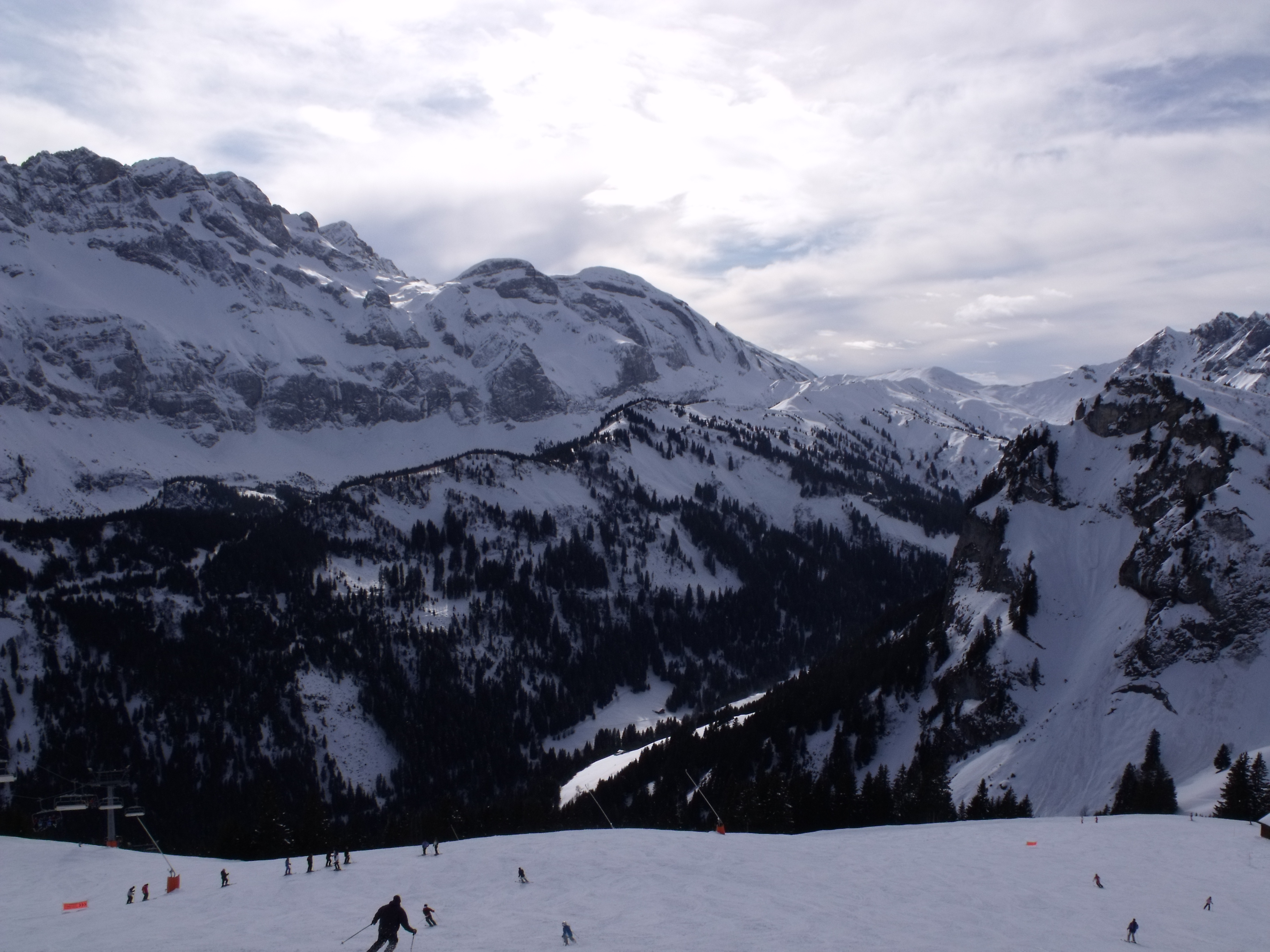
mindful skiing, feeling flow
Skiing is a doorway into the present moment and present-moment awareness. When you stand on top of that mountain with the sun in your face, the wind tugging at your jacket, the sound of silence following you, the smell of Alpine clean air, able to see the valley below you, and feeling the snow beneath your skiis, you are taken out of auto-pilot, out of ruminating about the past or the future.
You ski into the present moment, out of thinking and into awareness. It is like a wardrobe into a beautiful new land that has always been there, but we just couldn’t find the door.
There might be no visibility one day and you have to feel your way down the mountain with the soles (souls) of your feet – you are skiing on pure awareness. This is a mindful awareness practice. Your soul can express itself and feel through the soles of your feet.
I was talking about this to a group of skiers who also believe in God, and believe skiing brings them closer to God. Skiing is gloriously reality-focused like most mindful awareness practices (attending to your breath, your walking, what you eat). It enables us to experience what Mihaly Csikszentmihalyi calls ‘flow’, ‘the sense of gratification that we enter when we feel completely engaged in what we are doing.’ (Martin E.P. Seligman, Authentic Happiness, p.113)
Flow as a concept is related to mindfulness. Apparently Mihaly’s surname is pronounced ‘cheeks sent me high.’ Flow involves ‘deep, effortless involvement…our sense of self vanishes…time stops…'(Martin E.P. Seligman, Authentic Happiness, p.116) It sends us naturally high.
Skiing is intensely physical as is truly incarnated Christianity. Both pay attention to the body. Mindfulness also pays attention to the body.
The body is intelligent. The latest thinking is cognitive science of an embodied mind (Andy Clark, Being There: Putting Brain, Body, and World Together Again, MIT Press). As Christians we would agree with that, we would just want to put Brain, Body, World and God together again.
It was Pope John Paul II who said, ‘The body, in fact, and it alone, is capable of making visible what is invisible: the spiritual and divine…'(quoted in Christopher West, Theology of the Body for Beginners). As we ski in embodied minds in the mountains we begin to see the invisible, the spiritual and divine. We are present to a deeper Presence that has always been there.
One-Minute Icon – Windows of tolerance #mindfulness #compassion

how big are your windows of tolerance?
Take a look at this window which I have made as small as possible. Daniel Siegel in his book ‘The Mindful Therapist’ talks about ‘a window of tolerance’. We have limits to the things we can tolerate.
I was challenged recently talking to someone whose wife had died. How much of his pain could I tolerate? I was challenged recently by somebody’s book about their experience of depression, which was beyond anything I could imagine. My windows of tolerance were challenged and stretched.
Sometimes it is our own pain that we cannot tolerate.
What comes to mind for you as you look at this window? What comes into your awareness? Who can come and inhabit the tree of your life and who do you exclude? What bird-thoughts and bird-feelings can come to your tree for shelter? Step out of clock-time for one minute and allow whatever is deep within to come into your awareness.
‘In that day each of you will invite his neighbour to sit under his vine and fig-tree,’ declares the Lord Almighty (Zechariah 3:1o)
Can we listen to this ancient, open window to our neighbour?
Let’s make some noise about stress #stress
Let’s make some noise about stress #stress
Click on link above to article on Stress I’ve written which is on Christian Today website.
How God changes your brain for the better #brain scans
How God changes your brain for the better #brain scans (click this link)
A link to an interview of mine with Andrew Newberg, a neuroscientist in the USA who is the author of a number of books including ‘How God Changes Your Brain’
The dissolution of the moralities #moral memory
The dissolution of the moralities #moral memory
Click on the link above to go to a Baptist Times Online article I have just written on how we acquire moral memory as Christians. If we want to create a real community which shares Christ, Christlikeness, hospitality, service and attentiveness to the Other then we need moral memory.
One-minute Icon 2 #Icons

One Minute Icon 2
Step out of clock time for one minute. Switch your attention to this photo.
How do you read this? What does it write in your awareness, feelings, thoughts?Do you have joy to offer this morning?
#mindfulness is not minefulness – a minefield…
Mindfulness is not minefulness – a minefield as some Christians think, any more than religion is to blame for all the ills in the world. Those who are suspicious of it are to be welcomed though, for the difficult questions they might want to ask. Nothing should be unquestioned, accepted automatically. In psychology, we are always saying, do no harm.
Mindfulness is not a South Sea Bubble, soon to collapse and to be found empty of meaning, it is here to stay and it has real substance to it.
Mindfulness is not a bringer of world peace, and it is not the silver bullet to solve all the ills of our world and minds. But mindfulness is a universal human capacity, for we have a mindful brain. Although we often fail to remember to access that capacity for awareness and attention.
Mindfulness is a rapidly changing field. It needs to be examined with the rigour of evidence-based research, although those who work in that way do not have exclusive access to truth. Ordinary people have mindfulness and observations to make that could make all the difference. Theology will have something important to say as well. All the mindfulness-based and mindfulness-incorporating therapies coming out of mindfulness are different and need to be individually assessed and critiqued. They cannot be lumped together
Let’s not let the professionals take complete ownership of mindfulness, it should not be taken out of the hands of reality-focused poets, carpenters, fishermen and women, artists, contemplatives and mystics. It should help us see through consumerism and narcissism not be used as a tool of these things.
The ancient wisdom of religions has been dismissed by many in the West. It is now being rediscovered. What other hidden gems are there in the ancient paths? For Christians, mindfulness of God is central, along with reality-focused self-awareness.
It has been secularised, it is being rediscovered in Christian contemplation, Buddhists are asking how can they bring their wisdom to modern culture in a way that is different to secular psychology. Cognitive psychology and neuroscience have been looking at consciousness, awareness and attention before they ever heard of mindfulness.
If mindfulness (to rephase Goethe) is the liquid architecture of our mind, there is much more yet to be said. Is there a question not yet asked of it, and who will ask the question?
If mindfulnes is one of the central human capacities because we have mindful brains, how else can it be used? What other mindful awareness practices can be developed that help us cultivate mindfulness?
I for one, want to encourage Christians to be part of the dialogue in an intelligent, respectful and discerning way. One of the problems is that many comments about mindfulness are uninformed. Here is a good website which pulls together all the evidence-based research that outlines the benefits of mindfulness.
The Jesus Prayer -#the jesus prayer #contemplation
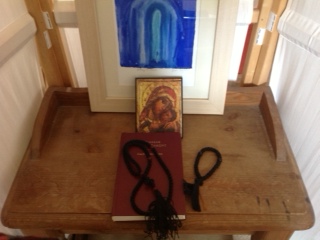
Just before my first sabbatical seven years I was stressed, anxious and near to burn-out. I hadn’t fully realised this, but just a few weeks before I was due to start the sabbatical I was lying in bed, and suddenly I felt this big ball of anxiety come out of my stomach, through my body, and out of my mouth. It was like a showing from God I was suddenly aware of the anxiety I had been holding down.
Then in a bookshop Simon Barrington Ward’s book The Jesus Prayer lept off the shelf at me. The book and the practice of the Jesus Prayer, helped me enormously, as did some conversations with Bishop Simon (formerly Bishop of Coventry), when doing some interviews for the Baptist Times. Mark’s Gospel also became a book of healing for me.
When I began to use the Jesus Prayer it acted very like some of the Celtic prayers, as a circle of protection. For a while it kept at bay the feelings of anxiety or the afflictive thoughts that were troubling me. But if you read the writings of the Desert Fathers and Mothers you find out there are some thoughts (and in the end all thoughts) that you can’t keep at bay. They called these the Eight Afflictive Thoughts, which became trivialised as the Seven Deadly Sins.
These were pride, anger, lust, gluttony, acedia, sadness, greed and vanity. At some point, as these thoughts are kept at bay for a while, we realise that we are not our thoughts, that we are bigger than our thoughts. If we are aware that we can take them captive, that relativises them – they are smaller and less powerful than we think. They are not the powers and authorities that they can become in our minds. By characterising these afflictive thoughts as demons, the Desert Fathers and Mothers achieved this observing distance from their thoughts; they relativised them in that way.
Mark tells us that one of the reasons we fail to see and hear and understand the mystery of the kingdom, the key to real living, is that we have hard hearts. Jesus asks the disciples, ‘Are your hearts hardened?’ (Mark 8:17) when they fail to understand the feeding of the 5,000. Contemplative practices like Lectio Divina and the Jesus Prayer enable us to open and soften our hearts – that is why they are so applicable to helping us become the disciples Mark wants us to be.
At some point we have to move from the Jesus Prayer acting like a protective circle, to something more like a fragile coracle in which we enter the sea of our thoughts and feelings and the wider world and God. We move out of the harbour into the open sea. The harbour is the place of experiential avoidance, the sea is where we engage with what we have been hiding from, what we have run from, what we have pushed down out of our awareness. We move from a place of narrow concentration to a place of open awareness.
From a psychological perspective, the disciples in Mark are guilty of experiential avoidance. When Jesus talks about the way of the cross and predicts His passion, Peter rebukes Him (Mark 8:32). He has to remind them twice more, in Mark 9 and 10, and then again in chapters 13 and 14. Watchfulness is facing reality, not running away from it, or pretending something else is reality – like being the greatest, saving one’ s self, or gaining the whole world.
Experiential avoidance is a psychological process that seeks to avoid what we believe will be painful feelings, thoughts, memories and bodily sensations within us. It causes us problems psychologically. For example, in times of conflict I would avoid facing the experience of my anger. I would end up with very tight neck and shoulder muscles that could go into spasm.
But when I faced the anger and the cluster of thoughts, feelings and bodily sensations with it, the anger did not seem to be such a fearful power and authority as I thought it was. I have often tried to avoid anxious feelings by keeping busy. But as the Jesus Prayer helps us to slow down and still ourselves, we become aware of what we have been avoiding.
How do we begin with the Jesus Prayer? It is important to pay attention to the body. Posture is important, and the way we sit. I find a prayer stool or a straight-backed chair where one can sit relaxed but in a good frame is important. Where we sit is also very important. Chose a place you can return to again and again that has no distractions. We can also pray the Jesus Prayer walking somewhere, or out in the world doing something else.
Traditionally in the Jesus Prayer, the first half of the sentence is prayed on the in-breath – ‘Lord Jesus Christ, Son of God,’ – and the second half of the sentence is prayed on the out-breath, ‘have mercy on me, a sinner.’ The breath is neutral, it belongs to no particular religious group. Breathing is something we all do, and we take it with us wherever we go. That makes it a useful aid in our prayer life. When we are anxious we often over-breathe, and this rhythmic use of it in the Jesus Prayer slows our breathing down.
I find that I repeat the prayer in cycles of 25, with a pause in between the cycles to offer prayers for whatever comes to mind, or simply to be in open awareness or contemplation of God’s presence. Beginning with four cycles is a good start.
It takes time to learn to move out of the harbour and experiential avoidance into the open sea, in the coracle of the simple prayer. In Mark’s gospel we are made aware of our incompleteness and need to be open to God at all times. The Jesus Prayer brings us to that point as well. Mark’s gospel teaches us perseverance – what has been called ‘deep practice’. Those who master a craft are distinguished by how much time they spend in practice, not by their innate ability. A concert pianist will have done on average 10,000 hours of practice to arrive at that level of skill. The Jesus Prayer reminds us about the need for ‘deep practice’. However, God in His grace may give us moments of epiphany that keep us praying in this way.
The best little book on The Jesus Prayer is Simon Barrington Ward’s, see the links here: http://www.amazon.co.uk/The-Jesus-Prayer-Simon-Barrington-Ward/dp/1841015881 and here http://www.brfonline.org.uk/9781841015880/
I have collected many books on The Jesus Prayer over the last few years, and will post some details in future articles. May it lead you into healing and the presence of God as it did for me. If you use the Jesus Prayer I would love to hear from you and start a dialogue, or if you are interested in using it.
 shaunlambert.co.uk