
Mindful of nature – Isaac the Syrian
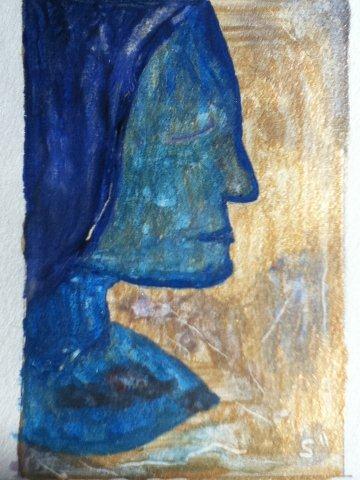 Isaac of Nineveh (The Syrian) of the seventh century was someone who who was mindful of nature. His purified heart, purified through contemplation of Scripture made him mindful of nature.
‘And what is a compassionate heart?..It is a heart that burns for all creation, for the birds, for the beasts, for the devils, for every creature. When he thinks about them, when he looks at them, his eyes fill with tears. So strong, so violent is his compassion….that his heart breaks when he sees the pain and the suffering of the humblest creature.’ (quoted in Olivier Clement, ‘The Roots of Christian Mysticism’, p. 227).
Christians who rediscover the ancient paths of contemplation will rediscover the possibility of seeing ‘every common bush afire with God’ (Gerard Manley Hopkins). They will rediscover a heart that burns for all creation.
A Riddle: Are you your thoughts and feelings?
In his brilliant book on the practice of contemplation Into The Silent Land Martin Laird (OSA) says the doorways to the present moment are guarded by three riddles. The first riddle is this: Are you your thoughts and feelings?
The Mindful/Discerning Ones – a charism of the Holy Spirit?
In his book ‘Words of Spirituality’ Enzo Bianchi writes, ‘in Buddism, it is through attention that one reaches a penetrating vision of reality, a way of seeing, what the desert fathers and the Christian tradition have called diorasis (seeing in depth, beyond appearances and exteriors) (p.34).
Diorasis is one of the ‘mindful’ Christian words, and someone who exhibited it was called a Discerning One, we could say a mindful one – for discernment is part of Christian mindfulness. It is not a narrow closed attitude of the mind but an open, discerning one. In Dialectical Behaviour Therapy (DBT) a mindfulness-incorporating therapy, the state of mind to access is ‘wise mind’. Discernment is about wisdom.
In ‘The Spirituality of the Christian East’ Tomas Spidlik calls this discernment, this seeing in depth a charism of the Holy Spirit, which included an ability to see into the hearts of people. It also included a knowledge of the mysteries of God.
this charism is considered a gift of God and also the result of personal purification, through a life of contemplative prayer, ‘Blessed are the pure in heart, for they will see God'(Matthew 5:8). The principal way of praying was the Jesus Prayer, the simple but profound invocation of the presence of God which contains the whole gospel, ‘Lord Jesus Christ Son of God, have mercy on me a sinner.’ This prayer was incarnated into the person through the first half of the prayer happening on the in-breath, and the second half on the out-breath.
This ancient prayer enables one to deal with the traditional eight afflictive thoughts of gluttony, lust and greed, anger, sadness and acedia, vanity and pride.
The grace of God enables all to become discerning ones, the humility of man enables all to co-work with God in contemplative prayer. This is the wisdom of the Desert Fathers and Mothers.
Olympic-level athletes of the mind
In his book ‘The Mindful Workplace’ Michael Chaskalson describes Tibetan Buddhist monks as ‘Olympic-level athletes of meditation.’ These Olympic level athletes of the mind were being brain-scanned by Western scientists who were staggered by the results they found.
The idea of Olympic-level athletes of the mind leapt out at me as I’ve been so impressed with the spirit in motion of the Paralympic athletes, their beauty, grace and disciplines of training.
This idea of Olympic-level athletes of the mind is a challenge to Christians who are to have ‘the mind of Christ’ (1 Corinthians 2:16). As Christians we are supposed to be able to have our minds ”filled to the measure of all the fulness of God.’ (Ephesians 3:19).We are to be in ‘strict training’ (1 Corinthians (:25).
And yet I don’t read of Christians being called Olympic athletes of the mind. Even though we believe in the transforming work of the Holy Spirit and the Word of God and God’s grace. We need to rediscover the contemplative practices of our past, the ancient paths, and walk in them again.
Repairing our view of the body
Repairing our view of the body
Serialisation of day 6 of A Book of Sparks – A Study in Christian MindFullness in Baptist Times Online
rediscovering Christian contemplative practice 4
rediscovering Christian contemplative practice 4
Facing our difficulties mindfully – serialisation of day 4 of A Book of Sparks – A Study in Christian MindFullness
in Baptist Times Online
Rediscovering Christian Contemplative Practice part 3
Rediscovering Christian Contemplative Practice part 3
Serialisation of day 3 of A Book of Sparks – A Study in Christian MindFullness in the Baptist Times Online
Rediscovering Christian contemplative practice part 2
Rediscovering Christian contemplative practice part 2
second article in Baptist Times serialising A Book of Sparks – A Study in Christian MindFullness, how we are shaped in the pattern of this world, the empty self as a construct of our consumer world
christian contemplative practice
christian contemplative practice
article in Baptist Times Online with serialisation of first chapter of A Book Of Sparks – A Study in Christian MindFullness
The verandah of your mind
‘The words English owes to India’ is a title of an article in the BBC News Magazine, reflecting on a programme due to be broadcast today on Radio 4 about a lexicon of words of Asian origin used by the British in India called ‘Hobson’Jobson: A Very English Enterprise’.
One of those words is verandah which is defined as an ‘open pillared gallery around a house.’ Some of my happiest moments have been sitting on verandahs in Africa as a child. I think we are also meant to have a verandah of the mind, although we often don’t.
A verandah opens up a house to what is going on in the environment in a 360 degree way. Many houses are designed in a closed way, there is no gallery around them, no openness to the world around. In the same way our minds should be open and aware of all that is going around in the environment, there is architecture there to enable this – but this architecture has often been buried away behind defences and walls and double-glazed windows.
Another word psychologists use to describe this lack of awareness and openness is automaticity or being on auto-pilot; as if we are sleep walking through life. A shuttered existence. A house, of course, only comes to life, when the shutters are thrown open.
Neuroscience says that contemplative/mindful practices create beneficial shifts in the architecture of the mind, the mind which is neuroplastic in design. You become more empathic and relational with others and less defended and fearful. A verandah of the mind is created where you can meet people, the world, and even God in a new way.
The pillars of silence, stillness, meditating on Scripture, memorising the living Word create a living memory within us of how to live life in all its fullness – as Christ did, creating an open gallery of goodness around us. A verandah of the mind.
 shaunlambert.co.uk