
link to my reflection on BBC Radio 2’s Good Morning Sunday with Clare Balding
link to my reflection on BBC Radio 2’s Good Morning Sunday with Clare Balding
Coco the mindful dog – my reflection on BBC Radio 2’s Good Morning Sunday with Clare Balding
click on the link above to visit the Good Morning Sunday clips
#mindful of the night sky with open awareness
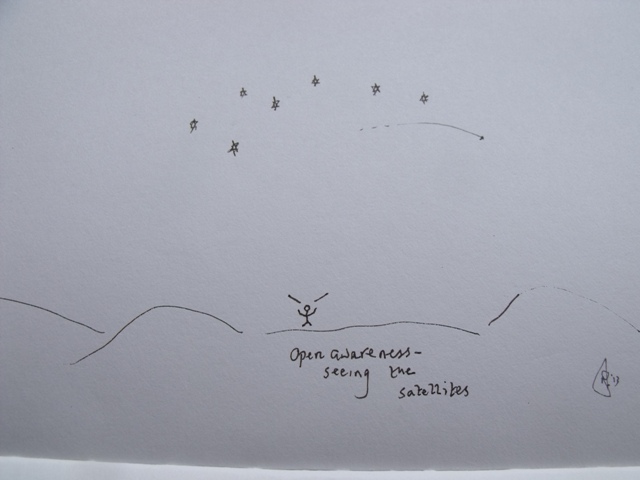
looking at the night sky with open awareness and seeing the shooting satellites
Someone had an App on their mobile phone that you could point at the sky and it would tell which star or constellations you were looking at. There are many ways to look at the night sky, but I was practicing two mindful ways. One is the way of focused attention, just looking at one star, or constellation. The focus of awareness is like a narrow beam of a torch.
In that way you can identify a star or constellation. Another way to look is the way of open awareness or open monitoring, a key distinctive of the universal human capacity to be mindful – where you try and open your awareness to the whole night sky, without focusing on one particular star or constellation.
What I saw when I did that was three different satellites (I assumed they were satellites) darting across the sky. Open awareness or monitoring helps us to see things that we wouldn’t see otherwise, it is a much broader beam of light, rather than a narrow beam.
In London I rarely see a good night sky because of light pollution. Although everyone has a capacity to be aware and attentive (mindfulness is a universal human capacity), when our minds are untrained in this way we often suffer from awareness pollution, we don’t see as clearly as we could. Mindfulness training helps clear the night sky of our minds so that we can see more clearly.
Mindfulness of God is another dimension to awareness and attention that takes us to a place of clearer seeing. Christians are called to be like the Wakeful One, Jesus, the master and commander of attention and awareness.
Hear the #meditative Ananias prayer as it is sung
Hear the #meditative Ananias prayer as it is sung
I outline below, again, the genesis of the befriending, compassionate prayer of blessing I have called the Ananias Prayer. Not only can it be used as a prayer of blessing, but it can now be used as a meditative sung prayer. My friend and worship leader, Glyn Burns, has set it to music. Here is a recording of it on SoundCloud.
In various mindfulness approaches there are befriending or compassion meditations. These again have their roots in Buddhist tradition of metta or loving kindness meditations. These would include compassion for oneself, a stranger and even someone we find difficult.
Of course loving-kindness and compassion play a central part in Christianity as well. As I looked at these metta meditations I was struck by their similarity to the prayer of Ananias of Damascus for Saul of Tarsus.
In the Book of Acts in the New Testament in chapter nine Saul has his famous Damascus Road experience. He is on his way to Damascus to arrest followers of The Way (Christians) when he is arrested by the risen Lord Jesus Christ
.Temporarily blind Saul is led into Damascus. A man there called Ananias has a vision from God who asks him to go and pray a prayer of blessing on Saul which will restore his sight and fill him with the compassionate presence of God, the Holy Spirit. Ananias questions the wisdom of praying for a stranger and an enemy, but God encourages him out of the way of fear into the way of love.
It is clear that the prayer of Ananias has a significant impact on Saul. When Saul talks about his encounter with Jesus, which includes the prayer of Ananias when scales fell from his eyes, and he is filled with the Holy Spirit, he says he has had three important experiences.
‘Not that I have already obtained all this, or have already been made perfect, but I press on to take hold of that for which Christ Jesus took hold of me.’ (Philippians 3:12)The word here for ‘took hold’ is literally ‘arrested.’ On the road to Damascus the love of Christ took hold of him.
When the scales fell from his eyes he ‘saw the light’. In 2 Corinthians 4:6 he says, ‘For God, who said, ‘Let light shine out of darkness,’ made his light shine in our hearts to give us the light of the knowledge of the glory of God in the face of Christ.’ This reference to light shining out of darkness goes back to Genesis 1:3 where God said ‘Let there be light.’
So Saul was taken hold of by the love of Christ, and the light of the love of God shone in his heart.
He then says in 1 Timothy 1:13-14, ‘Even though I was once a blasphemer and a persecutor and a violent man, I was shown mercy because I acted in ignorance and unbelief. The grace of our Lord was poured out on me abundantly, along with the faith and love that are in Christ Jesus.’
The compassionate mercy, grace and love of God were poured into Paul like an overwhelming river.
I felt in part these experiences were because of Ananias’ prayer of befriending and compassion. So I have put them in prayer form that we can pray first for ourselves, then a stranger, then an enemy, and finally back for ourselves.
In the words of one of Jesus’ most important statements ‘Love your neighbour as yourself’ (Matthew 22:39).These are the prayers:
May the love of Christ take hold of me
May the light of Christ shine in my heart
May the love of Christ flow through me like a river
and then
May the love of Christ take hold of him/her
May the light of Christ shine in his/her heart
May the love of Christ flow through him/her like a river
We pray it for our own self, then a stranger, then an enemy and finally for our own self again. Change is laid down by a succession of fresh experiences of love. In our prayer of blessing and befriending something real happens.
I attach summer here for you – a three-minute #Icon
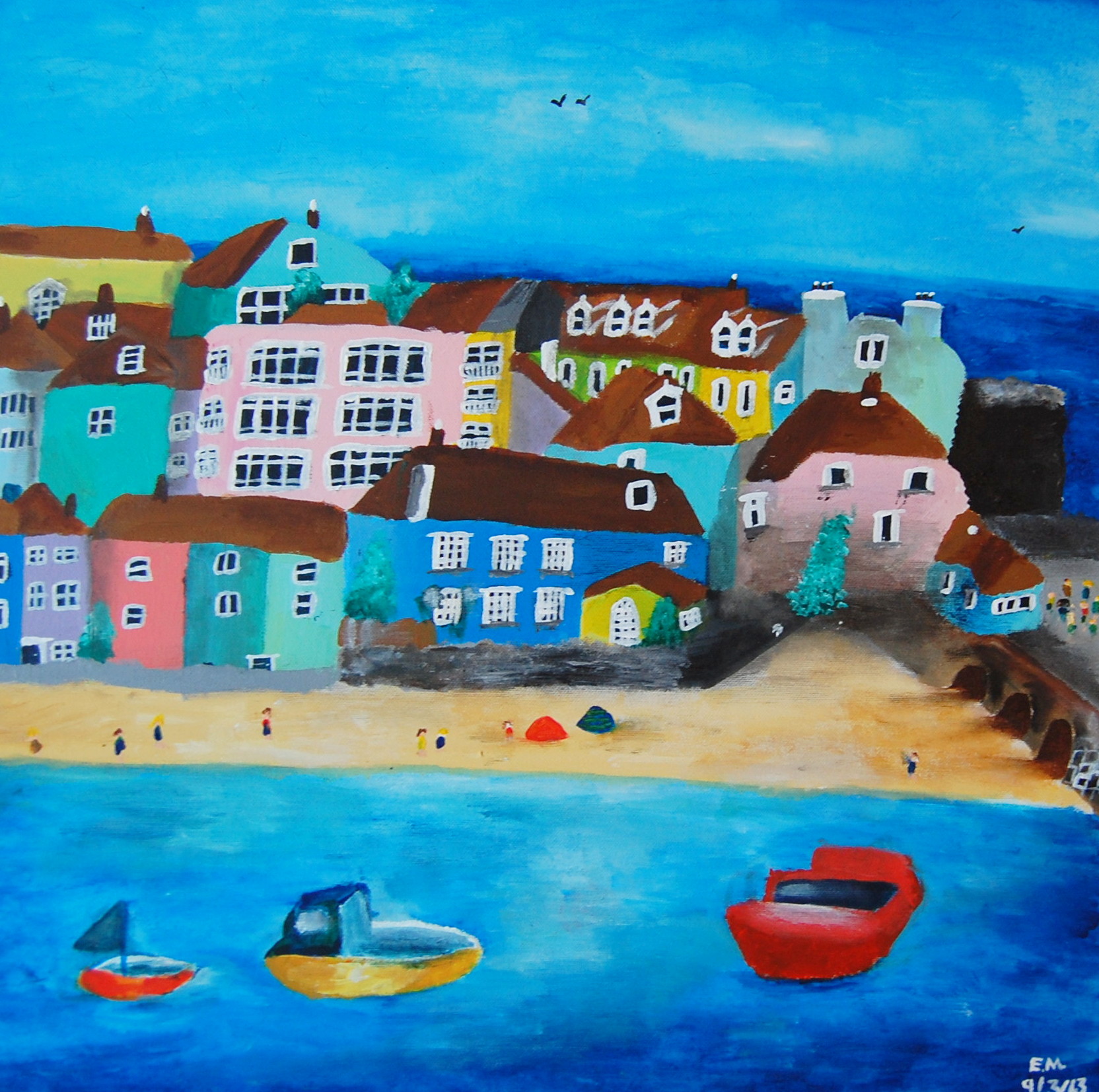
Harbour Bay by Emily Marten
Step out of clock time. Gaze at this painting without thinking. Just for three minutes. When your mind wanders bring it back to the painting. Try and gaze at it with open awareness, allowing whatever emerges to emerge.
The original painting by young artist Emily Marten is a square. The whole painting is, like the square, harmoniously balanced. What the artist has been able to do is look beneath the surface of the houses and the people, and draw out the colour of the emotions felt on this sunny, windswept day in St Ives, Cornwall.
If you ever wondered what the colours of joy and play and happiness and hope are, these are the colours, normally hidden away. It’s as if the artist has been looking down from where there are no clouds, reached in to the heart of the moment and pulled out the feelings of this place by the sea, with the special light.
I have been to this painting in real life, and that is where I am taken back. I can almost breathe again the happiness of walking on the beach, feeling the sand beneath my toes, the wind in my hair, and the sand on my face. Perhaps the sting of drying salt water on my arms. I am sure I can feel that.
As a painting it is like the Tardis. It reminds us that we are bigger on the inside than the outside. it’s called Harbour Bay. There in Harbour Bay I feel safe and free. I have been taken to that place within.
Let the painting befriend you. The artist has attached summer to the canvas for us.
#Practice spirituality the new social phenomenon
#Practice spirituality the new social phenomenon
Here is a link to my latest article on Instant Apostle’s website. Click on the link above. We are missing a spiritual awakening in our culture and a way of transformation.
The #befriending Ananias Prayer set to music
I outline below, again, the genesis of the befriending, compassionate prayer of blessing I have called the Ananias Prayer. Not only can it be used as a prayer of blessing, but it can now be used as a meditative sung prayer. My friend and worship leader, Glyn Burns, has set it to music. We will also do a recording of it soon so you can hear what it sounds like.
It should be sung in a lovingly repetitive way, like a Taize song. Here it is with the chords:
Ananias Prayer C Major
C G
May the love of Christ take hold of me
Am G6
May the light of Christ shine in my heart
Em Bm/E. F2. Dm/G C
May the love of Christ flow through me – like a river
©
Glyn Burns/Shaun Lambert
In various mindfulness approaches there are befriending or compassion meditations. These again have their roots in Buddhist tradition of metta or loving kindness meditations. These would include compassion for oneself, a stranger and even someone we find difficult.
Of course loving-kindness and compassion play a central part in Christianity as well. As I looked at these metta meditations I was struck by their similarity to the prayer of Ananias of Damascus for Saul of Tarsus.
In the Book of Acts in the New Testament in chapter nine Saul has his famous Damascus Road experience. He is on his way to Damascus to arrest followers of The Way (Christians) when he is arrested by the risen Lord Jesus Christ.
Temporarily blind Saul is led into Damascus. A man there called Ananias has a vision from God who asks him to go and pray a prayer of blessing on Saul which will restore his sight and fill him with the compassionate presence of God, the Holy Spirit.
Ananias questions the wisdom of praying for a stranger and an enemy, but God encourages him out of the way of fear into the way of love. It is clear that the prayer of Ananias has a significant impact on Saul. When Saul talks about his encounter with Jesus, which includes the prayer of Ananias when scales fell from his eyes, and he is filled with the Holy Spirit, he says he has had three important experiences.
‘Not that I have already obtained all this, or have already been made perfect, but I press on to take hold of that for which Christ Jesus took hold of me.’ (Philippians 3:12)
The word here for ‘took hold’ is literally ‘arrested.’ On the road to Damascus the love of Christ took hold of him.
When the scales fell from his eyes he ‘saw the light’. In 2 Corinthians 4:6 he says, ‘For God, who said, ‘Let light shine out of darkness,’ made his light shine in our hearts to give us the light of the knowledge of the glory of God in the face of Christ.’ This reference to light shining out of darkness goes back to Genesis 1:3 where God said ‘Let there be light.’
So Saul was taken hold of by the love of Christ, and the light of the love of God shone in his heart.
He then says in 1 Timothy 1:13-14, ‘Even though I was once a blasphemer and a persecutor and a violent man, I was shown mercy because I acted in ignorance and unbelief. The grace of our Lord was poured out on me abundantly, along with the faith and love that are in Christ Jesus.’
The compassionate mercy, grace and love of God were poured into Paul like an overwhelming river.
I felt in part these experiences were because of Ananias’ prayer of befriending and compassion. So I have put them in prayer form that we can pray first for ourselves, then a stranger, then an enemy, and finally back for ourselves. In the words of one of Jesus’ most important statements ‘Love your neighbour as yourself’ (Matthew 22:39).
These are the prayers:
May the love of Christ take hold of me
May the light of Christ shine in my heart
May the love of Christ flow through me like a river
and then
May the love of Christ take hold of him/her
May the light of Christ shine in his/her heart
May the love of Christ flow through him/her like a river
We pray it for our own self, then a stranger, then an enemy and finally for our own self again. Change is laid down by a succession of fresh experiences of love. In our prayer of blessing and befriending something real happens.
The boy on the edge of happiness – Matthew Hollis’s poem and a #mindful insight
The boy on the edge of happiness is the title of a book of poetry by Matthew Hollis. I haven’t read the book, or what I am imagining to be a poem of the same name. Although I would like to. I came across a tweet by the Poetry Society saying that Matthew Hollis was a ‘terribly good poet’, so I looked him up. That’s when the title, ‘The boy on the edge of happiness’ resonated deeply. It brought into my awareness something that was on the edge of my awareness.
As a boy and a man I have lived on the edge of happiness. Why would you do that?
I have known happiness and at crucial times in my life it felt like it was taken away. So I never quite trusted it to stay around.
The first time was going to boarding school at the age of 6 3/4s for a term. We would have a day sometime during the term when your parents would take you out, called an exeat.
At the beginning of the day happiness would flood back. And my mum says I would chat to them, and be lively and excited. But as the day drew to a close, I would be quiet, not speak, just look at them with my eyes filling with tears, but without crying. Happiness was draining away, or being taken away.
In short happiness couldn’t be trusted, it was safer to live on the edge of happiness.
I remember later when we would fly out to Kenya for the holidays from the UK from another school. The first night in my bedroom in Kenya would be a strange one. I would wake up on that first morning of the holidays, as light streamed through the curtains with a sinking heart imagining I was still at school. Suddenly I would realise this was a different sort of light and I would be filled with a sense of elation – I was home.
The first night at boarding school reversed the process. I would awake imagining I was home, with a light heart, and then realise with a sinking feeling that I was back at school.
The title of Matthew Hollis’s book of poetry rang me like a bell. I was filled with the revelation that ever since those early experiences I had lived on the edge of happiness. Never quite letting myself enter in all its fullness the happiness that was there, in case it was taken away.
The reason for writing about these memories that came back was that I wondered how many other people are living quietly on the edge of happiness for similar reasons?
When my mum told me the story of the exeat she said it used to break her heart to have to let me go back to the boarding part of school. The title of a poem has given me a deep mindful insight. Poetry has this capacity.
Daniel Siegel says of poetry…’Hearing poetry feels integrative. The science of language and the brain reveals that while the left hemisphere specializes in linguistic language, the right takes a dominant role in words with ambiguous meaning. Also, the imagery evoked by poetry seems to more directly activate the primary visuospatial processes of our brains…’ (The Mindful Brain, p. 161)…poetry creates a mindful state.
I am just experimenting, right now, mindfully, with trying to enter into the full experience of happiness, moment by moment as it arises. I felt it today. A moment of happiness should not be dismissed. As William Blake says:
To see a world in a grain of sand,
And a heaven in a wild flower,
Hold infinity in the palm of your hand,
And eternity in an hour.
There is a whole world in a single moment. Even a world of happiness.
The unappreciated but important act of #mindful reading
Mindful reading
I was born in Kenya and we didn’t have a TV or computers or any other technical distractions. So my mum taught me to read at the age of 3, and it is one of the greatest gifts I’ve been given.
I learnt to lose myself in books. I learnt to speed-read. I learnt to read selectively for academic study. But the most difficult form of reading, and perhaps the most important, is to learn how to read mindfully.
Mindful reading is different. One way I learnt this, and am still learning was through the slow prayerful reading of sacred text that is lectio divina. This slow form of reading is repetitive, lovingly repetitive. It is meditative and contemplative.
I also learnt a lot about reading mindfully, and was inspired to read in this way by Miriam Darlington’s lyrical Otter Country. We can read other texts that inspire mindful reading; it doesn’t have to be Scripture.
In fact I take Otter Country with me wherever I do a retreat or listening day or seminar, and I read sections to illustrate mindful reading, and mindful attentiveness through observing the natural world.
One of the main practices of A Book of Sparks: A Study in Christian MindFullness is mindful reading. On page 25 I wrote:
‘As we read each day, I would encourage you to read slowly, and mindFully; the very process of this type of reading can bring us into a place of awareness and attentiveness…’
This is not as easy as it sounds. This is mainly because we are trained to read in another way. I came across this quote about mindful or contemplative reading which explains this beautifully:
‘Finally the weekly reading assignments are subverted through the introduction of a contemplative reading practice. Rather than aggressively reading to have knowledge and gain ‘truth,’ participants learn a method which is a being with, not a doing of the text – an embodied, not a cognitive encounter.’[1]
We are so used to aggressively reading as an act of doing of or to the text, we do not know how to be with the text. Especially text that does not immediately surrender its meaning.
Mindfulness-Based Cognitive Therapy (MBCT) talks about learning to shift from the doing mode of mind to the being mode of mind. We are culturally conditioned in particular to inhabit the doing mode of mind. Our aggressive reading of texts reflects this. The shift to being happens through mindful awareness practices, meditative practices. One such practice, I believe, is mindful reading.
[1] Donald McCown, Diane Reibel & Marc S. Micozzi, Teaching Mindfulness (Springer, 2011), p. 160.
#mindfulness without meditation
#mindfulness without meditation
Here is a link to my article on PREMIER Mind and Soul about the work of Ellen Langer in the area of mindlessness and mindfulness.
In the #mindfulness garden of the mind

Someone sent me this beautiful photo of the mindfulness garden at the Chelsea Flower Show this year.
Then I read this quote very quickly afterwards:
‘Human love is not a well laid out little paradise in which the tendrils of the heart remain deeply entwined. An expansive space is needed, the unfathomable ‘ground’ has to open up or, to put in more personal terms, the gardener has to be allowed in.’ (Paul Mommaers, quoted in The Silent Cry, Dorothee Soelle, p.129).
In thinking about mindfulness, what does it mean to let the gardener in? In Dialectical Behaviour Therapy (DBT) perhaps we allow the gardener in when we access our wise mind through mindful awareness practices.
In Acceptance & Commitment Therapy (ACT), perhaps we let the gardener in when we are in touch with our observing self.
It is a certain kind of gardener though, non-judgemental and compassionate. Perhaps we automatically see certain negative thoughts as nettles and try to avoid them. The mindful gardener within us enables us to grasp the nettle, or realise it is not a weed, it is just a thought, a passing event. In the garden of the mind, then, the nettles come and go, they don’t take root when we reframe them and face them, and let them go.
The mindful gardener can sustain her attention on the garden, can switch attention back the garden when her mind wanders. But also has an open awareness to whatever is in the garden.
She can name whatever is there. In the garden of the mind the bindweed is the ruminative thought patterns, the secondary processes, that take us out of the present moment. Naming them, noticing them, but not getting caught up in them and returning to the present moment is an important skill. Again the bindweed then cannot take root.
The mindful gardener is able to be in the present moment, in communion with all their senses and the garden around them.
The best gardener is merely helping the garden grow itself, and fulfil its potential. The mindful therapist is helping the client help themselves, accessing their own human capacity to be mindful, aware and attentive.
In mindfulness from a Christian perspective we believe that we can let in another Gardener. The Gardener who made us. This Gardener works in a way that releases our inner freedom, so that we can spontaneously do the good that needs to be done. The garden of our mind, can be as beautiful as the gardens of the earth.
(photo by Wendy Reed)
 shaunlambert.co.uk