
A link to my review of Kenneth Steven’s novel Glen Lyon
Glen Lyon, a novel by Kenneth Steven, reviewed by Shaun Lambert
Read my review in the Baptist Times Online of Kenneth Steven’s brilliant novel Glen Lyon.
mindful of our Chilli thoughts and feelings

Mindful of our Chilli thoughts and feelings
As I looked at the beautiful chillies growing in our bathroom, it made me think of different people’s reactions to them. We have an international evening coming up where a range of curries from Asia and Africa will be available- all of them spiced with chilli. Some people will avoid the curries. Others will ask which the mild one is. And some will ask, ‘where is the really hot one?’
Sometimes our thoughts and feelings can be a bit like a red hot chilli, something we try and avoid. However, mindfulness faces, tastes and dissolves the thoughts and feelings we try to avoid.
And a bit like eating curry, the more we do this, the more our tolerance is to the more painful thoughts and feelings. As we are exposed to the taste of curries, we can begin to experiment with hotter ones. As we are exposed to the taste of our sharper thoughts and feelings, we can tolerate more and more painful ones – rather than avoiding them.
By facing them and tasting them, the amazing truth is that they begin to dissolve and lose their afflictive power in our lives.
Ever felt like stuck like a beetle on its back? #mindful solutions

Ever felt like a beetle on its back?
As I walked into the porch this afternoon, I saw a beetle struggling madly on its back, lying on the plastic cover of a letter that had dropped through the post box.
It made me think of times I had felt like that. The harder I had tried to sort something out the less effective my efforts where.
It can be like that with our afflictive thoughts and emotions which flip us on our back. We try to solve them with rational critical thinking, thinking that will flip us the right way – but like the beetle we remain stuck.
It is when we stop the ruminative struggling (like leg waving in a beetle) and step out of rational critical thinking (what psychologists call the doing mental gear) and step into the being mental gear that we can begin to right ourselves again. We do this by coming to our senses and anchoring ourselves in our breath, or in a body scan, or mindful walking (mindful awareness practices).
It really does flip us back to being the right way up, even though it feels counter-intuitive. Give these mindful awareness practices a go, and let go of the mad leg wiggling of rational critical thinking.
By the way I did rescue the beetle. I am sure it waved a thank you.
A Book of Sparks Podcast Recording
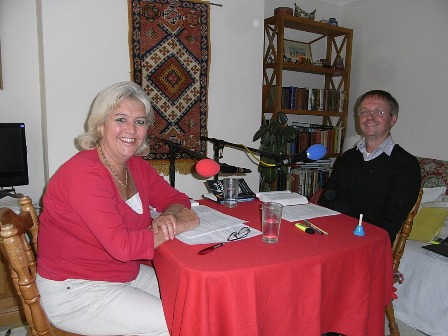
Spent yesterday with Gary Dell (@wisewordtv) and Cathy Le Feuvre recording six podcasts for A Book of Sparks – a Study in Christian MindFullness.
These were done as interviews, with readings from the book and example meditations or mindful awareness practices.
The idea came about for this to become a resource for small groups or individuals to use as they work their way through the 40 meditations in A Book of Sparks, along with a study guide.
An ecumenical prayer group are going to use the book as a post – Alpha course, and these recordings were initially done for them, as they begin their six-week course shortly.
Cathy’s new book is out this week, entitled ‘William and Catherine’ – the love story of the founders of the Salvation Army told through their letters. You can read more about this and her work in media communications, and background in broadcasting and production on her website: http://www.cathylefeuvre.com/.
Gary also has a wealth of experience in production and broadcasting and I am hoping to interview soon about his work via @wisewordtv.
Lyrical #mindfulness and the parables of Jesus
Lyrical #mindfulness and the parables of Jesus
Clink on the link above at Mind and Soul to access my article on ‘Lyrical mindfulness and the parables of Jesus
‘In their book, Teaching Mindfulness, McCown, Reibel and Micozzi talk about the need for a ‘lyric perspective on self-understanding,’ A lyric perspective doesn’t define our self-understanding as who we are (narrative), but how we are, it is about how we are in the moment, not who we are in a sustained self-story.’
The #mindful windows of awareness
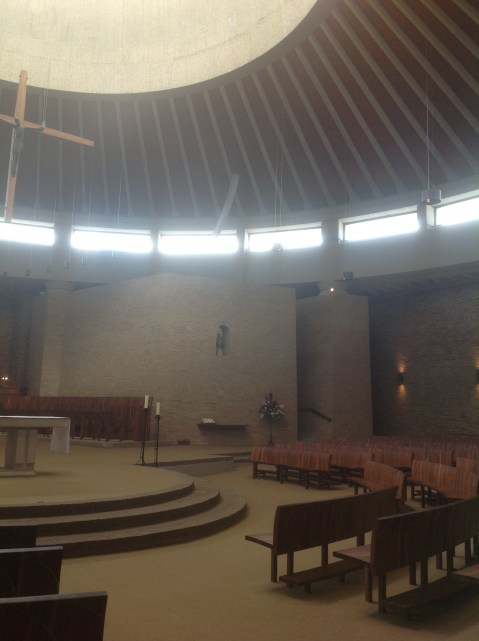
I have just come back from leading a retreat at Worth Abbey about shifting our mental gear from doing to being, from thinking to awareness. The beautiful Abbey Church has a visual parable built within it, that helps illustrate an important aspect of our awareness.
It is a circular church, and has windows running all around the rim of the circle (see photo). Attention is about what we do with our awareness. We can focus our attention, for example, on sounds – allowing whatever sounds are out there to come into our hearing. That is like looking through one window of the many we could look through in the Abbey Church.
Daniel Siegel in his book The Mindful Brain talks about us having a rim of awareness through which things can be attended to. We have our five senses on the rim, five windows if you like on to the world. But Daniel Siegel suggests we have eight senses: in the sixth sense we can become aware of what is going on in our body, in the seventh sense we can become aware of what is going on in our minds – thoughts, feelings, sensations, and in the eighth relational sense we can become aware of what is going on with other people around us.
I would also like to suggest that there is a ninth sense, that works with the other eight senses, which is about becoming aware of the presence of God.
We can focus our attention, just attending to one window, whether it is hearing or sight. But we can also cultivate an open awareness where we are able to allow all our senses to come into awareness. Using the Abbey Church as an example this is where light is coming in through all the windows, and we are aware of all the windows in the circular rim of the church simultaneously.
Often we live through only a few windows, the others blacked out to our awareness and attention. Mindfulness and contemplation open up all the windows of awareness to our awareness and attention. As this happens we begin to experience life in the moment as it truly is, which is whole and full of healthy possibilities, including the possibility of hearing the footsteps of the Invisible One in our life.
link to my reflection on BBC Radio 2’s Good Morning Sunday with Clare Balding
link to my reflection on BBC Radio 2’s Good Morning Sunday with Clare Balding
Coco the mindful dog – my reflection on BBC Radio 2’s Good Morning Sunday with Clare Balding
click on the link above to visit the Good Morning Sunday clips
the #mindful story of the (still) music of our minds

hearing the song
I have also been watching Howard Goodall’s Story of Music on BBC 2, The Age of Invention (1650-1750), and was enraptured with the performance of Antonio Vivaldi’s Four Seasons. I thought, surely this has been played somewhere in the world every day since 1723? Surely the world could never grow tired of listening to it!
I was surprised to hear that Vivaldi ended his days in his sixties in obscurity and poverty in Vienna, having left his beloved Venice, and that his music lay silent for nearly 200 years.
We all have these automatic assumptions. For example, surely New Year has always been celebrated on January 1st every year? According to Stephen Alford’s book The Watchers: a secret history of the Reign of Elizabeth I, January Ist as the first day of the New Year didn’t get adopted in England until 1752.
In the same period between 1650 and 1750 when the laws of gravity were discovered by Isaac Newton, Howard Goodall says musicians became aware of and began playing with the gravity of music. In particular he places one sequence of chords, ‘The Circle of Fifths,’ at the centre of musical gravity. In fact the dozen or so chord sequences beloved of composers in 1700, are, he says, still the top dozen harmonic sequences today.
Religion played its part in the discovery and invention of music, as it did in the discovery of the gravity of attention and awareness. All major religions played a part in this earlier age of discovery and invention of contemplative practices.
As I look at this gravity of awareness and attention, these archetypal chords of the mind, this still music within our thoughts and feelings – I think, surely the church has always been aware of this?
However, as Vivaldi’s Four Seasons fell silent and out of favour, so in the Western Church did this central area of attention and awareness. Watchfulness was once considered the hallmark of sanctity and holiness in the Christian life, but not so in the modern church. It has taken those outside the church, psychologists in particular, to mine the ancient wisdom of the contemplatives.
The modern church has limited itself to a meagre diet, the few notes that sound out reason, and rational, logical propositional thought, and has lost the ancient harmonies, melodies and rhythms of mystery. Indeed mystery and contemplation for some has been seen as forbidden fruit. We have become more harpsichord than piano, unable to play loud and soft.
So what are the archetypal chords of the mind?
The first is the ability to sustain our attention. When our mind wanders off on a ruminative tune, we notice that wandering, and what it wanders to, and switch our attention back to our object of focus. The aim is to catch the first thought as it sounds out, and not allow ruminative and secondary thought processes to write their own music, usually out of tune and discordant.
Within this pattern and in the infinite circle of the present moment we move from focused attention to a more open awareness. It is in that more open awareness as we still our minds that we begin to hear the music of God’s presence. We hear the seductive notes of the addiction to our own ego. We begin to hear the sounds of other people and the created world around us.
What is particularly interesting as you look at the history of composing, whether it is music, books, sermons, art, is that many Christians were involved. Many of them approached this act of composing as a ‘meditatio’, a meditation – and out of this approach came the most dazzling creativity.
Why do we need to rediscover the still music of our minds through contemplative practices? Through these archetypal chords of attention and awareness beauty is discovered and released, the visible is placed at the service of the invisible. In this new ecstatic seeing of reality, we are enabled to hear, in the words of William Blake, the song of the angel, the song of the wild flower.
#mindful of the night sky with open awareness
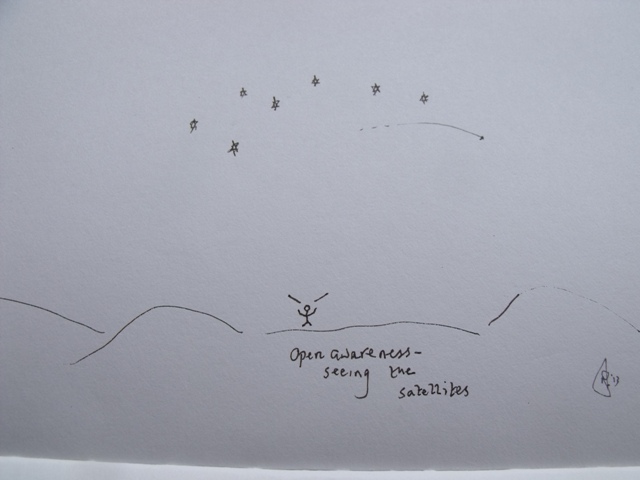
looking at the night sky with open awareness and seeing the shooting satellites
Someone had an App on their mobile phone that you could point at the sky and it would tell which star or constellations you were looking at. There are many ways to look at the night sky, but I was practicing two mindful ways. One is the way of focused attention, just looking at one star, or constellation. The focus of awareness is like a narrow beam of a torch.
In that way you can identify a star or constellation. Another way to look is the way of open awareness or open monitoring, a key distinctive of the universal human capacity to be mindful – where you try and open your awareness to the whole night sky, without focusing on one particular star or constellation.
What I saw when I did that was three different satellites (I assumed they were satellites) darting across the sky. Open awareness or monitoring helps us to see things that we wouldn’t see otherwise, it is a much broader beam of light, rather than a narrow beam.
In London I rarely see a good night sky because of light pollution. Although everyone has a capacity to be aware and attentive (mindfulness is a universal human capacity), when our minds are untrained in this way we often suffer from awareness pollution, we don’t see as clearly as we could. Mindfulness training helps clear the night sky of our minds so that we can see more clearly.
Mindfulness of God is another dimension to awareness and attention that takes us to a place of clearer seeing. Christians are called to be like the Wakeful One, Jesus, the master and commander of attention and awareness.
Hear the #meditative Ananias prayer as it is sung
Hear the #meditative Ananias prayer as it is sung
I outline below, again, the genesis of the befriending, compassionate prayer of blessing I have called the Ananias Prayer. Not only can it be used as a prayer of blessing, but it can now be used as a meditative sung prayer. My friend and worship leader, Glyn Burns, has set it to music. Here is a recording of it on SoundCloud.
In various mindfulness approaches there are befriending or compassion meditations. These again have their roots in Buddhist tradition of metta or loving kindness meditations. These would include compassion for oneself, a stranger and even someone we find difficult.
Of course loving-kindness and compassion play a central part in Christianity as well. As I looked at these metta meditations I was struck by their similarity to the prayer of Ananias of Damascus for Saul of Tarsus.
In the Book of Acts in the New Testament in chapter nine Saul has his famous Damascus Road experience. He is on his way to Damascus to arrest followers of The Way (Christians) when he is arrested by the risen Lord Jesus Christ
.Temporarily blind Saul is led into Damascus. A man there called Ananias has a vision from God who asks him to go and pray a prayer of blessing on Saul which will restore his sight and fill him with the compassionate presence of God, the Holy Spirit. Ananias questions the wisdom of praying for a stranger and an enemy, but God encourages him out of the way of fear into the way of love.
It is clear that the prayer of Ananias has a significant impact on Saul. When Saul talks about his encounter with Jesus, which includes the prayer of Ananias when scales fell from his eyes, and he is filled with the Holy Spirit, he says he has had three important experiences.
‘Not that I have already obtained all this, or have already been made perfect, but I press on to take hold of that for which Christ Jesus took hold of me.’ (Philippians 3:12)The word here for ‘took hold’ is literally ‘arrested.’ On the road to Damascus the love of Christ took hold of him.
When the scales fell from his eyes he ‘saw the light’. In 2 Corinthians 4:6 he says, ‘For God, who said, ‘Let light shine out of darkness,’ made his light shine in our hearts to give us the light of the knowledge of the glory of God in the face of Christ.’ This reference to light shining out of darkness goes back to Genesis 1:3 where God said ‘Let there be light.’
So Saul was taken hold of by the love of Christ, and the light of the love of God shone in his heart.
He then says in 1 Timothy 1:13-14, ‘Even though I was once a blasphemer and a persecutor and a violent man, I was shown mercy because I acted in ignorance and unbelief. The grace of our Lord was poured out on me abundantly, along with the faith and love that are in Christ Jesus.’
The compassionate mercy, grace and love of God were poured into Paul like an overwhelming river.
I felt in part these experiences were because of Ananias’ prayer of befriending and compassion. So I have put them in prayer form that we can pray first for ourselves, then a stranger, then an enemy, and finally back for ourselves.
In the words of one of Jesus’ most important statements ‘Love your neighbour as yourself’ (Matthew 22:39).These are the prayers:
May the love of Christ take hold of me
May the light of Christ shine in my heart
May the love of Christ flow through me like a river
and then
May the love of Christ take hold of him/her
May the light of Christ shine in his/her heart
May the love of Christ flow through him/her like a river
We pray it for our own self, then a stranger, then an enemy and finally for our own self again. Change is laid down by a succession of fresh experiences of love. In our prayer of blessing and befriending something real happens.
 shaunlambert.co.uk