
Mind and Soul – Christianity and mental health
Mind and Soul – Christianity and mental health
An interview with Rev Will Van der Hart and Rob Waller, Consultant Psychiatrist, founders of PREMIER Mind and Soul which works at the interface of the church and mental health.
Today is World Mental Health Day, particularly focusing on depression. This is an interview of hope.
miriam darlington luminous poem #poetry
miriam darlington luminous poem #poetry
Apricots luminously enfolded in words…read it and feel your mouth fill with anticipation.
Coco Open Attentive and Learning
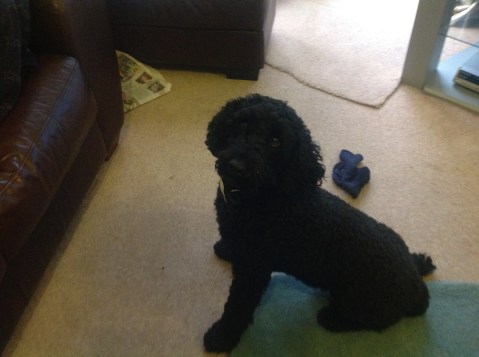
Coco asks for bigger photo for his blog
Coco the mindful dog- part two
 We thought we would carry out the next brain-scan (no harm to dog) experiment out there in the field so to speak. The sophisticated software and scanning headgear was developed by Top Dog Neuroscience Ltd. Basically it scans the dog’s mind and translates the brain-waves into thoughts.
the big cunning dog he does put me in strange gear what will all my friends think but I do know he has ham in his pocket even though my head is humming I think it will be a day for sniffing today and rolling in things because the big cunning dog that is the master I do know that he has forgotten my ball and all my friends will be there so I have to show them that I am a big cunning dog too and the master I do love him but I do know that I wiill win the chess game and end up on his bed if I keep howling but I do know that he doesn’t know that I play chess….(at this point on the computer the thoughts translated by the software dried up. Coco was sniffing things at this point and we think that his brain had switched to pure awareness. Beautiful patterns appeared instead of thoughts. I am thinking of getting them printed and sold as Coco’s paintings. It might help to pay the vet bills….the sniffing has stopped).
If I sit and look at him now I do know that he will give me some ham which is in his left zipped pocket look in my eyes give me ham….(at this point very powerful brain waves were measured and the experiment was abandoned for the day). I felt it important to give Coco some ham as a reward.
A Mindful Experiment- read this Paul Kingsnorth poem
A Mindful Experiment- read this Paul Kingsnorth poem
In Daniel Siegel’s book The Mindful Brain the author talks about the mindful awareness induced by poetry, creating what he calls ‘a receptive presence of mind’ (p.161). By presence he says ‘I mean quite specifically the state of receptive awareness of our open minds to whatever arises as it arises’ (p.161).
Paul Kingsnorth’s poem ‘Vodadahue Mountain’ has just that impact. Follow the link to this poem, read it attentively and see what happens. Daniel Siegel argues that such poems activate the streams of awareness within us (p.162).
This poem won the 2012 Wenlock poetry prize. As I read it I had a moment of clear vision that there is, to paraphrase Luther, something important written on, trees, flowers, clouds and stars (and mountains, elephants and pumas). Something I need to track.
An eco-no to evil – the mindful tree
 In ‘The Roots of Christian Mysticism’ by Olivier Clement there is a fragment of a quote from Paul Claudel talking about the art of Japanese painters. This is in a chapter entitled The Glory of God Hidden in His Creatures and the quote says ‘for them, the visible world was a perpetual allusion to Wisdom, like that great tree which, with unutterable majesty, says No to evil for us’ (p.223).
Paul Claudel apparently had a profound conversion to Catholicism at the age of 18. I can’t be sure what great tree he is talking about, but the tree that sprung to my mind was the mysterious tree ‘of the knowledge of good and evil’ (Genesis 2:17).
What struck me about what Claudel might be helping us to understand is why this mysterious tree is there in Genesis. Maybe it is called the tree of the knowlege of good and evil, to help us say No to evil – it is an eco-No. Claudel also said in La Ville, ‘A pure eye and a fixed gaze see every object becoming transparent in front of them'(p.222, Clement).
The great tree is there in Genesis to help us say No to evil, and perhaps that embodied Wisdom is in every tree. If we looked at any tree attentively enough, we might see the ‘No’ of God written in each leaf, the No to evil.
One of the great evils, therefore, is how we treat trees and the rest of Creation. The obvious example is the continued destruction of the rain forest. It seems that the eco-No was there in the beginning. Wisdom sits in the tree, and we need to notice it.
Mindful of nature – Isaac the Syrian
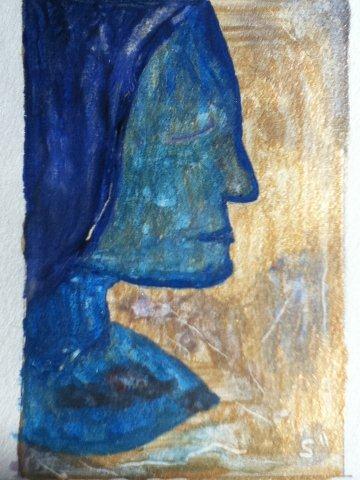 Isaac of Nineveh (The Syrian) of the seventh century was someone who who was mindful of nature. His purified heart, purified through contemplation of Scripture made him mindful of nature.
‘And what is a compassionate heart?..It is a heart that burns for all creation, for the birds, for the beasts, for the devils, for every creature. When he thinks about them, when he looks at them, his eyes fill with tears. So strong, so violent is his compassion….that his heart breaks when he sees the pain and the suffering of the humblest creature.’ (quoted in Olivier Clement, ‘The Roots of Christian Mysticism’, p. 227).
Christians who rediscover the ancient paths of contemplation will rediscover the possibility of seeing ‘every common bush afire with God’ (Gerard Manley Hopkins). They will rediscover a heart that burns for all creation.
Mindful Conversation 1
Last night I met with some therapists who are Christians to talk about mindfulness. I wanted to know had they come across it, where had they come across it, what did they think of it?
I learnt a lot from the dialogue, and I hope we can start many more conversations. One of the key learning points I think that came out of our discussion is the importance of clarifying definitions.
So we talked about mindfulness as a universal human capacity. What evidence do we have? I am interested in collecting examples! There is the attentiveness in nature-writing, the way poetry can lead us into mindful awareness. I came across some research recently trying to determine if tango dancing is as effective as mindfulness in reducing symptoms of psychological stress and promoting wellbeing (http://www.complementarytherapiesinmedicine.com/article/S0965-2299(12)00089-1/abstract).
We talked about the mindful awareness practices (mindfulness meditations) that help us develop mindfulness and their reality-focused nature. Christianity is an incarnational religion and so how might we scan our bodies?
We talked about the overlap and distinctives with Christian contemplative practices and their therapeutic as well as spiritual value. Our God is of course interested in our mental, physical and emotional health. Jesus came that we might live life in all its fullness.
It is also clear that intelligent and engaged study and dialogue with Buddhism and Buddhists is an important path to follow right now.
Someone asked what would be a good introductory book to read on mindfulness. I recommended ‘Mindfulness: a practical guide to Finding Peace in a Frantic World’ by Mark Williams and Danny Penman (http://franticworld.com/). Professor Mark Williams is one of the leading researchers into mindfulness and co-developer of Mindfulness-Based Cognitive Therapy (MBCT), and Dr Danny Penman is an award-winning journalist and author. MBCT is recommended by the UK’s National Institute for Health and Clinical Excellence as a treatment for depression.
It is very clearly written, well-researched and very human book, infused with a deep compassion for all who might read it. Read it and see what you make of it?
We mustn’t be the apocryphal little boy with his finger in the dyke, trying to hold back mindfulness. The dyke has long gone. What we had last night was intelligent, respectful and engaged dialogue.
A Riddle: Why is present-moment awareness so important?
Jesus was a riddler and so riddles must be important. ‘Why is present-moment awareness so important?’
As Jesus said, ‘Therefore do not worry about tomorrow..’ (Matthew 6:34)
A Riddle: Are you your thoughts and feelings?
In his brilliant book on the practice of contemplation Into The Silent Land Martin Laird (OSA) says the doorways to the present moment are guarded by three riddles. The first riddle is this: Are you your thoughts and feelings?
 shaunlambert.co.uk