
Honey cakes of thanks to #Rowan Williams
Rowan Williams is due to step down as Archbishop of Canterbury at the end of the year. I don’t think he has been fully understood or appreciated during his 10 years in office.
I read his biography Rowan’s Rule by Rupert Shortt a while back. I understand that during his time at Canterbury he was sent faeces through the Royal Mail, by evangelical Christians. As Iconoclasts we seem to have lost the icon of dialogue and grace.
However, he also seems to have been seriously misrepresented on a number of issues. One of the problems is that theologically he is not easily put in any camp. But there is much in his thinking and writing that makes him a friend of evangelicals. He encouraged fresh expressions of church, is orthodox by conviction and has a high view of Scripture.
Although many comment on how hard some of his writing is to understand, because of the complexity of his theological language, it is because he is dealing with difficult questions in what he calls ‘critical’ theology. He tackles apologetic issues, questions our culture raises, in a subtle, poetic and highly intelligent manner – and speaks to people outside the church that black and white thinkers repulse. He sent a beautifully clear and charming letter to a six year old called Lulu, who had asked the question of God, ‘how did you get invented?’
In particular many find his spiritual writings like Silence and Honey Cakes, an exploration of the wisdom of the Desert Fathers and Mothers, luminous and helpful. Someone I know who has met the Archbishop says that he is a deeply spiritual man and has a charismatic presence with other people. Surely this is the real mark of a Christian – how they are face to face with real people, not how they are in the virtual world of the media?
I was at Worth Abbey a while back and a phrase of the Archbishop’s leapt off the page I was reading and shook me spiritually – it seemed to be no coincidence that just outside lightning and thunder were shaking the building.
He said that ‘Jesus Christ was a person in whom the freedom of God was completely at work.’ I asked myself, what would it mean for me, to be a person in whom the freedom of God was completely at work? I was left shaken by the implications. But at a smaller but no less important level, I think it would mean this for evangelicals.
We need to dissent and dialogue with grace and love. One thing Rowan Williams is renowned for is the way he listens to every side of a debate. Even as a Bishop in Wales he found time to pastor and counsel ordinary members of his flock, people that others dismissed as unimportant.
I think it means in the present that each one of us should write to him affirming many of the good things he has done since being in office, and to say thank you for doing an impossible and thankless role. Perhaps some of us could even send him some honey cakes. I know that he acknowledges the letters and expressions of support more than counteract the hate mail.
He is also someone who tries to live out this idea of being someone who allows the freedom of God to work without obstacle within. This has led him to be accused of holy naivety. But it also means that in a genuine crisis, the courage of Christ comes out. If you are not sure about this, read the account of how he nearly died in the September 11 bombings of the World Trade Centre in Rupert Shortt’s biography. It is deeply moving.
Being mindful means seeing beneath the stereotypes, and seeing through the eyes of God. I for one am going to find some honey cakes to send him. Perhaps you will join me?
The Jesus Prayer -#the jesus prayer #contemplation
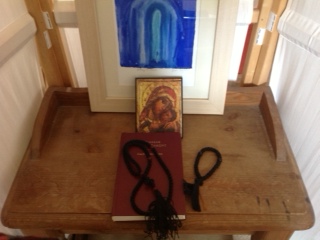
Just before my first sabbatical seven years I was stressed, anxious and near to burn-out. I hadn’t fully realised this, but just a few weeks before I was due to start the sabbatical I was lying in bed, and suddenly I felt this big ball of anxiety come out of my stomach, through my body, and out of my mouth. It was like a showing from God I was suddenly aware of the anxiety I had been holding down.
Then in a bookshop Simon Barrington Ward’s book The Jesus Prayer lept off the shelf at me. The book and the practice of the Jesus Prayer, helped me enormously, as did some conversations with Bishop Simon (formerly Bishop of Coventry), when doing some interviews for the Baptist Times. Mark’s Gospel also became a book of healing for me.
When I began to use the Jesus Prayer it acted very like some of the Celtic prayers, as a circle of protection. For a while it kept at bay the feelings of anxiety or the afflictive thoughts that were troubling me. But if you read the writings of the Desert Fathers and Mothers you find out there are some thoughts (and in the end all thoughts) that you can’t keep at bay. They called these the Eight Afflictive Thoughts, which became trivialised as the Seven Deadly Sins.
These were pride, anger, lust, gluttony, acedia, sadness, greed and vanity. At some point, as these thoughts are kept at bay for a while, we realise that we are not our thoughts, that we are bigger than our thoughts. If we are aware that we can take them captive, that relativises them – they are smaller and less powerful than we think. They are not the powers and authorities that they can become in our minds. By characterising these afflictive thoughts as demons, the Desert Fathers and Mothers achieved this observing distance from their thoughts; they relativised them in that way.
Mark tells us that one of the reasons we fail to see and hear and understand the mystery of the kingdom, the key to real living, is that we have hard hearts. Jesus asks the disciples, ‘Are your hearts hardened?’ (Mark 8:17) when they fail to understand the feeding of the 5,000. Contemplative practices like Lectio Divina and the Jesus Prayer enable us to open and soften our hearts – that is why they are so applicable to helping us become the disciples Mark wants us to be.
At some point we have to move from the Jesus Prayer acting like a protective circle, to something more like a fragile coracle in which we enter the sea of our thoughts and feelings and the wider world and God. We move out of the harbour into the open sea. The harbour is the place of experiential avoidance, the sea is where we engage with what we have been hiding from, what we have run from, what we have pushed down out of our awareness. We move from a place of narrow concentration to a place of open awareness.
From a psychological perspective, the disciples in Mark are guilty of experiential avoidance. When Jesus talks about the way of the cross and predicts His passion, Peter rebukes Him (Mark 8:32). He has to remind them twice more, in Mark 9 and 10, and then again in chapters 13 and 14. Watchfulness is facing reality, not running away from it, or pretending something else is reality – like being the greatest, saving one’ s self, or gaining the whole world.
Experiential avoidance is a psychological process that seeks to avoid what we believe will be painful feelings, thoughts, memories and bodily sensations within us. It causes us problems psychologically. For example, in times of conflict I would avoid facing the experience of my anger. I would end up with very tight neck and shoulder muscles that could go into spasm.
But when I faced the anger and the cluster of thoughts, feelings and bodily sensations with it, the anger did not seem to be such a fearful power and authority as I thought it was. I have often tried to avoid anxious feelings by keeping busy. But as the Jesus Prayer helps us to slow down and still ourselves, we become aware of what we have been avoiding.
How do we begin with the Jesus Prayer? It is important to pay attention to the body. Posture is important, and the way we sit. I find a prayer stool or a straight-backed chair where one can sit relaxed but in a good frame is important. Where we sit is also very important. Chose a place you can return to again and again that has no distractions. We can also pray the Jesus Prayer walking somewhere, or out in the world doing something else.
Traditionally in the Jesus Prayer, the first half of the sentence is prayed on the in-breath – ‘Lord Jesus Christ, Son of God,’ – and the second half of the sentence is prayed on the out-breath, ‘have mercy on me, a sinner.’ The breath is neutral, it belongs to no particular religious group. Breathing is something we all do, and we take it with us wherever we go. That makes it a useful aid in our prayer life. When we are anxious we often over-breathe, and this rhythmic use of it in the Jesus Prayer slows our breathing down.
I find that I repeat the prayer in cycles of 25, with a pause in between the cycles to offer prayers for whatever comes to mind, or simply to be in open awareness or contemplation of God’s presence. Beginning with four cycles is a good start.
It takes time to learn to move out of the harbour and experiential avoidance into the open sea, in the coracle of the simple prayer. In Mark’s gospel we are made aware of our incompleteness and need to be open to God at all times. The Jesus Prayer brings us to that point as well. Mark’s gospel teaches us perseverance – what has been called ‘deep practice’. Those who master a craft are distinguished by how much time they spend in practice, not by their innate ability. A concert pianist will have done on average 10,000 hours of practice to arrive at that level of skill. The Jesus Prayer reminds us about the need for ‘deep practice’. However, God in His grace may give us moments of epiphany that keep us praying in this way.
The best little book on The Jesus Prayer is Simon Barrington Ward’s, see the links here: http://www.amazon.co.uk/The-Jesus-Prayer-Simon-Barrington-Ward/dp/1841015881 and here http://www.brfonline.org.uk/9781841015880/
I have collected many books on The Jesus Prayer over the last few years, and will post some details in future articles. May it lead you into healing and the presence of God as it did for me. If you use the Jesus Prayer I would love to hear from you and start a dialogue, or if you are interested in using it.
Mindful Conversation 1
Last night I met with some therapists who are Christians to talk about mindfulness. I wanted to know had they come across it, where had they come across it, what did they think of it?
I learnt a lot from the dialogue, and I hope we can start many more conversations. One of the key learning points I think that came out of our discussion is the importance of clarifying definitions.
So we talked about mindfulness as a universal human capacity. What evidence do we have? I am interested in collecting examples! There is the attentiveness in nature-writing, the way poetry can lead us into mindful awareness. I came across some research recently trying to determine if tango dancing is as effective as mindfulness in reducing symptoms of psychological stress and promoting wellbeing (http://www.complementarytherapiesinmedicine.com/article/S0965-2299(12)00089-1/abstract).
We talked about the mindful awareness practices (mindfulness meditations) that help us develop mindfulness and their reality-focused nature. Christianity is an incarnational religion and so how might we scan our bodies?
We talked about the overlap and distinctives with Christian contemplative practices and their therapeutic as well as spiritual value. Our God is of course interested in our mental, physical and emotional health. Jesus came that we might live life in all its fullness.
It is also clear that intelligent and engaged study and dialogue with Buddhism and Buddhists is an important path to follow right now.
Someone asked what would be a good introductory book to read on mindfulness. I recommended ‘Mindfulness: a practical guide to Finding Peace in a Frantic World’ by Mark Williams and Danny Penman (http://franticworld.com/). Professor Mark Williams is one of the leading researchers into mindfulness and co-developer of Mindfulness-Based Cognitive Therapy (MBCT), and Dr Danny Penman is an award-winning journalist and author. MBCT is recommended by the UK’s National Institute for Health and Clinical Excellence as a treatment for depression.
It is very clearly written, well-researched and very human book, infused with a deep compassion for all who might read it. Read it and see what you make of it?
We mustn’t be the apocryphal little boy with his finger in the dyke, trying to hold back mindfulness. The dyke has long gone. What we had last night was intelligent, respectful and engaged dialogue.
 shaunlambert.co.uk