
A Book of Sparks Podcast Recording
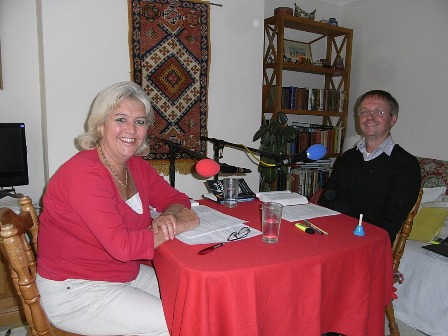
Spent yesterday with Gary Dell (@wisewordtv) and Cathy Le Feuvre recording six podcasts for A Book of Sparks – a Study in Christian MindFullness.
These were done as interviews, with readings from the book and example meditations or mindful awareness practices.
The idea came about for this to become a resource for small groups or individuals to use as they work their way through the 40 meditations in A Book of Sparks, along with a study guide.
An ecumenical prayer group are going to use the book as a post – Alpha course, and these recordings were initially done for them, as they begin their six-week course shortly.
Cathy’s new book is out this week, entitled ‘William and Catherine’ – the love story of the founders of the Salvation Army told through their letters. You can read more about this and her work in media communications, and background in broadcasting and production on her website: http://www.cathylefeuvre.com/.
Gary also has a wealth of experience in production and broadcasting and I am hoping to interview soon about his work via @wisewordtv.
Lyrical #mindfulness and the parables of Jesus
Lyrical #mindfulness and the parables of Jesus
Clink on the link above at Mind and Soul to access my article on ‘Lyrical mindfulness and the parables of Jesus
‘In their book, Teaching Mindfulness, McCown, Reibel and Micozzi talk about the need for a ‘lyric perspective on self-understanding,’ A lyric perspective doesn’t define our self-understanding as who we are (narrative), but how we are, it is about how we are in the moment, not who we are in a sustained self-story.’
The #mindful windows of awareness
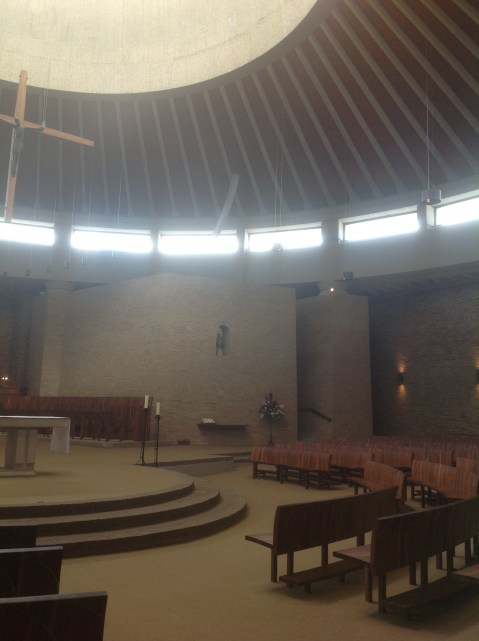
I have just come back from leading a retreat at Worth Abbey about shifting our mental gear from doing to being, from thinking to awareness. The beautiful Abbey Church has a visual parable built within it, that helps illustrate an important aspect of our awareness.
It is a circular church, and has windows running all around the rim of the circle (see photo). Attention is about what we do with our awareness. We can focus our attention, for example, on sounds – allowing whatever sounds are out there to come into our hearing. That is like looking through one window of the many we could look through in the Abbey Church.
Daniel Siegel in his book The Mindful Brain talks about us having a rim of awareness through which things can be attended to. We have our five senses on the rim, five windows if you like on to the world. But Daniel Siegel suggests we have eight senses: in the sixth sense we can become aware of what is going on in our body, in the seventh sense we can become aware of what is going on in our minds – thoughts, feelings, sensations, and in the eighth relational sense we can become aware of what is going on with other people around us.
I would also like to suggest that there is a ninth sense, that works with the other eight senses, which is about becoming aware of the presence of God.
We can focus our attention, just attending to one window, whether it is hearing or sight. But we can also cultivate an open awareness where we are able to allow all our senses to come into awareness. Using the Abbey Church as an example this is where light is coming in through all the windows, and we are aware of all the windows in the circular rim of the church simultaneously.
Often we live through only a few windows, the others blacked out to our awareness and attention. Mindfulness and contemplation open up all the windows of awareness to our awareness and attention. As this happens we begin to experience life in the moment as it truly is, which is whole and full of healthy possibilities, including the possibility of hearing the footsteps of the Invisible One in our life.
the #mindful story of the (still) music of our minds

hearing the song
I have also been watching Howard Goodall’s Story of Music on BBC 2, The Age of Invention (1650-1750), and was enraptured with the performance of Antonio Vivaldi’s Four Seasons. I thought, surely this has been played somewhere in the world every day since 1723? Surely the world could never grow tired of listening to it!
I was surprised to hear that Vivaldi ended his days in his sixties in obscurity and poverty in Vienna, having left his beloved Venice, and that his music lay silent for nearly 200 years.
We all have these automatic assumptions. For example, surely New Year has always been celebrated on January 1st every year? According to Stephen Alford’s book The Watchers: a secret history of the Reign of Elizabeth I, January Ist as the first day of the New Year didn’t get adopted in England until 1752.
In the same period between 1650 and 1750 when the laws of gravity were discovered by Isaac Newton, Howard Goodall says musicians became aware of and began playing with the gravity of music. In particular he places one sequence of chords, ‘The Circle of Fifths,’ at the centre of musical gravity. In fact the dozen or so chord sequences beloved of composers in 1700, are, he says, still the top dozen harmonic sequences today.
Religion played its part in the discovery and invention of music, as it did in the discovery of the gravity of attention and awareness. All major religions played a part in this earlier age of discovery and invention of contemplative practices.
As I look at this gravity of awareness and attention, these archetypal chords of the mind, this still music within our thoughts and feelings – I think, surely the church has always been aware of this?
However, as Vivaldi’s Four Seasons fell silent and out of favour, so in the Western Church did this central area of attention and awareness. Watchfulness was once considered the hallmark of sanctity and holiness in the Christian life, but not so in the modern church. It has taken those outside the church, psychologists in particular, to mine the ancient wisdom of the contemplatives.
The modern church has limited itself to a meagre diet, the few notes that sound out reason, and rational, logical propositional thought, and has lost the ancient harmonies, melodies and rhythms of mystery. Indeed mystery and contemplation for some has been seen as forbidden fruit. We have become more harpsichord than piano, unable to play loud and soft.
So what are the archetypal chords of the mind?
The first is the ability to sustain our attention. When our mind wanders off on a ruminative tune, we notice that wandering, and what it wanders to, and switch our attention back to our object of focus. The aim is to catch the first thought as it sounds out, and not allow ruminative and secondary thought processes to write their own music, usually out of tune and discordant.
Within this pattern and in the infinite circle of the present moment we move from focused attention to a more open awareness. It is in that more open awareness as we still our minds that we begin to hear the music of God’s presence. We hear the seductive notes of the addiction to our own ego. We begin to hear the sounds of other people and the created world around us.
What is particularly interesting as you look at the history of composing, whether it is music, books, sermons, art, is that many Christians were involved. Many of them approached this act of composing as a ‘meditatio’, a meditation – and out of this approach came the most dazzling creativity.
Why do we need to rediscover the still music of our minds through contemplative practices? Through these archetypal chords of attention and awareness beauty is discovered and released, the visible is placed at the service of the invisible. In this new ecstatic seeing of reality, we are enabled to hear, in the words of William Blake, the song of the angel, the song of the wild flower.
divine contraband and the divine stowaway

‘When I stand before customs-officers and police-commissioners,
I smile mischievously, for no one detects
the divine contraband, the stowaway,
whose highly discreet presence is visible
only to angels’ glances.’
Dom Helder Camara
I sometimes smile when I hear people say that we must keep God out of certain things. That idea came back to me when I read this quote from Dom Helder Camara, a political bishop and mystic from Brazil, who died in 1999.
Troublesome priests are locked up, or worse, by repressive governments, not just for themselves, but because they carry divine contraband, they have a divine stowaway on board.
But this idea of divine contraband is also one of hope. In politics there is divine contraband, a divine stowaway hiding in someone. God can’t be kept out. In the world of business there is divine contraband, a divine stowaway hiding in someone. God can’t be kept out.
But this is also true in our own lives. There is no part of our own life that is unworthy of our attention, or God’s.
We can pay attention to our body and find divine contraband. We can step out of clock-time for three minutes, for one minute, and find divine contraband. There is no place where God cannot emerge.
In the whirlpool of my thoughts #mindfully

(Wendy Reed photo)
Like the duck we need to stay at the rim of our thoughts, where we can observe them. It is too easy to be sucked into the whirlpool of our thoughts, believing them to an accurate readout of reality rather than passing events.
It takes attention and awareness to stay on the rim of our thoughts, observing them gently and compassionately. The natural pull of their gravity takes us towards the whirlpool where we lose perspective.
On the rim of my thoughts I am aware, through my senses, of what is around me. I can find inner freedom and peace, the whirlpool is not all there is.
the duck on the rim
of the circle of water
is me and my thoughts
#Practice spirituality the new social phenomenon
#Practice spirituality the new social phenomenon
Here is a link to my latest article on Instant Apostle’s website. Click on the link above. We are missing a spiritual awakening in our culture and a way of transformation.
The boy on the edge of happiness – Matthew Hollis’s poem and a #mindful insight
The boy on the edge of happiness is the title of a book of poetry by Matthew Hollis. I haven’t read the book, or what I am imagining to be a poem of the same name. Although I would like to. I came across a tweet by the Poetry Society saying that Matthew Hollis was a ‘terribly good poet’, so I looked him up. That’s when the title, ‘The boy on the edge of happiness’ resonated deeply. It brought into my awareness something that was on the edge of my awareness.
As a boy and a man I have lived on the edge of happiness. Why would you do that?
I have known happiness and at crucial times in my life it felt like it was taken away. So I never quite trusted it to stay around.
The first time was going to boarding school at the age of 6 3/4s for a term. We would have a day sometime during the term when your parents would take you out, called an exeat.
At the beginning of the day happiness would flood back. And my mum says I would chat to them, and be lively and excited. But as the day drew to a close, I would be quiet, not speak, just look at them with my eyes filling with tears, but without crying. Happiness was draining away, or being taken away.
In short happiness couldn’t be trusted, it was safer to live on the edge of happiness.
I remember later when we would fly out to Kenya for the holidays from the UK from another school. The first night in my bedroom in Kenya would be a strange one. I would wake up on that first morning of the holidays, as light streamed through the curtains with a sinking heart imagining I was still at school. Suddenly I would realise this was a different sort of light and I would be filled with a sense of elation – I was home.
The first night at boarding school reversed the process. I would awake imagining I was home, with a light heart, and then realise with a sinking feeling that I was back at school.
The title of Matthew Hollis’s book of poetry rang me like a bell. I was filled with the revelation that ever since those early experiences I had lived on the edge of happiness. Never quite letting myself enter in all its fullness the happiness that was there, in case it was taken away.
The reason for writing about these memories that came back was that I wondered how many other people are living quietly on the edge of happiness for similar reasons?
When my mum told me the story of the exeat she said it used to break her heart to have to let me go back to the boarding part of school. The title of a poem has given me a deep mindful insight. Poetry has this capacity.
Daniel Siegel says of poetry…’Hearing poetry feels integrative. The science of language and the brain reveals that while the left hemisphere specializes in linguistic language, the right takes a dominant role in words with ambiguous meaning. Also, the imagery evoked by poetry seems to more directly activate the primary visuospatial processes of our brains…’ (The Mindful Brain, p. 161)…poetry creates a mindful state.
I am just experimenting, right now, mindfully, with trying to enter into the full experience of happiness, moment by moment as it arises. I felt it today. A moment of happiness should not be dismissed. As William Blake says:
To see a world in a grain of sand,
And a heaven in a wild flower,
Hold infinity in the palm of your hand,
And eternity in an hour.
There is a whole world in a single moment. Even a world of happiness.
The unappreciated but important act of #mindful reading
Mindful reading
I was born in Kenya and we didn’t have a TV or computers or any other technical distractions. So my mum taught me to read at the age of 3, and it is one of the greatest gifts I’ve been given.
I learnt to lose myself in books. I learnt to speed-read. I learnt to read selectively for academic study. But the most difficult form of reading, and perhaps the most important, is to learn how to read mindfully.
Mindful reading is different. One way I learnt this, and am still learning was through the slow prayerful reading of sacred text that is lectio divina. This slow form of reading is repetitive, lovingly repetitive. It is meditative and contemplative.
I also learnt a lot about reading mindfully, and was inspired to read in this way by Miriam Darlington’s lyrical Otter Country. We can read other texts that inspire mindful reading; it doesn’t have to be Scripture.
In fact I take Otter Country with me wherever I do a retreat or listening day or seminar, and I read sections to illustrate mindful reading, and mindful attentiveness through observing the natural world.
One of the main practices of A Book of Sparks: A Study in Christian MindFullness is mindful reading. On page 25 I wrote:
‘As we read each day, I would encourage you to read slowly, and mindFully; the very process of this type of reading can bring us into a place of awareness and attentiveness…’
This is not as easy as it sounds. This is mainly because we are trained to read in another way. I came across this quote about mindful or contemplative reading which explains this beautifully:
‘Finally the weekly reading assignments are subverted through the introduction of a contemplative reading practice. Rather than aggressively reading to have knowledge and gain ‘truth,’ participants learn a method which is a being with, not a doing of the text – an embodied, not a cognitive encounter.’[1]
We are so used to aggressively reading as an act of doing of or to the text, we do not know how to be with the text. Especially text that does not immediately surrender its meaning.
Mindfulness-Based Cognitive Therapy (MBCT) talks about learning to shift from the doing mode of mind to the being mode of mind. We are culturally conditioned in particular to inhabit the doing mode of mind. Our aggressive reading of texts reflects this. The shift to being happens through mindful awareness practices, meditative practices. One such practice, I believe, is mindful reading.
[1] Donald McCown, Diane Reibel & Marc S. Micozzi, Teaching Mindfulness (Springer, 2011), p. 160.
#mindfulness without meditation
#mindfulness without meditation
Here is a link to my article on PREMIER Mind and Soul about the work of Ellen Langer in the area of mindlessness and mindfulness.
 shaunlambert.co.uk