
My talk at Somerville College Chapel Oxford, #mindfulness- a Christian perspective
My talk at Somerville College Chapel Oxford, #mindfulness- a Christian perspective
Link to my talk on ‘mindfulness – a Christian perspective’ at Somerville College Chapel Oxford, now on their blog
Better link to UCB radio interview with me on silence and contemplation
Better link to UCB radio interview with me on silence and contemplation
Link to UCB Christian radio Paul Hammond’s interview with me earlier this year on silence, contemplation, meditation and mindfulness
Interesting facts about the English word #’mindfulness’
The Buddhist technical term sati in Pali (or smrti in Sanskrit) was first translated with the English word mindfulness by T.W. Rhys Davids in 1881. So says Rupert Gethin in his article On some definitions of mindfulness (Contemporary Buddhism Vol. 12, No. 1, May 2011).
Previous dictionaries had translated this complex technical term with translations such as ‘remembrance, memory, reminiscence, recollection, thinking of or upon (any person or thing), calling to mind.’ (p.263)
One of the misunderstandings of the word ‘mindfulness’ is that people sometimes assume it is a Buddhist word, rather than an English word that translates a Buddhist term.
Gethin goes on to say that he is not surprised that this word is used. The OED ‘records the use of the English ‘mindfulness’ in the sense of ‘the state or quality of being mindful; attention; memory (obs.); intention, purpose (obs.).’ from 1530 A.D.’ (p.264)
Early uncertainty about how to translate the word sati gives way to mindfulness becoming ‘the only possible English translation of sati’ from 1910 with Rhys Davids influential translation of the Mahasatipatthana Sutta. (p.265) It is not surprising then, with this OED reference to the date 1530, that the King James Version of the Bible published in 1611 has the word ‘mindful’ in it a number of times.
‘What is man, that thou art mindful of him? and the son of man, that thou visitest him?’ (Psalm 8:4) Being mindful of God is becoming aware of when He ‘visitest’ us.
How can #mindfulness be secular, Buddhist, or Christian?
How can mindfulness be secular, Buddhist or Christian? Richard Burnett has written an excellent, well-researched, erudite and thought-provoking thesis called ‘Mindfulness in schools: learning lessons from the adults – secular and Buddhist (see link below). Within his thesis are important ideas that enable us to begin to answer the question above.
Firstly, mindfulness can be used in different settings because it is a universal human capacity for awareness and attention in the present-moment and must be distinguished from the meditative or mindful awareness practices that lead to this mode of awareness. In an important note on page 6 of his thesis Burnett says, ‘There is nothing ‘Buddhist’ about being mindful and paying attention to the present moment. Kabat-Zinn compares this to calling gravity ‘British’ because it was discovered by Newton.’
Secondly, it has a historical presence in Buddhism and Christianity, and in secular psychology there has also been a long focus on awareness and attention and the regulation of emotions. In other words people came across the capacity for mindfulness within different contexts, originally these contexts were religious. The other key idea, then, is to understand the context.
Richard Burnett is someone who has looked at this question of context within the setting of introducing mindfulness into schools (http://mindfulnessinschools.org/).
Thirdly, in counselling there is an important emphasis on client autonomy, respecting a person’s world view, experience and ethical values. That means boundaries are important. What is the context in which the client lives? An atheist might want to engage with a purely secular mindfulness.
This question of boundaries and client autonomy arises in mindfulness because it is a universal human capacity, and therefore appears in different contexts. These forms must be well defined and clearly articulated, although there is shared territory between the forms as well as distinctives. But a secular mindfulness course must not be ‘Buddhism by the back door.’ (p.32)
The key question is I guess: how do we ensure secular mindfulness is secular, Buddhist mindfulness is Buddhist and Christian mindfulness is Christian, for those to whom it matters? Someone looking at life through a secular lens for example.
Burnett argues, quite rightly that mindfulness in schools does not have the same objective as clinical psychology, because ‘in a classroom context we are not treating specific pathologies.’ (p. 24). Nor can it be introduced as a spiritual practice ‘as a classroom is not the place for religious instruction.’ (p.24) It can be used more generally to promote the key attitudes found in the National Framework for religious education of ‘self-awareness, respect for all, open-mindedness and appreciation and wonder.’ (p.27)
It then requires what has been called an ‘informational context’ (Feldman); or a ‘framework of understanding’ (Teasdale) or what Kabat-Zinn calls ‘scaffolding’. (p.28) Buddhist mindfulness is set within an ancient and complex scaffolding. (p.28) Helpfully, Burnettt argues that ‘The scaffolding in clinical mindfulness may be much smaller, but is very well constructed and arguably more effective in the treatment of specific conditions.’ (p.29) Mindfulness within Buddhism is set within religious or spiritual scaffolding, within clinical mindfulness it is secular (generally), although there are psychologists reframing Buddhism as a wise and ancient psychology and bringing in Buddhist insights that are psychological.
Burnett quotes from Kabat-Zinn, the pioneer of clinical mindfulness, as saying that mindfulness ‘may have to give up being Buddhism in any formal religious sense.’ (p.31)
This clear boundary around clinical mindfulness to ensure it is secular is important as Burnett outlines in a quote from Michael Chaskalson, (one of the key figures in mindfulness he has interviewed): ‘If you don’t establish clear boundaries you will exclude some people. There will be practising Christians for example, or dedicated Dawkins style atheists coming on courses and I don’t want to exclude them from conversation.’ (p.31)
So within schools Burnett argues that mindfulness should not be Buddhist (almost certainly). (p.31) If you are doing a Religious Studies A-level in Buddhism you would refer to the Buddhist scaffolding. But when taught as a practice it should be within scaffolding that is clearly secular. In that context what it can address, as a backbone for the engagement, is what Mark Williams calls ‘universal vulnerabilities.’ Although specific vulnerabilities identified in the context of schools such as ‘anxiety of exams,’ peer pressure, or mood swings, could be indicated to pupils. (p.33)
Burnett argues that mindfulness, especially in schools, brings with it ‘a sense of possibility.’ ( p.33). Burnett highlights these other possibilities, pointing out that there are a broad ‘range of potential applications’, including functional, therapeutic, to more spiritual applications when the context is appropriate. (p.33)
What I have been trying to develop, through ‘A Book of Sparks: a Study in Christian MindFullness’ and other writings, is a Christian scaffolding, drawing on biblical and historical roots for the development of mindfulness within the Christian tradition, as well as looking at the benefits of engaging with it today.
Within this setting I believe it has spiritual as well as therapeutic benefits, because of the overlaps, and shared territory, and because we are ’embodied’ people. The evidence-based research within clinical psychology suggests that it would also be appropriate to point Christians, under the holistic guidance of doctors and therapists, to secular clinical mindfulness which might address ‘specific’ vulnerabilities they might be living with. For Christians are not immune from the universal and specific vulnerabilities that afflict all human beings.
Within this research I am keen to work collaboratively with other Christians who are interested in mindfulness, both psychologically and theologically. I am grateful for the collaborative partnerships that are beginning. Space doesn’t permit a description of the scaffolding that makes mindfulness Christian, I have done that elsewhere, but I do believe that for Christians, as well, as they rediscover their contemplative roots, it has a very real ‘sense of possibility.’
A Christian perspective on attention, awareness and #mindfulness
A Christian perspective on attention, awareness and #mindfulness
An article I have written on attention, awareness and mindfulness for Premier Mind & Soul. Please follow the link.

‘He’ was unreservedly receptive #windows of tolerance

Hope never dies
depression and the church Baptist Times online article by Cathy Wield
The Baptist Times Online has recently run an article by Cathy Wield, about the church and depression. The link is above, as is the link to her own website. Out of her experience of depression she has written a book called A Thorn in My Mind, Mental Illness, Stigma and the Church, published by Instant Apostle.
I have met Cathy and read the book in one sitting. It is an extraordinary book which left me full of hope, but also stretched my windows of tolerance for dealing with other people’s pain. I came across these words this morning by theologian Boros, ‘He (Christ) created within himself a place for every encounter. He was unreservedly receptive.’ (‘Encountering Reality’ by Bishop George Appleton & Debbie Davies, published by Amate Press, Oxford, p. 13).
I know that I don’t have a place within that is able to be unreservedly attentive to every encounter. But that is an aspiration. That is what it means to be mindFull within the Christian perspective.
A #mindful experiment with a #poem – Columba by Kenneth C Steven
Columba poem by Kenneth C Steven, the poet reads… (click on this link)
In Josephine Hart’s book Words That Burn – How to read Poetry and why, she begins her introduction with these words.
‘How do you possess a poem? Well, ‘same as for love’. Pay attention to it. Listen to it. It will speak to you on the page. Silently. Or you may wish, as the critic Harold Bloom advises, to speak it out loud to yourself…’ (p.1).
You can also (best of all) hear it read out, live with the poet, or a recording of it. As Josephine Hart goes on to say, ‘The poetry sounds out and I ‘trip..into the boundless’, as Frost described it.’ (p.1)I think the oral performance is the most primal form.
This is a poem by Kenneth C Steven called Columba. Click on the link and you can hear the poem sound out…and you may trip into the boundless. A perceptive person introduced me to his poetry.
The mindful experiment is becoming aware of where the poem takes you…
One-Minute Icon: inner #sanctuary

Inner sanctuary
Paintings like poetry can shift our mental gears from doing to being, from thinking to awareness, from autopilot to mindfulness, from self-preoccupation to contemplation of God, which becomes love for others and the creation around us.
Step out of clock-time for one minute and focus your attention on the painting. As your mind wanders allow yourself to become aware of the noise in your head, the afflictive thoughts, the self-preoccupied narratives. Allow the volume on those thoughts and feelings to be turned up. Become aware of the silence in the painting. You can click on the picture to make it bigger.
As I was praying this morning I came across this painting I had done in France a while back. As the rain beat down outside, and it looked like we wouldn’t see the sun today I suddenly wanted to be in this bright summer place in France. But then I also thought: this is a picture of what my inner sanctuary could look like. My inner sanctuary doesn’t have to be grey like the external world was this morning.
How do we create this inner sanctuary? If you want a good book to begin, read Father Christopher Jamison’s ‘Finding Sanctuary’ (see attached link). What are some of the building blocks? Virtue…silence…meditation and contemplation…
Three-Minute Icon – #Patience – guest artist Natalie Woodhouse
Natalie’s paintings on Facebook

Natalie
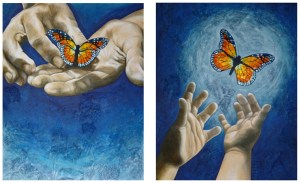
Hope in fragility through patient waiting
In his book The Mindful Brain Daniel Siegel writes, ‘Poetry, like silence, creates a new balance of memory and moment. We see with fresh eyes through the poet’s artistry, which illuminates with words a new landscape that before was hidden beneath the veil of everyday language.’ (p54).
I think this is also true of art, which helps us to move from a clouded thinking to a new awareness, moving from thinking to the streams of awareness in our minds.
So step out of clock-time for 3 minutes and just look at Natalie’s painting. If your mind wanders, notice what it wanders to and bring it back to the painting. Pay attention to what comes into your awareness. Write it down.
This is what Natalie says of this painting:
‘PATIENCE’
This painting was based on an image someone had for me of a butterfly emerging form its cocoon too early – when it was not yet ready. God was holding it in his hands, stroking its wings, waiting for them to dry. It had to be patient while God dried its wings – if released too early the butterfly wouldn’t be able to fly. Something big and spectacular will come but you have to wait patiently – it cannot be rushed. Trust in God’s timing, not your own. Be patient while God ‘dries your wings’…
What I love about Natalie’s paintings is their texture, they invite you reaching out and touching them. Have a look at some of her other paintings on the attached Facebook link. Too often art is hidden away behind glass and barriers. I feel if I touched the butterfly I would come away with wingdust on my fingers.
As I gazed at the painting I was reminded that it is alright to be fragile. An experience of when I felt I was falling apart, and someone was able to hold me until my wings dried, came to mind. In the patient waiting of fragility, the painting also gives me hope.
(These is some details about Natalie:
The side of God that I find easiest to relate to is God the creator and artist. When I took a year out in Australia I used to walk along the beach each morning and marvel at how the scenery, colours and texture would change so much from day to day. I would imagine God ‘painting’ the scene – each day a new and exciting canvas – and as I walked I would say to Him “loving your work today God”. It was at these times that I felt closest to Him and most at peace. I try to capture glimpses of the incredible beauty of God’s creation in my paintings – nature being the ultimate inspiration. I work primarily in acrylics on canvas, often adding texture through mixed media. Having completed a degree in Surface Pattern design I also enjoy working with textiles, designing and making clothing, cushions, bedding and wall art, amongst other things.
Email: natwoodhouse@hotmail.com)
 shaunlambert.co.uk