
Mindful of nature – Isaac the Syrian
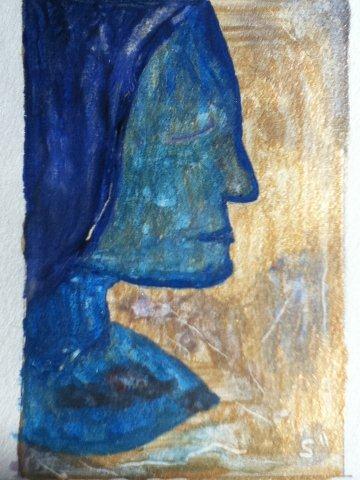 Isaac of Nineveh (The Syrian) of the seventh century was someone who who was mindful of nature. His purified heart, purified through contemplation of Scripture made him mindful of nature.
‘And what is a compassionate heart?..It is a heart that burns for all creation, for the birds, for the beasts, for the devils, for every creature. When he thinks about them, when he looks at them, his eyes fill with tears. So strong, so violent is his compassion….that his heart breaks when he sees the pain and the suffering of the humblest creature.’ (quoted in Olivier Clement, ‘The Roots of Christian Mysticism’, p. 227).
Christians who rediscover the ancient paths of contemplation will rediscover the possibility of seeing ‘every common bush afire with God’ (Gerard Manley Hopkins). They will rediscover a heart that burns for all creation.
A Riddle: Why is present-moment awareness so important?
Jesus was a riddler and so riddles must be important. ‘Why is present-moment awareness so important?’
As Jesus said, ‘Therefore do not worry about tomorrow..’ (Matthew 6:34)
A Riddle: Are you your thoughts and feelings?
In his brilliant book on the practice of contemplation Into The Silent Land Martin Laird (OSA) says the doorways to the present moment are guarded by three riddles. The first riddle is this: Are you your thoughts and feelings?
The earliest example of mindfulness?
The earliest example of mindfulness?
On the Granta website is an essay by Casper Henderson called ‘Barely Imagined Beings’ (Book of same name just out). In it he shows An image from the Chauvet cave paintings, which are over 30,000 years old.
It is a scene of lions about to attack. Casper quotes from David Quammen’s book (Monster of God: The Man-Eating Predator in the Jungles of History and the Mind), who writes that the scene has been painted not with fear but ‘a skilled hand, a calm heart,and an attentive, reverential eye.’
Is this the earliest evidence for the universal human capacity for mindfulness, through mindful art?
The Mindful/Discerning Ones – a charism of the Holy Spirit?
In his book ‘Words of Spirituality’ Enzo Bianchi writes, ‘in Buddism, it is through attention that one reaches a penetrating vision of reality, a way of seeing, what the desert fathers and the Christian tradition have called diorasis (seeing in depth, beyond appearances and exteriors) (p.34).
Diorasis is one of the ‘mindful’ Christian words, and someone who exhibited it was called a Discerning One, we could say a mindful one – for discernment is part of Christian mindfulness. It is not a narrow closed attitude of the mind but an open, discerning one. In Dialectical Behaviour Therapy (DBT) a mindfulness-incorporating therapy, the state of mind to access is ‘wise mind’. Discernment is about wisdom.
In ‘The Spirituality of the Christian East’ Tomas Spidlik calls this discernment, this seeing in depth a charism of the Holy Spirit, which included an ability to see into the hearts of people. It also included a knowledge of the mysteries of God.
this charism is considered a gift of God and also the result of personal purification, through a life of contemplative prayer, ‘Blessed are the pure in heart, for they will see God'(Matthew 5:8). The principal way of praying was the Jesus Prayer, the simple but profound invocation of the presence of God which contains the whole gospel, ‘Lord Jesus Christ Son of God, have mercy on me a sinner.’ This prayer was incarnated into the person through the first half of the prayer happening on the in-breath, and the second half on the out-breath.
This ancient prayer enables one to deal with the traditional eight afflictive thoughts of gluttony, lust and greed, anger, sadness and acedia, vanity and pride.
The grace of God enables all to become discerning ones, the humility of man enables all to co-work with God in contemplative prayer. This is the wisdom of the Desert Fathers and Mothers.
The anxious shoal in my mind
 In the sea of awareness in my mind fish swim in. Sometimes (often) one of them thinks there’s a shark in the sea outside the harbour of my head. Other fish-thoughts cluster anxiously to him.
I become that anxious shoal even though I am not that shoal, and I am bigger than that shoal of fish-thoughts. And there wasn’t even a shark in the water outside the harbour of my head.
But the shoal begins to tell the story of the shark that has got bigger, and more and more fish-thoughts gather and swim around frantically telling the untrue story about the shark that isn’t actually there.
Just in the corner of the bowl of my mind swims a little bright goldfish which taps the side of my mind and says, ‘you are bigger than these fish-thoughts and perhaps the shark isn’t actually there’. Suddenly the water calms and the shoal of fish-thoughts swim away and they have disshoalved.
More fish-thoughts swim into the harbour of my mind…the little gold Right-fish thought is still and still there.
50 shades of mindfulness
Article on Evangelical Alliance website – culture section – Friday Night Theology
Otter Country – mindful of nature
Miriam Darlington, a poet, has written a beautiful book called ‘Otter Country – in search of the wild otter’, published just recently by Granta. It is a book to be read slowly, with a chocolate-covered cappucino and lemon tart. Perhaps only a chapter a day as a treat to be savoured and tasted.
I have read just the first three chapters so far but I am captivated. Like all good poets, through awareness, attention, and observation she has got under the skin of the otter. Miriam, along with all poets and nature writers is mindful of nature, and demonstrates that mindfulness is a universal human capacity. Within our mindful brain we all have the capacity for wise present-moment awareness that sees far and true.
Her words melt the padlocks of your mind and suddenly you are free to slip into the book as the otter slips into the river or the sea. Read it and see again.
Knowing the patterns of our mind
Knowing the patterns of our mind
Day 7 of serialisation of A Book of Sparks – A Study in Christian MindFullness in the Baptist Times Online
Discovering the patterns of our mind through contemplation and allowing them to be transformed by God’s presence.
Rediscovering Christian Contemplative practice – day 5
Rediscovering Christian Contemplative practice – day 5
The distortion of narcissism – week 5 of serialisation of A Book of Sparks – a Study in Christian MindFullness. We need to become self-aware of this pattern of the world to which we are all conformed.
 shaunlambert.co.uk