
A #mindful experiment with a #poem – Columba by Kenneth C Steven
Columba poem by Kenneth C Steven, the poet reads… (click on this link)
In Josephine Hart’s book Words That Burn – How to read Poetry and why, she begins her introduction with these words.
‘How do you possess a poem? Well, ‘same as for love’. Pay attention to it. Listen to it. It will speak to you on the page. Silently. Or you may wish, as the critic Harold Bloom advises, to speak it out loud to yourself…’ (p.1).
You can also (best of all) hear it read out, live with the poet, or a recording of it. As Josephine Hart goes on to say, ‘The poetry sounds out and I ‘trip..into the boundless’, as Frost described it.’ (p.1)I think the oral performance is the most primal form.
This is a poem by Kenneth C Steven called Columba. Click on the link and you can hear the poem sound out…and you may trip into the boundless. A perceptive person introduced me to his poetry.
The mindful experiment is becoming aware of where the poem takes you…
One-Minute Icon – Guitar of the seas #conservation
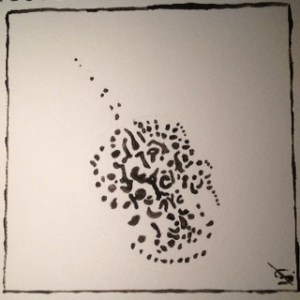
Guitar of the seas
Step out of clock time for one minute. Gaze at the painting. What do you see? Art like poetry helps move us from doing to being, from freighted thinking to open awareness, gets behind our defences…allows hidden things to surface in our minds.
What do you see? What came into your mind?
I spent the afternoon with some friends at the SEA LIFE London Aquarium which does a huge amount for marine conservation. It was amazing to see all the unbelievable creatures…but I was also shocked at story after story of how we are threatening their ecological future, from sea horses to turtles.
When I looked at the stingrays I saw guitars of the seas.
Honey cakes of thanks to #Rowan Williams
Rowan Williams is due to step down as Archbishop of Canterbury at the end of the year. I don’t think he has been fully understood or appreciated during his 10 years in office.
I read his biography Rowan’s Rule by Rupert Shortt a while back. I understand that during his time at Canterbury he was sent faeces through the Royal Mail, by evangelical Christians. As Iconoclasts we seem to have lost the icon of dialogue and grace.
However, he also seems to have been seriously misrepresented on a number of issues. One of the problems is that theologically he is not easily put in any camp. But there is much in his thinking and writing that makes him a friend of evangelicals. He encouraged fresh expressions of church, is orthodox by conviction and has a high view of Scripture.
Although many comment on how hard some of his writing is to understand, because of the complexity of his theological language, it is because he is dealing with difficult questions in what he calls ‘critical’ theology. He tackles apologetic issues, questions our culture raises, in a subtle, poetic and highly intelligent manner – and speaks to people outside the church that black and white thinkers repulse. He sent a beautifully clear and charming letter to a six year old called Lulu, who had asked the question of God, ‘how did you get invented?’
In particular many find his spiritual writings like Silence and Honey Cakes, an exploration of the wisdom of the Desert Fathers and Mothers, luminous and helpful. Someone I know who has met the Archbishop says that he is a deeply spiritual man and has a charismatic presence with other people. Surely this is the real mark of a Christian – how they are face to face with real people, not how they are in the virtual world of the media?
I was at Worth Abbey a while back and a phrase of the Archbishop’s leapt off the page I was reading and shook me spiritually – it seemed to be no coincidence that just outside lightning and thunder were shaking the building.
He said that ‘Jesus Christ was a person in whom the freedom of God was completely at work.’ I asked myself, what would it mean for me, to be a person in whom the freedom of God was completely at work? I was left shaken by the implications. But at a smaller but no less important level, I think it would mean this for evangelicals.
We need to dissent and dialogue with grace and love. One thing Rowan Williams is renowned for is the way he listens to every side of a debate. Even as a Bishop in Wales he found time to pastor and counsel ordinary members of his flock, people that others dismissed as unimportant.
I think it means in the present that each one of us should write to him affirming many of the good things he has done since being in office, and to say thank you for doing an impossible and thankless role. Perhaps some of us could even send him some honey cakes. I know that he acknowledges the letters and expressions of support more than counteract the hate mail.
He is also someone who tries to live out this idea of being someone who allows the freedom of God to work without obstacle within. This has led him to be accused of holy naivety. But it also means that in a genuine crisis, the courage of Christ comes out. If you are not sure about this, read the account of how he nearly died in the September 11 bombings of the World Trade Centre in Rupert Shortt’s biography. It is deeply moving.
Being mindful means seeing beneath the stereotypes, and seeing through the eyes of God. I for one am going to find some honey cakes to send him. Perhaps you will join me?
#Kurt Jackson/ painter wilderness reams angels medicine walks and memory
Kurt Jackson, the painter. He has a way of seeing things at different levels to most people. It includes wilderness, reams, angels, medicine walks and memory.
This his link: http://www.kurtjackson.com/index.html
Let me give you a quote from Miriam Darlington’s blog http://wild-watching.blogspot.co.uk/:
‘I’m standing beside a gate, screened by some sallow and oak branches. A movement on the water. The size of a water vote, but with a wake. Henry Williamson, who wrote “Tarka the Otter” and spent many years down at otter-nose level, called it a ‘ream’. Half way between a ripple, and a beam of light.’
Kurt Jackson is someone who sees ‘reams’. They are there but often invisible to the clothed eye. It is not just in landscapes we find them. There are reams with people, ripples and beams of goodness. In every day there are reams of God, ripples and beams of presence.
Annie Dillard in her book Teaching A Stone To Talk has a chapter in it ‘A Field of Silence.’ At the end she writes, ‘There are angels in those fields, and, I presume, in all fields, and everywhere else. I would go to the lions for this conviction, to witness this fact.’ (p.136)
When I look at Kurt Jackson’s paintings I understand what Annie Dillard is saying. Jackson’s paintings are bathed with the light of angels, but not fluffy, chubby angels but angels that make you write, ‘Holiness is a force, and like the others it can be resisted. It was given, but I didn’t want to see it.’ (Annie Dillard, pp.134-135)
Wilderness psychotherapy sends children and others out on medicine walks. As I look at Jackson’s paintings I end up walking in the landscapes. But it is a medicine walk.
There’s an idea in NewScientist of 6th October in their memory section, that memories are very important in shaping our happiness or sadness, ‘Our memories act as a kind of ballast that holds us steady in times of stress…’ (p.38). ‘Over-general memory’ as it has been called, where people ‘paint their past in broad brush strokes’ (p.39) but don’t remember the details can be linked to depression. As I gazed attentively and openly at Jackson’s paintings I found memories rising to the surface, happy ones. I found awarenesses of oneness, and unity rising to the surface. The paintings became a medicine-walk.
Slow down and look at Kurt Jackson’s paintings today- take a medicine walk amonst the reams of angels.
#mindful experiment with #poetry #autumn
poem-of-the-week-john-clare (click on this link)
This is a watchful, noticing, self-aware reflection on a watchful, noticing self-aware poet. Read both John Clare’s Autumn, but also Carol Rumens’s reflections on it.
Daniel Siegel says of poetry…’Hearing poetry feels integrative. The science of language and the brain reveals that while the left hemisphere specializes in linguistic language, the right takes a dominant role in words with ambiguous meaning. Also, the imagery evoked by poetry seems to more directly activate the primary visuospatial processes of our brains…’ (The Mindful Brain, p. 161)…poetry creates a mindful state.
Now speak the poem out loud, or get someone to read it to you…hearing may be different to reading…is there a new receptive awareness?
#ash trees, coracles and #otters in their sleep-knots
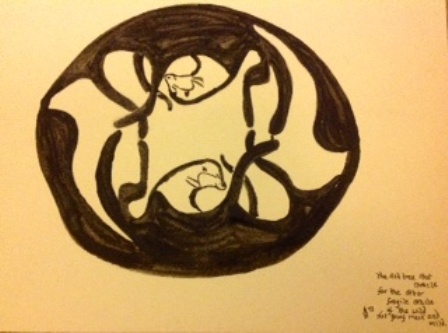
the otter sleeps in the coracle of the ash-tree roots
‘The wild otter I saw would no doubt be out of the water and making tracks to its own musky holt, to curl belly upward, in a home of roots, peat and rocks. I imagine him enfolded in his fur, dreaming of water; a tight sleep-knot, enjoying the deep sleep of one who exists totally in the moment.’ ( Miriam Darlington, Otter Country, pp.40-41)
‘Up and down the banks are the complex root systems of ash trees, which otters particularly love to use as holts as they provide hidden shelter and easy access to water.’ (Otter Country, p.175)
As I read these words I imagined the roots of the ash tree making a coracle, floating the otter to sleep in its hidden shelter. So I drew this as a coracle sleep-knot.
The ash tree root
coracle
for the otter
fragile oracle
of the wild
not going meek and mild.
#mindful skiing – feeling #flow and #contemplation
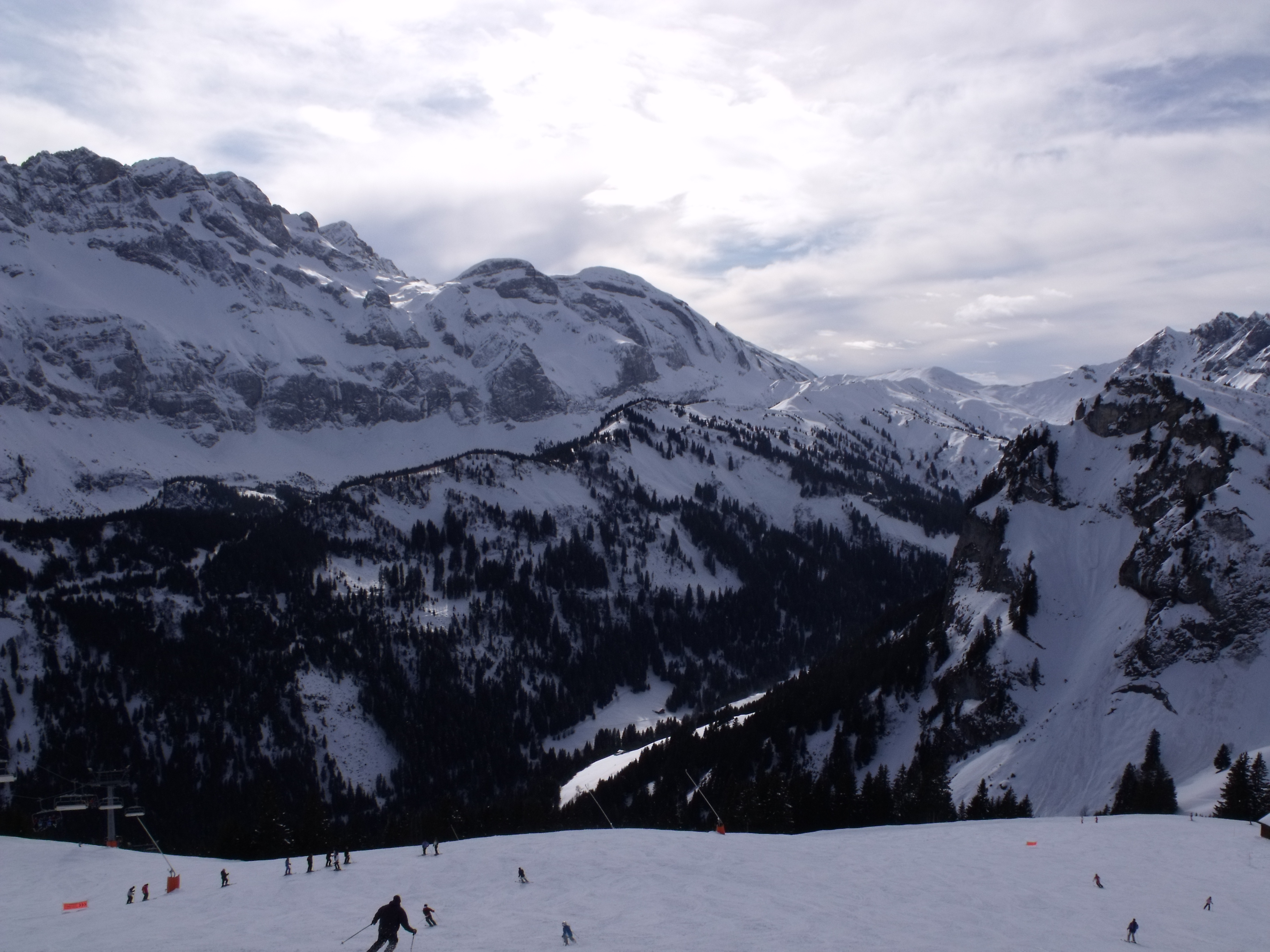
mindful skiing, feeling flow
Skiing is a doorway into the present moment and present-moment awareness. When you stand on top of that mountain with the sun in your face, the wind tugging at your jacket, the sound of silence following you, the smell of Alpine clean air, able to see the valley below you, and feeling the snow beneath your skiis, you are taken out of auto-pilot, out of ruminating about the past or the future.
You ski into the present moment, out of thinking and into awareness. It is like a wardrobe into a beautiful new land that has always been there, but we just couldn’t find the door.
There might be no visibility one day and you have to feel your way down the mountain with the soles (souls) of your feet – you are skiing on pure awareness. This is a mindful awareness practice. Your soul can express itself and feel through the soles of your feet.
I was talking about this to a group of skiers who also believe in God, and believe skiing brings them closer to God. Skiing is gloriously reality-focused like most mindful awareness practices (attending to your breath, your walking, what you eat). It enables us to experience what Mihaly Csikszentmihalyi calls ‘flow’, ‘the sense of gratification that we enter when we feel completely engaged in what we are doing.’ (Martin E.P. Seligman, Authentic Happiness, p.113)
Flow as a concept is related to mindfulness. Apparently Mihaly’s surname is pronounced ‘cheeks sent me high.’ Flow involves ‘deep, effortless involvement…our sense of self vanishes…time stops…'(Martin E.P. Seligman, Authentic Happiness, p.116) It sends us naturally high.
Skiing is intensely physical as is truly incarnated Christianity. Both pay attention to the body. Mindfulness also pays attention to the body.
The body is intelligent. The latest thinking is cognitive science of an embodied mind (Andy Clark, Being There: Putting Brain, Body, and World Together Again, MIT Press). As Christians we would agree with that, we would just want to put Brain, Body, World and God together again.
It was Pope John Paul II who said, ‘The body, in fact, and it alone, is capable of making visible what is invisible: the spiritual and divine…'(quoted in Christopher West, Theology of the Body for Beginners). As we ski in embodied minds in the mountains we begin to see the invisible, the spiritual and divine. We are present to a deeper Presence that has always been there.
redeeming the ordinary #poetry #mindfulwriter

road sign that inspired a Haiku
Though autumn wind blows/spring lake in me is greening/fear not winter snows
This is a Haiku inspired by a road sign.
Frank Cottrell Boyce is a children’s writer who said this in an article in The Daily Telegraph recently, ‘I believe my job is not to dazzle with new wonders, but to scrub off the patina of familiarity so that my readers can see again how dazzling things already are.’
He is a mindful writer.
The ordinary is dazzling. An ordinary road sign can be seen in a new light. Why don’t you look out for road signs that catch your eye and write a Haiku or some other reflection on it? Our eyes are smeared with the lard of familiarity. Seeing with new eyes requires us to access the streams of awareness in us, moving out of ruminative and automatic thinking. We often dismiss people in the way we dismiss road signs. Mindfulness is seeing the extraordinary in the ordinary.
#Otters and #Ash trees live together
I’ve been re-reading Miriam Darlington’s luminous book Otter Country: in search of the wild otter, published by Granta Books.
I noticed two phrases I hadn’t noticed first time:
‘Ash trees are most popular with otters because their roots from a complicated system of shelter below ground, and re often right by or even overhanging the water, so that the otter can slip subtly in and out.’ p.77
‘Up and down the banks are the complex root systems of ash trees, which otters particularly love to use as holts as they provide hidden shelter and easy access to the water.’ p. 175
I have been entranced by the otter following Miriam Darlington’s description of them, where it as if she has become the otter. I have been left wondering if the otter is at increased risk and threatened by the Ash tree crisis? They live together, the ash tree and the otter.
Does anyone know?
The rhythm of alternate #community
Community is a far country by Shaun Lambert
The rhythm of alternate
Mindfulness/MindFullness can be set at the centre of an alternate rhythm of life. It has an important community aspect within Christianity. It has to do with an aware and attentive rhythm of life that is alternate, that is other-focused.
When our lives are out of rhythm we suffer. If the rhythm of waking and sleeping is off-balance life becomes about mere survival. If in a marriage the rhythm of intimacy, affection and sex is imbalanced or missing then we experience emotional pain and depression. If we do not eat regularly, or we overeat or eat the wrong things we will experience ill-health as well as emotional roller-coaster rides.
But having a rhythm of life is more than just a life-work-home balance. Rhythm is built into the created order – whether it is the rising of the sun or the setting of it. Our bodies run to rhythms from the obvious heart beat, to less obvious beats.
But the rhythm of life we are seeking to establish seeks to do something else – it is a counter-cultural response to the cultural trends of our day – consumerism, individualism and narcissism. These trends make us too busy.
The wisdom about rhythms of life is to be found in the monastic movements both new and old. These rhythms used to be called rules – in the sense that they help us measure what is right and wrong.
How important is a rhythm of life? It is as important as breathing. If we do not live consistently within a spiritual rhythm of life we shall die of spiritual asthma.
There are a number of key scriptures that inform our rhythm, and should inform the discipleship of any Christian. Romans 12:2 tells us that our transformed mind becomes the rule(r) that establishes and tests the rhythm of life for us, ‘Do not conform any longer to the pattern of this world, but be transformed by the renewing of your mind. Then you will be able to test and approve what God’s will is…’
What are we to be transformed into? We find the answer in 2 Corinthians 3:18, ‘And we, who with unveiled faces all reflect the Lord’s glory, are being transformed into his likeness…’ We are looking to create an inner sanctuary that we can carry around with us into all of life. The most famous Rule is that of St Benedict. In his Rule Benedict explains how to live ‘a Christ-centred life with others.’[1]
What makes up a rhythm of life and enables us to pay attention to the priorities of Christian faith and develop the awareness that can test what God’s will is for our lives? I have been looking at different communities to see how they live together; including Taize in France, the Bose community in Italy, The Moot in London, and the mayBe community. This is to try and answer the question, can a congregation be a real community?
Over the last few months we have explored The Moot’s structure to their rhythm of life beginning with spiritual postures – that develop the awareness of God’s presence in our lives. This begins with the idea of spiritual postures. This has been influenced by a brilliant book Faith Postures: Cultivating Christian Mindfulness by Holly Sprink. To The Moot this asks how we are in the present moment, in other words our way of being, not just doing.
An obvious posture is the one that sees the glass half-empty or half-full. The foundational posture is that of faith rather than fear. 2012 has been a year of fear in many ways and we need to daily re-align ourselves with a position of faith not fear.
A posture of faith and not fear needs to make vows, have values that guide the rhythm of life. We believe in a relational God who is presence, and so we are called to be present to each other. So presence to God, to each other, and to the world is a key value that we can vow to maintain.
One of the ways we can be present together is through hospitality. It needs an intentional rhythm. Another way we can be present together is through service.
As we work on a rhythm of alternate we are seeking something elusive, perhaps something we don’t believe in. This is what Abbot Christopher Jamison calls inner freedom, ‘Sometimes the way people speak about the human heart implies that in this interior world there is no freedom, that it is a fixed world that cannot be changed.’[2]
There is freedom and we can find it.
The Moot’s address
Holly Sprink’s book
 shaunlambert.co.uk