
The mindful awareness practice of confessional walking
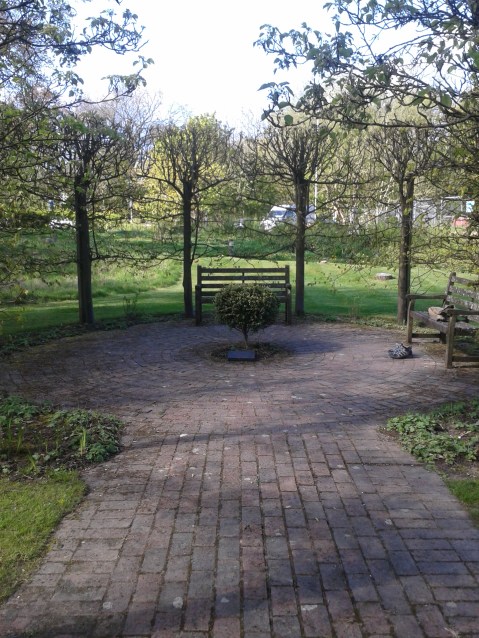
One of my favourite mindful awareness or meditative practices is mindful walking. Within the formal meditation you take a certain number of steps, with your focus of attention on the soles of your feet, the movements that make up a step, and the streams of awareness inside you that are your senses. Along with this focused attention you can cultivate an open awareness to gravity as it acts on your body as you slow your movements down, your balance, sounds around you…
You can of course go on an extended walk as a mindful awareness practice, a walk of being rather than doing. As I’ve practiced the more formal meditation, in places like this little garden in the grounds of the Royal National Orthopedic Hospital (RNOH) in Stanmore I noticed that my mind began to clear and difficult decisions became easier as if in the process of walking the negativity within was trailing out behind me.
I was reminded of a story about Desert Father Moses, which is quoted in Rowan William’s little book ‘Silence and Honey Cakes’ (p.29). In the story Moses is invited to a meeting where a fellow monk is to be judged because he has sinned. First, Moses refuses to go, and then when someone goes to fetch him, Moses takes a leaky jug filled with water with him.
When asked why, Moses replies, ‘My sins run out behind me and I cannot see them, yet here I am coming to sit in judgement on the mistakes of somebody else.’ (Williams, 29)
Moses here is talking about the existence of our sinful trail through life as a negative reality. However, through my experience of mindful walking I’ve realised we can use such a walk in a contemplative way, where we intentionally allow what has been sinful in our life, the mistakes, to run out behind us in confessional awareness – to bring us to a state of forgiveness in our relationship with God.
This active way of contemplating through a walk, may help us to actually let go of our mistakes, and when we have noticed them, asked and received for forgiveness – actually move on, rather than clinging endlessly in negative rumination to those mistakes.
In the process we arrive, not at a place of self-critical judgement, or a projected judgement of others, which Jesus himself asks us to leave behind (Matthew 7:1-5) but a place of clear seeing in which we can take the ‘rain forest’ out of our own eye before we try and take the speck of dust out of someone else’s eye.
Fear and anger, guilt and shame stop us seeing clearly, and silt up our ability to respond wisely to our mistakes. In our contemplative and confessional walking, we can let this silt run out behind us. Usually, then, we can find a place of wisdom and compassion and freedom rather than fear and continued slavery to our sinful habits.
You do not need to take a hammer to clay- #mindful non-judgemental compassionate attention

As I look at the mountain and draw it meditatively, as a mindful awareness practice I can find a creative space. In that space little creative seeds emerge.
I saw the stone hammers of time had shaped archetypal triangles and squares that made a larger whole, as one might hammer a hang drum into musical shapes. The colours that emerged were not there visibly, but invisibly, the colour of feelings.
Take 15 minutes out of clock time and with pencil,or pen try to recreate the shapes. Focus your attention. As your mind wanders notice what it wanders to and bring it back to the drawing. This noticing is meta-awareness. If you have time, what colours would you paint the mountain?
Having a collection of water colour tubes that you play with on paper enables you to find your feelings. It’s a worthwhile investment.
When I do a meditative drawing exercise with people it is often the most revealing of all. What often emerges clearly is negative self-judgement…’I can’t draw, I’m not an artist…I’m useless at this.’ In the meditative drawing as you exercise your muscle of attention it is about the process not the outcome, but often we jump straight to negative judgement of the outcome.
We often give these negative thoughts the status of being an accurate readout of reality. And so we take them like stone hammers to our plastic brain. These thoughts are not an accurate readout of reality, they are passing events in the mind, like clouds that need to be noticed compassionately and non-judgementally and let go of. Do this and the stone hammer dissolves.
You do not need to take a hammer to clay.
contemplative seeing, the mindful study of painting…
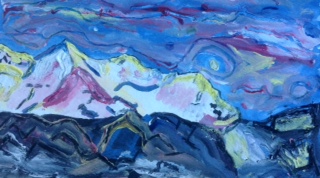
The silent mountain is passionate
Mirabai Bush talks about contemplative seeing, ‘the mindful study of painting and sculpture as ‘beholding” (which involves appreciation, care, the involvement of our senses). We are able in beholding to ‘hold’ something in our attention until something emerges into our awareness.
I called this painting ‘what the mountain was feeling..’ it came out of beholding this particular mountain range. What then came out was ‘the silent mountain was passionate.’ Of course, contemplative seeing is not limited to painting and sculpture, for me it began with the contemplative seeing of the mountain.
Taking time to behold means that time can open up and we can have a moment of clear seeing, an epiphany.
#mindfully choosing the palette of colour you paint with..
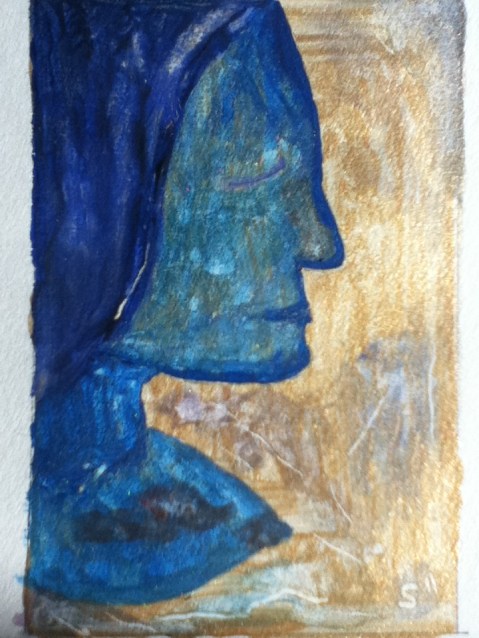
I was leading a retreat at Worth Abbey on watchfulness over the weekend. On the Sunday morning I got up early and walked to the Abbey Church at 6.15. There is very little light pollution and the night sky was very open.
The stars beckoned me to look at them, stopping me in my tracks. Their beautiful silence brought tears to my eyes. I have always liked the Don McLean song Vincent (starry, starry night) about Van Gogh. The opening lyrics came into my head as a refrain:
‘Starry, starry night,
Paint your palette blue and gold…’
The rational part of my brain said, ‘the words are not right’. The actual words are:
‘Starry, starry night,
Paint your palette blue and GREY..’
But a voice came back to me saying, ‘no, you paint your palette blue and gold.’
It felt like a message from the stars for the New Year.
For me blue speaks of faithfulness and stability and sticking with people, God, the way of watchfulness and mindfulness. Gold speaks of the brightness of hope.
What mindfulness has taught me is that I can choose the palette of colours I paint my life with. Each thought and feeling has its own colour. Sometimes I have painted with grey, allowed depressed thoughts to become a ruminative pattern in my mind. I have learnt that they are passing events in my mind, that they are not me and that I can let them go.
As I have noticed them and let them go, blue and gold thoughts have sprung up. The message of hope came as a gift from the stars, ‘paint your palette blue and gold…’ I can mindfully choose the palette of colour I paint with. And so can you.
#mindfulness and the selfie
An early 21st century word in the news recently is selfie. The Oxford Dictionary defines it as follows:
‘a photograph that one has taken of oneself, typically one taken with a smartphone or webcam and uploaded to a social media website.’
It is often perceived to be narcissistic, a photo taken with the lens of the ego. But it is not a new phenomenon, it is an outer reflection of something that happens internally all the time. We are constantly taking ‘selfies’ in our minds. But we don’t just take them with the lens of the ego.
Acceptance and Commitment Therapy (ACT), a mindfulness incorporating therapy talks about cognitive fusion, where we look at life from our thoughts. Each thought can be a little selfie. Here are some examples from Steven C. Hayes book Get Out of Your Mind & Into Your Life (p.57):
- I am so depressed
- I am so anxious
- I am so tired of being in constant pain
The problem with this as Steven Hayes points out is ‘Cognitive fusion means you are taking these statements as literal truths and, eventually you begin to believe that you, in fact, are your pain.’ (p.57).
The antidote is to look at your thoughts rather than look at life from your thoughts. This is cognitive defusion. If we look at our thoughts and say ‘I am having the feeling of sadness’ (p.75), this is a more accurate picture of reality than the fused selfie ‘I am sad.’
As we step back and observe our thoughts we disarm them and they begin to dissolve. This is part of being mindful. The central insight of mindfulness, from the perspective of secular psychology, Buddhism or Christianity is the realisation that I am not my thoughts, that I am bigger than my thoughts, that my thoughts are just passing events in the mind.
So we can say the following:
- mindfulness is not a selfie taken through the lens of ego it is a reperceiving of the self taken through the lens of awareness
- mindfulness is not a selfie taken through the lens of self-hatred it is a reperceiving of the self taken through the lens of mindful compassion
- mindfulness is not a selfie taken through the lens of anxiety it is a reperceiving of the self taken through the lens of cognitive defusion
Our culture’s current preoccupation with selfies is a sign that we need mindfulness and mindful awareness practices.
The four steps in the dance of #mindful attention
In a little article on the Mindful website recently Daniel Goleman highlighted the dance steps of the mind in most meditations: focusing our attention, the mind wandering, noticing that the mind has wandered and what it has wandered to, and removing it from where it has got attached and returning to your focus of attention. Daniiel Goleman points out that there are four things going on in this dance : focused attention, mind wandering, meta-awareness which notices your mind has wandered and detaching from where the mind has wandered and bringing it back.
I noticed that the four steps of the dance began with four letters that make a mnemonic of two parts, F.M. & M.D.
- Focused Attention
- Mind wandering
- Meta-Awareness which notices your mind has wandered
- Detaching from where the mind has wandered and bringing it back
I don’t know what these two sets of initials bring to mind for you? Reflect on them a moment. What they bring to mind for me is this.
F.M. I associate with radio stations and tuning in to them. So the steps of Focused Attention and Mind Wandering are about tuning in and out from the frequency of our focus. What is fascinating about Daniel Goleman’s article is that he points out each of these steps involves a different circuitry in our brain.
M.D. I associate with Doctors and healing, a Doctor of Medicine. The healing of our minds and re-sculpting of our brains occurs through these steps of the dance of attention.
The point of the mnemonic is simply to help us remember the four steps of the healing dance of attention. Launch that boat of attention and begin to dance in the sea of awareness.

Remember to be reclothed in #mindful beauty

Many of us at a Remembrance Day service may have sung the great hymn ‘Dear Lord and Father of mankind’.
It is about finding a place of stillness, a contemplative mindful place – where we can sense God’s presence and hear His voice.
But it also speaks to me about what are some Christian distinctives about being mindful.
The first distinctive comes in the first verse where we sing, ‘re-clothe us in our rightful mind.’ Christians believe there is a shape to this right mind, both ethically and in terms of the values we live by. This shape is the very mind of Christ HImself (1 Corinthians 2:16).
But that mind has to be developed through contemplation, the re-clothing takes a lifetime of contemplating God mindfully. It leads us to a life of sacrifice and service lived for others.
The second distinctive that speaks to me through this hymn, is the idea that Jesus sees all things with the Father, ‘interpreted by love!’ ( verse two). This mind of Christ as it is developed in us, our right mind, sees the world ‘interpreted by love!’ The perfect love of God interprets, sees things, truthfully and with absolute clarity.
It is fear that takes us out of our right mind, and it is God’s perfect love that drives out fear (1 John 4:18).
the #mindful story of the (still) music of our minds

hearing the song
I have also been watching Howard Goodall’s Story of Music on BBC 2, The Age of Invention (1650-1750), and was enraptured with the performance of Antonio Vivaldi’s Four Seasons. I thought, surely this has been played somewhere in the world every day since 1723? Surely the world could never grow tired of listening to it!
I was surprised to hear that Vivaldi ended his days in his sixties in obscurity and poverty in Vienna, having left his beloved Venice, and that his music lay silent for nearly 200 years.
We all have these automatic assumptions. For example, surely New Year has always been celebrated on January 1st every year? According to Stephen Alford’s book The Watchers: a secret history of the Reign of Elizabeth I, January Ist as the first day of the New Year didn’t get adopted in England until 1752.
In the same period between 1650 and 1750 when the laws of gravity were discovered by Isaac Newton, Howard Goodall says musicians became aware of and began playing with the gravity of music. In particular he places one sequence of chords, ‘The Circle of Fifths,’ at the centre of musical gravity. In fact the dozen or so chord sequences beloved of composers in 1700, are, he says, still the top dozen harmonic sequences today.
Religion played its part in the discovery and invention of music, as it did in the discovery of the gravity of attention and awareness. All major religions played a part in this earlier age of discovery and invention of contemplative practices.
As I look at this gravity of awareness and attention, these archetypal chords of the mind, this still music within our thoughts and feelings – I think, surely the church has always been aware of this?
However, as Vivaldi’s Four Seasons fell silent and out of favour, so in the Western Church did this central area of attention and awareness. Watchfulness was once considered the hallmark of sanctity and holiness in the Christian life, but not so in the modern church. It has taken those outside the church, psychologists in particular, to mine the ancient wisdom of the contemplatives.
The modern church has limited itself to a meagre diet, the few notes that sound out reason, and rational, logical propositional thought, and has lost the ancient harmonies, melodies and rhythms of mystery. Indeed mystery and contemplation for some has been seen as forbidden fruit. We have become more harpsichord than piano, unable to play loud and soft.
So what are the archetypal chords of the mind?
The first is the ability to sustain our attention. When our mind wanders off on a ruminative tune, we notice that wandering, and what it wanders to, and switch our attention back to our object of focus. The aim is to catch the first thought as it sounds out, and not allow ruminative and secondary thought processes to write their own music, usually out of tune and discordant.
Within this pattern and in the infinite circle of the present moment we move from focused attention to a more open awareness. It is in that more open awareness as we still our minds that we begin to hear the music of God’s presence. We hear the seductive notes of the addiction to our own ego. We begin to hear the sounds of other people and the created world around us.
What is particularly interesting as you look at the history of composing, whether it is music, books, sermons, art, is that many Christians were involved. Many of them approached this act of composing as a ‘meditatio’, a meditation – and out of this approach came the most dazzling creativity.
Why do we need to rediscover the still music of our minds through contemplative practices? Through these archetypal chords of attention and awareness beauty is discovered and released, the visible is placed at the service of the invisible. In this new ecstatic seeing of reality, we are enabled to hear, in the words of William Blake, the song of the angel, the song of the wild flower.
The therapeutic Lindisfarne dragon emerges #mindfully
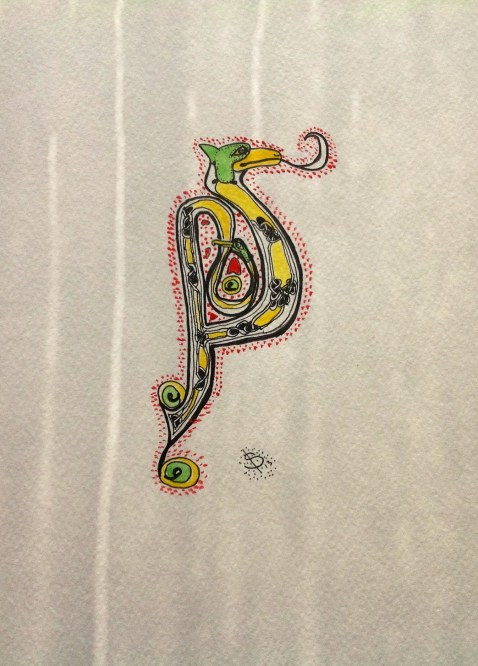
A meditative drawing is an act of discovering our embodiment mindfully.
Mind shift from doing to being at Worth Abbey 6-8 September
I will be drawing on my experience in the banking world, counselling and psychotherapy and the world of ministry to help those in the workplace explore and understand their own stress levels, the archetypal relationships that exist in work with others, the importance of releasing creativity through contemplative practices that enable a ‘mind shift’ into inner freedom and flow.
 shaunlambert.co.uk