
The rhythm of alternate #community
Community is a far country by Shaun Lambert
The rhythm of alternate
Mindfulness/MindFullness can be set at the centre of an alternate rhythm of life. It has an important community aspect within Christianity. It has to do with an aware and attentive rhythm of life that is alternate, that is other-focused.
When our lives are out of rhythm we suffer. If the rhythm of waking and sleeping is off-balance life becomes about mere survival. If in a marriage the rhythm of intimacy, affection and sex is imbalanced or missing then we experience emotional pain and depression. If we do not eat regularly, or we overeat or eat the wrong things we will experience ill-health as well as emotional roller-coaster rides.
But having a rhythm of life is more than just a life-work-home balance. Rhythm is built into the created order – whether it is the rising of the sun or the setting of it. Our bodies run to rhythms from the obvious heart beat, to less obvious beats.
But the rhythm of life we are seeking to establish seeks to do something else – it is a counter-cultural response to the cultural trends of our day – consumerism, individualism and narcissism. These trends make us too busy.
The wisdom about rhythms of life is to be found in the monastic movements both new and old. These rhythms used to be called rules – in the sense that they help us measure what is right and wrong.
How important is a rhythm of life? It is as important as breathing. If we do not live consistently within a spiritual rhythm of life we shall die of spiritual asthma.
There are a number of key scriptures that inform our rhythm, and should inform the discipleship of any Christian. Romans 12:2 tells us that our transformed mind becomes the rule(r) that establishes and tests the rhythm of life for us, ‘Do not conform any longer to the pattern of this world, but be transformed by the renewing of your mind. Then you will be able to test and approve what God’s will is…’
What are we to be transformed into? We find the answer in 2 Corinthians 3:18, ‘And we, who with unveiled faces all reflect the Lord’s glory, are being transformed into his likeness…’ We are looking to create an inner sanctuary that we can carry around with us into all of life. The most famous Rule is that of St Benedict. In his Rule Benedict explains how to live ‘a Christ-centred life with others.’[1]
What makes up a rhythm of life and enables us to pay attention to the priorities of Christian faith and develop the awareness that can test what God’s will is for our lives? I have been looking at different communities to see how they live together; including Taize in France, the Bose community in Italy, The Moot in London, and the mayBe community. This is to try and answer the question, can a congregation be a real community?
Over the last few months we have explored The Moot’s structure to their rhythm of life beginning with spiritual postures – that develop the awareness of God’s presence in our lives. This begins with the idea of spiritual postures. This has been influenced by a brilliant book Faith Postures: Cultivating Christian Mindfulness by Holly Sprink. To The Moot this asks how we are in the present moment, in other words our way of being, not just doing.
An obvious posture is the one that sees the glass half-empty or half-full. The foundational posture is that of faith rather than fear. 2012 has been a year of fear in many ways and we need to daily re-align ourselves with a position of faith not fear.
A posture of faith and not fear needs to make vows, have values that guide the rhythm of life. We believe in a relational God who is presence, and so we are called to be present to each other. So presence to God, to each other, and to the world is a key value that we can vow to maintain.
One of the ways we can be present together is through hospitality. It needs an intentional rhythm. Another way we can be present together is through service.
As we work on a rhythm of alternate we are seeking something elusive, perhaps something we don’t believe in. This is what Abbot Christopher Jamison calls inner freedom, ‘Sometimes the way people speak about the human heart implies that in this interior world there is no freedom, that it is a fixed world that cannot be changed.’[2]
There is freedom and we can find it.
The Moot’s address
Holly Sprink’s book
Rare Sharing OtteR tracked to British Library #ecology
Rare sharing OtteR tracked to British Library. Read about how OtteRs share their country with us in Miriam Darlington’s Otter Country and how we can share their country with them. For OtteRs swim where they will.
http://www.amazon.co.uk/dp/1847084850/ref=pe_25661_32502941_pe_vfe_dt1

Sharing OtteR found at British Library
autumn leaf-thoughts #mindfulness

autumn leaf-thoughts
What autumn leaf-thoughts are you clinging on to, that you now need to let go? Something from the past? Autumn leaves tell us that now is the time to let go of many of our unhelpful thoughts we no longer need to ruminate on. Sometimes they are well camouflaged and we don’t spot them.
Thought-boats #mindfulness

thought-boat
Which thought-boats that come into your mind do you hook onto the most, and start ruminating about?
#mindfulness is not minefulness – a minefield…
Mindfulness is not minefulness – a minefield as some Christians think, any more than religion is to blame for all the ills in the world. Those who are suspicious of it are to be welcomed though, for the difficult questions they might want to ask. Nothing should be unquestioned, accepted automatically. In psychology, we are always saying, do no harm.
Mindfulness is not a South Sea Bubble, soon to collapse and to be found empty of meaning, it is here to stay and it has real substance to it.
Mindfulness is not a bringer of world peace, and it is not the silver bullet to solve all the ills of our world and minds. But mindfulness is a universal human capacity, for we have a mindful brain. Although we often fail to remember to access that capacity for awareness and attention.
Mindfulness is a rapidly changing field. It needs to be examined with the rigour of evidence-based research, although those who work in that way do not have exclusive access to truth. Ordinary people have mindfulness and observations to make that could make all the difference. Theology will have something important to say as well. All the mindfulness-based and mindfulness-incorporating therapies coming out of mindfulness are different and need to be individually assessed and critiqued. They cannot be lumped together
Let’s not let the professionals take complete ownership of mindfulness, it should not be taken out of the hands of reality-focused poets, carpenters, fishermen and women, artists, contemplatives and mystics. It should help us see through consumerism and narcissism not be used as a tool of these things.
The ancient wisdom of religions has been dismissed by many in the West. It is now being rediscovered. What other hidden gems are there in the ancient paths? For Christians, mindfulness of God is central, along with reality-focused self-awareness.
It has been secularised, it is being rediscovered in Christian contemplation, Buddhists are asking how can they bring their wisdom to modern culture in a way that is different to secular psychology. Cognitive psychology and neuroscience have been looking at consciousness, awareness and attention before they ever heard of mindfulness.
If mindfulness (to rephase Goethe) is the liquid architecture of our mind, there is much more yet to be said. Is there a question not yet asked of it, and who will ask the question?
If mindfulnes is one of the central human capacities because we have mindful brains, how else can it be used? What other mindful awareness practices can be developed that help us cultivate mindfulness?
I for one, want to encourage Christians to be part of the dialogue in an intelligent, respectful and discerning way. One of the problems is that many comments about mindfulness are uninformed. Here is a good website which pulls together all the evidence-based research that outlines the benefits of mindfulness.
Want a thousand new followers? Read the #Narcissist’s Creed
A NERVE got hit metaphorically speaking as I was reading a book about creeds like the Caesarean creed, and the Jerusalem creed which influenced the Nicene creed.
I felt the nerve tingle because I had just been reading the psychologist Erich Fromm about the marketing creed of western society.
The marketing society’s creed says all that is good exists outside of one’s self, and one’s self is defined by what we possess, not by who we are. It is only when people believe this creed and live it out by becoming ‘homo consumens’, a total consumer, that the marketing society can continue to survive. Everything then becomes narcissistic, and so the #narcissist’s creed is born.
In much of the Western church we have become consumers of worship, rather than people consumed by worship, even though we hide that unpalatable truth behind biblical sounding words.
I am always fascinated by stories of fragments of ancient documents that are found. Some years ago in the Egyptian desert a fragment of the Nicene-Constantinopolitan creed was found, and some scholars believe it may have been used as a sort of ecclesiastical charm bracelet.
In our consumer world God has become a sort of ecclesiastical charm bracelet, who will give us health, wealth, prosperity, and ensure that nothing bad will happen to us, who are of course, ultimately good people.
I wondered if maybe in a thousand years time fragments of the new creed of the church would be found, buried beneath the remains of a shopping mall cathedral, perhaps to be called, the Blue Water fragment of the Niceme creed.
I call it the NiceMe creed because it sounds almost authentic. Also it summarizes the main tenets of Niceme Christianity. I am ‘nice me’ not sinful me. God exists to be ‘nice to me.’ God being nice to me involves me never suffering or having pain, having the right house, car, clothes, children etc. God is nice to me by allowing me to take and not to give, and to walk away from relationships and churches if they fail to meet my total consumer demands. This is the creed of the narcissist.
As this creed is implicit and ought to be recorded for prosperity, I took the liberty of beginning to write it down. The Niceme creed:
I believe in One God, the Father of niceMe, who has made heaven and earth for niceMe, and all things visible and invisible for niceMe. I believe in one servant Jesus Christ, begotten of the Father, before all worlds to serve niceMe in the marketing world.God for niceMe, light for niceMe, very God of very God for niceMe, beholden to niceMe. Who for niceMe and my happiness came down from heaven, and was incarnate by the Holy Spirit of the virgin Mary, and was made man solely to meet all my niceMe needs and wants. He was crucified also for niceMe under Pontius Pilate; he suffered and was buried that niceMe might never suffer pain; and the third day he rose again, according to the Scriptures; and ascended into heaven, and sits on the right hand of the Father, that I might be transformed into homo consumens. And he shall come again, with glory, to judge those who haven’t met my wants and needs, so that my niceMe kingdom might have no end.
This is just a fragment and it may be that there may be other versions of it in each of the great consumer centres of this marketing world that need to be made explicit.
Of course, this creed is something that the marketing society does not want made explicit. And it may be that copies of it will be seized and burnt, and that it becomes an offence to publicize the Niceme creed.
I understand that in the early church during times of persecution the Scripture would be seized and burnt, and that ministers who surrendered the Bible to the authorities were stripped of the right to be ministers by the church.
I hope the same spirit of resistance can be found somewhere in the church!
Erich Fromm wrote about this in 1955, and his words are prophetic and should have sparked a reformation of the church to avoid becoming homo consumens within church culture.
I wonder if we went even further back to the early Church fathers and their reflections on Scripture which took creedal form, we might be able to see the Niceme creed more clearly as it works its influence in our worship services and ‘just the minimum requirement’ and ‘just looking the part’ discipleship.
If Fromm’s analysis is correct, which I believe it is, then the big danger for pastors as Eugene Petersen puts it, is that ministers become shopkeepers.
As the only safe way to transform the church is to begin by transforming me, I am going to look and see if over the last 15 years I have been more a shopkeeper promoting the Niceme creed, or somone who by attentively reading the Nicene creed becomes someone for others not someone for me. And maybe Someone else will get the followers if we follow the right creed.
‘The Quiet Girl’ by Peter Hoeg, one of best books ever written? #goodbooks
Peter Hoeg the Danish author has a new book out called The Elephant Keepers’ Children. I am about to buy it, but I was surprised to read in the Telegraph’s Review section (Saturday October 6) that his novel The Quiet Girl published in 2006 had been poorly received.
I think The Quiet Girl is the most satisfying novel I have read as an adult (best nature book ‘Otter Country by Miriam Darlington). A contemplative approach apparently informs his working practices, and that would suggest to me that The Quiet Girl was ahead of its time. With Rowan Williams, the Archbishop of Canterbury stressing the centrality of contemplation as a key to renewed humanity and a new way of seeing in recent weeks, The Quiet Girl deserves another look.
One of the things I like about the book is the way the author sees and hears the world. The book is impossible to classify in terms of genre. It is like a riddle, and like all good riddles I am not going to try and explain it.
The main character, Kasper, like the author, is deeply attentive to the world. There is a razor sharp discerning, balanced with an open awareness to the things our culture offers us, both low and high. Kasper knows things. He knows the mystics, the clowns, the philosophers, the composers alongside knowing alcohol inside out, the holes in our souls, and the shadows that accompany us.
It is a spiritual book as well as being deeply focused on material reality in all its mysteriousness. It is both aware of icons and orthodoxy, and also for some it will seem iconoclastic and unafraid of heresies. The Quiet Girl has one of the best opening lines I have read. ‘SHE ALMIGHTY HAD tuned each person into a musical key, and Kasper could hear it.’ Everything flows out of this opening key.
Peter Hoeg knows music, and makes the reader want to know music in the same way, to indwell it as Kasper does. He recognizes an ‘icon of sounds’ when he hears it. There are throwaway lines on prayer, the ego and being special, on philosophy and music that are worth the price of the book alone as meditations.
But I come back to the seeing. This is a book written by a contemplative human, and it is the most satisfyingly complex and deeply human book I have read as an adult. In 2006 it may have fallen quietly to the ground. But today? Today I think it will begin to resonate. As for the heroine, the quiet girl herself, I will give nothing away. Read it and see for yourself. Find the silence.
The Jesus Prayer -#the jesus prayer #contemplation
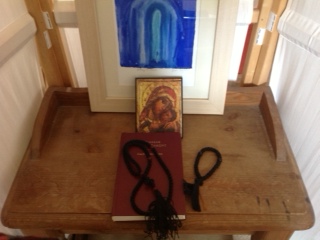
Just before my first sabbatical seven years I was stressed, anxious and near to burn-out. I hadn’t fully realised this, but just a few weeks before I was due to start the sabbatical I was lying in bed, and suddenly I felt this big ball of anxiety come out of my stomach, through my body, and out of my mouth. It was like a showing from God I was suddenly aware of the anxiety I had been holding down.
Then in a bookshop Simon Barrington Ward’s book The Jesus Prayer lept off the shelf at me. The book and the practice of the Jesus Prayer, helped me enormously, as did some conversations with Bishop Simon (formerly Bishop of Coventry), when doing some interviews for the Baptist Times. Mark’s Gospel also became a book of healing for me.
When I began to use the Jesus Prayer it acted very like some of the Celtic prayers, as a circle of protection. For a while it kept at bay the feelings of anxiety or the afflictive thoughts that were troubling me. But if you read the writings of the Desert Fathers and Mothers you find out there are some thoughts (and in the end all thoughts) that you can’t keep at bay. They called these the Eight Afflictive Thoughts, which became trivialised as the Seven Deadly Sins.
These were pride, anger, lust, gluttony, acedia, sadness, greed and vanity. At some point, as these thoughts are kept at bay for a while, we realise that we are not our thoughts, that we are bigger than our thoughts. If we are aware that we can take them captive, that relativises them – they are smaller and less powerful than we think. They are not the powers and authorities that they can become in our minds. By characterising these afflictive thoughts as demons, the Desert Fathers and Mothers achieved this observing distance from their thoughts; they relativised them in that way.
Mark tells us that one of the reasons we fail to see and hear and understand the mystery of the kingdom, the key to real living, is that we have hard hearts. Jesus asks the disciples, ‘Are your hearts hardened?’ (Mark 8:17) when they fail to understand the feeding of the 5,000. Contemplative practices like Lectio Divina and the Jesus Prayer enable us to open and soften our hearts – that is why they are so applicable to helping us become the disciples Mark wants us to be.
At some point we have to move from the Jesus Prayer acting like a protective circle, to something more like a fragile coracle in which we enter the sea of our thoughts and feelings and the wider world and God. We move out of the harbour into the open sea. The harbour is the place of experiential avoidance, the sea is where we engage with what we have been hiding from, what we have run from, what we have pushed down out of our awareness. We move from a place of narrow concentration to a place of open awareness.
From a psychological perspective, the disciples in Mark are guilty of experiential avoidance. When Jesus talks about the way of the cross and predicts His passion, Peter rebukes Him (Mark 8:32). He has to remind them twice more, in Mark 9 and 10, and then again in chapters 13 and 14. Watchfulness is facing reality, not running away from it, or pretending something else is reality – like being the greatest, saving one’ s self, or gaining the whole world.
Experiential avoidance is a psychological process that seeks to avoid what we believe will be painful feelings, thoughts, memories and bodily sensations within us. It causes us problems psychologically. For example, in times of conflict I would avoid facing the experience of my anger. I would end up with very tight neck and shoulder muscles that could go into spasm.
But when I faced the anger and the cluster of thoughts, feelings and bodily sensations with it, the anger did not seem to be such a fearful power and authority as I thought it was. I have often tried to avoid anxious feelings by keeping busy. But as the Jesus Prayer helps us to slow down and still ourselves, we become aware of what we have been avoiding.
How do we begin with the Jesus Prayer? It is important to pay attention to the body. Posture is important, and the way we sit. I find a prayer stool or a straight-backed chair where one can sit relaxed but in a good frame is important. Where we sit is also very important. Chose a place you can return to again and again that has no distractions. We can also pray the Jesus Prayer walking somewhere, or out in the world doing something else.
Traditionally in the Jesus Prayer, the first half of the sentence is prayed on the in-breath – ‘Lord Jesus Christ, Son of God,’ – and the second half of the sentence is prayed on the out-breath, ‘have mercy on me, a sinner.’ The breath is neutral, it belongs to no particular religious group. Breathing is something we all do, and we take it with us wherever we go. That makes it a useful aid in our prayer life. When we are anxious we often over-breathe, and this rhythmic use of it in the Jesus Prayer slows our breathing down.
I find that I repeat the prayer in cycles of 25, with a pause in between the cycles to offer prayers for whatever comes to mind, or simply to be in open awareness or contemplation of God’s presence. Beginning with four cycles is a good start.
It takes time to learn to move out of the harbour and experiential avoidance into the open sea, in the coracle of the simple prayer. In Mark’s gospel we are made aware of our incompleteness and need to be open to God at all times. The Jesus Prayer brings us to that point as well. Mark’s gospel teaches us perseverance – what has been called ‘deep practice’. Those who master a craft are distinguished by how much time they spend in practice, not by their innate ability. A concert pianist will have done on average 10,000 hours of practice to arrive at that level of skill. The Jesus Prayer reminds us about the need for ‘deep practice’. However, God in His grace may give us moments of epiphany that keep us praying in this way.
The best little book on The Jesus Prayer is Simon Barrington Ward’s, see the links here: http://www.amazon.co.uk/The-Jesus-Prayer-Simon-Barrington-Ward/dp/1841015881 and here http://www.brfonline.org.uk/9781841015880/
I have collected many books on The Jesus Prayer over the last few years, and will post some details in future articles. May it lead you into healing and the presence of God as it did for me. If you use the Jesus Prayer I would love to hear from you and start a dialogue, or if you are interested in using it.
Killing our children softly #consumerism
 WE ARE killing our children softly with the song of consumerism. It’s a deadly lullaby that stops us seeing the world dying around us. It weaves a shroud around us that wraps us up in a closed system of thinking. This virus that some name affluenza is more contagious than swine flu. But how does it spread?
We need to begin by washing our hands after every advert. Big business uses the applied research of consumer psychology to manipulate powerful and nonconscious psychological processes in us so that we will buy their particular products but also adopt a consumer lifestyle.
Studies show that much of consumer behaviour is automatic and unexamined. This leaves us open to being controlled, and advertising and marketing strategies try to strengthen that automatic thinking because it leads to over-consumption. It is critical and observant thinking about our patterns of consuming that breaks the unthinking patterns of over-consumption. It is here that mindfulness can have an ethical component.
As we vegetate in front of the TV information is processed on autopilot, mindlessly. Advertisers know this and seek to exploit it. It is clear that big business has been very good at reshaping us into over-consumers.
Advertising is adept at creating this closed system of thought whereby the consumer believes shopping is the only answer to his deep desire for fulfilment. Sadly many spiritual answers are also now packaged as consumer products.
One of the main ways advertisers form our preferences is through the use of exposure. I exaggerate but if you take a popular programme like The X Factor it feels like there is now 30 seconds of singing followed by 15 minutes of adverts.
The other key technique is conditioning. In conditioning the product, which might mean nothing to us, is paired with something that we do desire and the advertisers hope that we make an association between the two stimuli. For example there was an advert which appeared before the 9 p.m. watershed which had a partially naked woman advertising a product for bleeding gums. A classic piece of crude conditioning.
Consumerism is a cruel master. Beneath the promise of well-being in each advert and marketing campaign is the whisper of fear that slides through our letterboxes, creeps into our homes and heads, hearts and beds. Without this you will be nobody. Without this no one will like you.
It is for no small reason that Jesus tells us we cannot serve two masters.
The effect on our children is as bad as anything imagined by Philip Pullman in his Dark Materials trilogy, where childrens’ souls are cut away. What can we do about it?
It is important as parents to watch the TV programmes our children watch. We can teach our children to turn the sound down when adverts come on, or we can sit with them and help them deconstruct the adverts.
It is possible to retrain our minds, for example people are much more aware of ethical issues to shopping, whether it is fair trade or child labour.
As Christians Jesus tells us we can either be cross-bearers or consumers but not both. The cross is many things, but as Martin Luther said, Crux probat omnia – everything is put to the test of the cross. Only by putting our consumer patterns to the test of the cross can we break the habit within us of mindless and automatic consumption. In the same way the cross helps us develop the habit of sacrificial and generous giving and a simpler lifestyle.
It is through the cross that we reach the crown of fulfilment and life in all its fullness. Unless we address this deep desire for fulfilment and the real reasons for inner emptiness the quick fix offered by the world of advertising will continue to allure us.
As usual we often have the answer but are not aware of it. Research also shows that a sense of connectedness and belonging to a community gives a us a sense of fulfilment thereby breaking the consumer mentality that grips us.
As Paul says the hour has come for us to wake up from our slumber (Romans 13:11). If our average tithe as Christians measures our wakefulness, we are only 2 ½ % awake to God, and 97 ½ % consumers. Be aware of affluenza. Protect yourself. Protect others.
 shaunlambert.co.uk