
One-Minute Icon – Guitar of the seas #conservation
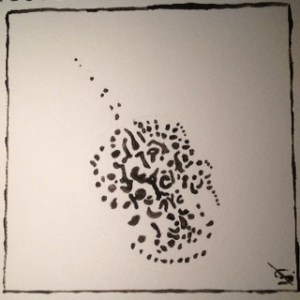
Guitar of the seas
Step out of clock time for one minute. Gaze at the painting. What do you see? Art like poetry helps move us from doing to being, from freighted thinking to open awareness, gets behind our defences…allows hidden things to surface in our minds.
What do you see? What came into your mind?
I spent the afternoon with some friends at the SEA LIFE London Aquarium which does a huge amount for marine conservation. It was amazing to see all the unbelievable creatures…but I was also shocked at story after story of how we are threatening their ecological future, from sea horses to turtles.
When I looked at the stingrays I saw guitars of the seas.
One-Minute Icon: inner #sanctuary

Inner sanctuary
Paintings like poetry can shift our mental gears from doing to being, from thinking to awareness, from autopilot to mindfulness, from self-preoccupation to contemplation of God, which becomes love for others and the creation around us.
Step out of clock-time for one minute and focus your attention on the painting. As your mind wanders allow yourself to become aware of the noise in your head, the afflictive thoughts, the self-preoccupied narratives. Allow the volume on those thoughts and feelings to be turned up. Become aware of the silence in the painting. You can click on the picture to make it bigger.
As I was praying this morning I came across this painting I had done in France a while back. As the rain beat down outside, and it looked like we wouldn’t see the sun today I suddenly wanted to be in this bright summer place in France. But then I also thought: this is a picture of what my inner sanctuary could look like. My inner sanctuary doesn’t have to be grey like the external world was this morning.
How do we create this inner sanctuary? If you want a good book to begin, read Father Christopher Jamison’s ‘Finding Sanctuary’ (see attached link). What are some of the building blocks? Virtue…silence…meditation and contemplation…
One-minute Icon – #play as important as sleep
 Take a minute out of clock-time. Look at the painting. When your mind wanders, note what it is wandering to, and switch your attention back to the painting. Try to find a place of open awareness rather than thinking (which paintings and poetry enable). What came to mind?
I was reading about the importance of play in one of the late Howard Clinebell’s books. Then in Miriam Darlington’s playful Otter Country I read about the ability of otters to take on the colour and texture of the water around them, ‘the water on the fur produces a blur effect, reflecting light and giving a strange soft focus. It’s not just the otter’s colour that keeps it hidden; it also uses the water and light to its advantage.’ (p.248)
I decided to play around with the colours of otters and the water they live in. What about snow otters? You don’t have to be an artist to play around with colours on a piece of paper, it can be a meditative or revealing act. The colours we instinctively chose might tell us something about our mood.
When was the last time you played?
In a book called ecotherapy – healing ourselves, healing the earth, the late Howard Clinebell quotes from a psychiatrist Stuart L. Brown on the ‘playful behaviour of both young and adult wild animals from the Arctic to Africa. He discovered how remarkably playful animals are, including creatures as diverse as polar bears, elephants, wolves, zebras, leopards, dolphins, cranes, and chimpanzees.’ (p.230) I have no doubt this includes otters. He concludes that ‘exciting studies of the brain, evolution, and ethnology or animal behaviour, suggest that play may be as important to life – for us and other animals – as sleeping and dreaming.’ (p.230)
Brown went on to study what happens when human beings are deprived of play….’Brown studied 26 convicted murderers in Texas and found that 90 percent of these men had largely playless childhoods or played only in destructive ways like bullying and cruelty to aniimals.’ (p.230)
ancientdeepwatchingfrees #contemplation
This is a link to www.christiantoday.com which has a longer article on slowing down at Advent and turning away from our anxious, acquisitive, competitive and suspicious watching this Christmas, to a deeper watching modelled by Jesus.
advents not adverts (click on this link)
How God Changes Your Brain for the better audio seminar at New Wine LSE #contemplate
You can get the audio for a seminar I did at New Wine LSE this summer on the latest neuroscientific evidence for contemplative practices changing your brain for the better from www.essentialchristian.com .
How God changes your brain for the better audio seminar (click on this link)
#Christmas is coming: which season will lead us ADVENT or ADVERT?
an ever watchful eye (click on this link)
As Christmas comes will we in the season of Advent, wait for the adventure, or be Advert-led? Here is an Advent reflection I have written on the South Asian Concern blog, about a watching that is not anxious, acquisitive or competitive.
One-Minute Icon – losing our get up and go #timeout
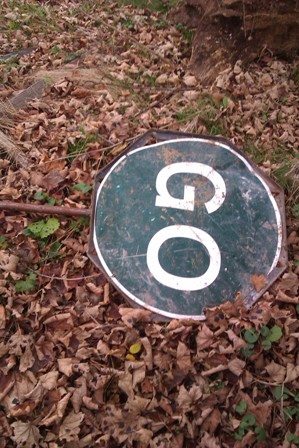
Have you lost your Go sign?
Walking back from the gym the other day I saw this Go sign that had been thrown into a field.
Take a minute out of clock-time and just observe it. If your mind wanders, notice where it goes and bring it back to the picture. Allow whatever comes into your awareness to be noticed, and then come back to the picture. What comes to mind for you? Have you lost your Go sign?
What struck me is that often we lose our Go sign, we simply cannot get up and go. I think that is because often we have first lost our amber ‘Slow down’ sign. Our ‘Stop’ sign is not even in our awareness or consciousness, it is buried deep within.
Advent tells us to slow down. Sometimes it is our bodies that shout ‘stop!’ We need all three signs working well.
When was the last time you consciously slowed down, or simply stopped?
What is this life if full of care
We have no time to stand and stare?
William Henry Davies
For the full poem here is the link: http://www.poemhunter.com/poem/leisure/
In praise of the slow making of the Lindisfarne gospels and inner arks #makingthings
One of the lessons of the Lindisfarne Gospels was their slow, contemplative making. We can apply this practice to our children, marriages, work, relationship to the book of nature, peace. These things need a slow, contemplative making.
Michelle P. Brown’s book The Lindisfarne Gospels: Society, Spirituality and the Scribe would be one of my top three Christmas buys this year. In talking about the meaning of this book she says something deeply profound.
‘Jennifer O’Reilly has drawn attention to the patristic concept of the ‘inner library’ and the necessity for each believer to make him or herself a library of the divine Word, a sacred responsibility which Cummian referred to as ‘entering the Sanctuary of God’ by studying and transmitting Scripture. Books are the vessels from which the believer’s ark, or inner library is filled.’ (pp.398-399)
This says something about the meaning of our own lives, that there is to be a guiding inner ark. This ark carries not just our little self, but other things of the world, as the first ark carried breeding animals to save them. In our inner ark we are also to carry the presence of God.
What struck me was that this is a real carrying of what is there in the world. I might want to save the gerenuk, or Lindisfarne otters, and as I slowly contemplate them and grow in knowing about them, I begin to carry them with me in a way that might save them – because I bring this knowing to others.
Michelle P. Brown’s book was I believe a slow, contemplative making – and I write in praise of slow making. Inner arks, like books, are a product of slow making as well.
You could also read Carl Honore’s In Praise of Slow.
http://publishing.bl.uk/book/lindisfarne-gospels-and-early-medieval-world
Silence and contemplation #Worth Abbey retreat 4-6 January 2013
Worth abbey retreat 4-6 January 2013. (Click on this link)
I am leading a retreat at Worth Abbey 4-6 January 2013 on silence, contemplation and watchfulness. Click on the link above for more details.
#Kurt Jackson/ painter wilderness reams angels medicine walks and memory
Kurt Jackson, the painter. He has a way of seeing things at different levels to most people. It includes wilderness, reams, angels, medicine walks and memory.
This his link: http://www.kurtjackson.com/index.html
Let me give you a quote from Miriam Darlington’s blog http://wild-watching.blogspot.co.uk/:
‘I’m standing beside a gate, screened by some sallow and oak branches. A movement on the water. The size of a water vote, but with a wake. Henry Williamson, who wrote “Tarka the Otter” and spent many years down at otter-nose level, called it a ‘ream’. Half way between a ripple, and a beam of light.’
Kurt Jackson is someone who sees ‘reams’. They are there but often invisible to the clothed eye. It is not just in landscapes we find them. There are reams with people, ripples and beams of goodness. In every day there are reams of God, ripples and beams of presence.
Annie Dillard in her book Teaching A Stone To Talk has a chapter in it ‘A Field of Silence.’ At the end she writes, ‘There are angels in those fields, and, I presume, in all fields, and everywhere else. I would go to the lions for this conviction, to witness this fact.’ (p.136)
When I look at Kurt Jackson’s paintings I understand what Annie Dillard is saying. Jackson’s paintings are bathed with the light of angels, but not fluffy, chubby angels but angels that make you write, ‘Holiness is a force, and like the others it can be resisted. It was given, but I didn’t want to see it.’ (Annie Dillard, pp.134-135)
Wilderness psychotherapy sends children and others out on medicine walks. As I look at Jackson’s paintings I end up walking in the landscapes. But it is a medicine walk.
There’s an idea in NewScientist of 6th October in their memory section, that memories are very important in shaping our happiness or sadness, ‘Our memories act as a kind of ballast that holds us steady in times of stress…’ (p.38). ‘Over-general memory’ as it has been called, where people ‘paint their past in broad brush strokes’ (p.39) but don’t remember the details can be linked to depression. As I gazed attentively and openly at Jackson’s paintings I found memories rising to the surface, happy ones. I found awarenesses of oneness, and unity rising to the surface. The paintings became a medicine-walk.
Slow down and look at Kurt Jackson’s paintings today- take a medicine walk amonst the reams of angels.
 shaunlambert.co.uk