
mindful paths to peace article via @RetreatsUK
This is my article in Retreats 2016 which can be ordered from @RetreatsUK:
http://www.retreats.org.uk/retreatsjournal.html.
If you want to know more about retreats next year it is the best one stop guide!


http://www.christiantoday.com/article/mindfulness.how.it.works.and.why.christians.should.practise.it/69083.htm
Christian Today asked Rev Shaun Lambert, who has trained extensively in counselling and psychotherapy, to explain.
#Mindfulness, Incarnation, Grace & the Ordinary
MIndfulness, Incarnation, Grace and the Ordinary
The grace of the Incarnation means we can look for the incarnation of grace in the embodied world in which we live. This grace is incarnated in different ways, including the embedding of wisdom into the natural world.
Grace is often incarnated but unlooked for in the ordinary. It wasn’t until the ordinary was temporarily under threat in my life that I rediscovered this truth.
Earlier in November a joint in my back jammed, causing a band of muscles to go into spasm and probably pinch a nerve momentarily. For two days I couldn’t sit up or walk without help. I needed help to get dressed and to wash. Every time I tried to sit up or stand up, my back would spasm again, and I would be literally screaming with the acute pain. I later discovered that I had also suffered an annular tear in one of the discs in my lower back.
Suddenly, in the moment, those ordinary, taken-for-granted experiences, such as sitting, walking and taking a shower, seemed to be wonderful, mysterious things filled with grace and glory. I longed to be able to do them without pain, and to really appreciate them.
How can we remember to appreciate the grace that dwells in ordinary things?
By indwelling our grace-given embodied awareness. This embodied awareness is called ‘mindfulness’. Mindfulness is our universal human capacity for awareness and attention and needs to be distinguished from the mindful awareness or meditative practices that enable us to become more mindful.
The gravity of awareness and attention – gravity because it is central to our life and as invisible to us as gravity – is one of the central gifts of grace that is incarnated in our embodied living.
How might we define mindfulness? The most well-known definition is by Jon Kabat-Zinn: ‘Mindfulness means paying attention in a particular way: on purpose, in the present moment, and nonjudgmentally’.[1] This definition can be broken down into three main components, of intention, attention and attitude.[2]
The purpose of intention is very important. For example, I use secular mindful awareness practices to face my anxiety. I use Christian mindful awareness practices to come into the presence of God, in whose love my fear dissolves. Jesus put intention at the heart of the attentive life, ‘But seek first his kingdom and his righteousness, and all these things will be given to you as well’ (Matthew 6:33, emphasis added). Out of our intention comes the motivation to keep seeking, to keep meditating. Bernard of Clairvaux also puts intentio, intention, at the heart of the life of prayer. At the heart of intentio is the idea of ‘looking closely’ with what Bernard called ‘the face of the soul’.[3]
The second key element of mindfulness is attention, which is how we use our awareness. Awareness is ‘attending to experience itself, as it presents itself in the here and now.’[4] Jesus also commands us to clearly focus our attention. He does this through stories where we fail to pay attention to the detail: ‘Look at the birds of the air; they do not sow or reap or store away in barns, and yet your heavenly Father feeds them’ (Matthew 6:26, emphasis added). This is not a casual glance but involves looking with attention and awareness for the wisdom embedded in the life of these small birds.
Shapiro et al suggest that the third axiom of mindfulness is attitude. The authors explain that ‘persons can learn to attend to their own internal and external experiences, without evaluation or interpretation, and practice acceptance, kindness and open-ness even when what is occurring in the field of experience is contrary to deeply held wishes or experiences.’[5] Very importantly, they say that this enables us to develop ‘the capacity not to continually strive for pleasant experiences, or to push aversive experiences away.’[6]
Jesus tells us to face the reality of our internal attitudes: ‘Why do you look at the speck of sawdust in your brother’s eye and pay no attention to the plank in your own eye?’ (Matthew 7:3). He also commands us to be non-judgmental and to practise being non-judgmental in a continuous way: ‘Do not judge, or you too will be judged’ (Matthew 7:1). What he commends is clear seeing: ‘First take the plank out of your own eye, and then you will see clearly to remove the speck from your brother’s eye’ (Matthew 7:5).
Clear seeing through cultivating watchfulness became the intention of the early Christian contemplatives. The aim of watchfulness was to achieve diakrisis – ‘the seeing clearly into oneself.’[7] Diakrisis could lead to diorasis, or discernment, and one could become a diaratikos, a ‘Discerning One’ – or one could say a ‘Mindful One.’[8]
With this came a new centre, which was a mindfulness of God. This phrase was used by a fifth-century bishop, Diadochus of Photike. The Greek phrase Diadochus uses, which was translated as ‘mindfulness of God’, was mneme theou, literally ‘the memory of God’, or ‘the remembrance of God’. It was a living, embodied memory.
Mindfulness helped relieve my acute pain in the moment, and it also helped me stop the pain becoming suffering. I was able to catch undermining thoughts such as ‘My back is always going to be like this now,’ and let them go.
It also reminded me of the grace of the Incarnation. As I sit here just before Christmas I can better resist the siren calls of the false Christmas of the adverts, incarnated in emptiness and ultimately disappointment. I will savour every ordinary moment, considering each one, until I see the grace incarnated in them.
Shaun Lambert is a trained counsellor and psychotherapist as well as being Senior Minister of Stanmore Baptist Church.
The second edition of ‘A Book of Sparks – a Study in Christian MindFullness’ is published by Instant Apostle and is available in paperback and electronic formats.
For trade, it is available from Lion Hudson c/o Marston and from CLC.
[1] Jon Kabat-Zinn, Wherever you go, there you are: Mindfulness meditation in everyday life (New York: Hyperion, 1994), 4, quoted in Zindel V. Segal, J. Mark G. Williams & John D. Teasdale, Mindfulness-Based Cognitive Therapy for Depression (New York: Guilford Press, 2002) 40.
2 Shauna L. Shapiro et al., ‘Mechanisms of Mindfulness,’ Journal of Clinical Psychology 62, no.3 (2006): 374, accessed 18 July 2014. http://dx.doi.org/10.1002/jclp.20237.
3 Michael Casey, Athirst For God: Spiritual Desire in Bernard of Clairvaux’s Sermons on the Song of Songs (Kalamazoo: Cistercian Publications, 1988), 117.
4 Shauna L. Shapiro et al., ‘Mechanisms of Mindfulness,’ Journal of Clinical Psychology, 376.
5 Shauna L. Shapiro et al., ‘Mechanisms of Mindfulness,’ Journal of Clinical Psychology, 377.
6 Shauna L. Shapiro et al., ‘Mechanisms of Mindfulness,’ 377.
7 Mary Margaret Funk, Thoughts Matter, New York: Continuum (1998) 89.
8 Irenee Haussher, Spiritual Direction in the Early Christian East (Cistercian Publications, 1990), .91.
[1] Jon Kabat-Zinn, Wherever you go, there you are: Mindfulness meditation in everyday life (New York: Hyperion, 1994), 4, quoted in Zindel V. Segal, J. Mark G. Williams & John D. Teasdale, Mindfulness-Based Cognitive Therapy for Depression (New York: Guilford Press, 2002) 40.
[2] Shauna L. Shapiro et al., ‘Mechanisms of Mindfulness,’ Journal of Clinical Psychology 62, no.3 (2006): 374, accessed 18 July 2014. http://dx.doi.org/10.1002/jclp.20237.
[3] Michael Casey, A thirst For God: Spiritual Desire in Bernard of Clairvaux’s Sermons on the Song of Songs (Kalamazoo: Cistercian Publications, 1988), 117.
[4] Shauna L. Shapiro et al., ‘Mechanisms of Mindfulness,’ Journal of Clinical Psychology, 376.
[5] Shauna L. Shapiro et al., ‘Mechanisms of Mindfulness,’ Journal of Clinical Psychology, 377.
[6] Shauna L. Shapiro et al., ‘Mechanisms of Mindfulness,’ 377.
[7] Mary Margaret Funk, Thoughts Matter, New York: Continuum (1998) 89.
[8] Irenee Haussher, Spiritual Direction in the Early Christian East (Cistercian Publications, 1990), .91.
A Folk song from the Land of Ge, smuggled out – Mimne the Seer

As promised here is a recording of a folk song written by Hudor about Mimne, that has been recorded by Glyn Burns who wrote the music:
#Mindful Church Cafe After Hours at Costa/Stanmore begins 6.30 p.m. Wednesday 0ctober 8
Mindful Church Café
An introduction to Mindfulness
for health and of God
What is ‘Mindfulness’?
Mindfulness is our universal human capacity for awareness and attention, and interest in mindfulness is growing exponentially.
Mindfulness is being introduced into health, education, work and many other areas, although its roots are spiritual, with all the great faith traditions having some version of mindfulness.
Mindfulness can be enhanced through meditative and other practices, both secular and spiritual.
Mindful Church Café is a six week introduction to mindfulness, both mindfulness for health and mindfulness of God.
Venue: Costa Coffee Stanmore (24-26 Church Road, Stanmore, HA7 4AW)
Time: 18:30 -20:15
Date: Starts 8th October (Session 1)
It is being run by Shaun Lambert who is a trained counsellor and psychotherapist, as well as being Senior Minister of Stanmore Baptist Church. He is in great demand as a speaker, teacher and lecturer in the area of mindfulness.
If you want to find out more or sign up to the course, please contact Shaun via this website or phone 020 8954 2250
#Mindfulness article via Associaton of Christian Counsellors magazine Accord
Dear Shaun,
I have been suffering from recurrent depression and my doctor has recommended I try Mindfulness-Based Cognitive Therapy (MBCT). Someone in my church has said I shouldn’t touch it with a bargepole because mindfulness has Buddhist roots. Apparently it also involves meditation, and in meditation you are trying to empty your mind, aren’t you? Isn’t that dangerous?
I’m desperate for help – can you offer me any guidance?
Yours ever,
Concerned Christian
Dear Concerned Christian,
You are right! There is some confusion and caution within the church when it comes to mindfulness. It is important to bring some clarity into this area so you can make an informed decision.
Mindfulness is our universal human capacity for awareness and attention. This capacity needs to be distinguished from the mindful awareness or meditative practices that help us develop this innate ability to be mindful. A doctor in the USA called Jon Kabat-Zinn who pioneered the use of mindfulness within medicine in the 1970s, through what he called Mindfulness-Based Stress Reduction (MBSR), pointed out that saying mindfulness is Buddhist is like saying that gravity is British because Isaac Newton discovered it!
Human capacity
All the main faiths discovered the gravity of awareness and attention very early on and developed different forms of mindful or meditative practice. What is more recent is that the secular world, represented by cognitive psychology and neuroscience, among others, has become interested in mindfulness.
Because mindfulness is our universal human capacity for attention and awareness, Christians, Buddhists and secular psychologists can engage with mindfulness in different ways and with different intentions.
Reality focused
The main intention within secular psychology is to use mindfulness for health – in the treatment of depression, anxiety, stress, chronic pain and many other conditions. There is a lot of evidence-based research supporting its efficacy in these areas. Because the pioneering psychologists who developed MBSR and MBCT want their treatments to be widely accepted, they have worked very hard to separate mindfulness and its practices from its religious roots. Generally in secular psychology mindfulness is defined as ‘paying attention in a particular way: on purpose, in the present moment, and non-judgementally’.
Christians can use these secular psychologies with the intention of using mindfulness for health. The meditative or mindful awareness practices (MAPs), although originally taken from Buddhism, are neutral – anyone can use them. These practices are ‘reality-focused’ practices helping you to develop an awareness of your inner life of thoughts, feelings and bodily sensations. In fact new MAPs are being developed which are not dependent on Buddhist roots.
Internal capacities
When it comes to emptying our mind neuroscientists and cognitive psychologists tell us it is impossible. Our multiple brain is constantly sending messages to our mind. In meditation within mindfulness you are not trying to empty your mind, even if it were possible. What you are trying to do is something else entirely.
How our minds work in relation to our thoughts, feelings and bodily sensations is fascinating but we often operate without a clear map of what goes on inside us. A number of internal capacities are involved when we are practising mindfulness. If I say to you, ‘Tell me what you are thinking and feeling,’ you can tell me. The key question to ask is, ‘How can you do that?’
Your senses
Human beings are the only animal that can observe their own thoughts, feelings and bodily sensations. This capacity is a form of awareness, sometimes called ‘meta-awareness’. We are cultivating this capacity when we practise mindfulness.
What you are doing is moving out of the thinking part of your mind into your senses and your capacity for awareness.
Seventh sense
Alongside our capacity for meta-awareness, our five senses are streams of awareness within us, although we usually don’t think of them in that way – and we often take them for granted! Daniel Siegel, an interpersonal neurobiologist who works with mindfulness, says that we actually have eight senses. The sixth sense is our ability to become aware of what is going on in our body. We know when we are in pain, or feeling tired or elated. The seventh sense is our ability to become aware of our thoughts and feelings. The eighth sense is our ability to be aware of what other people are thinking and feeling.
When we are meditating in mindfulness we are switching from our normal analytical thinking – what has been called our ‘doing’ mental gear – to our awareness within, or ‘being’ mental gear. This switch is sometimes described as a move from our narrative self to our experiential self.
Central insight
Why is this important? Knowing this helps us understand the central insight of mindfulness, whether from a Christian, Buddhist or secular psychological perspective. According to Christian contemplative writer Martin Laird, the key question to ask when we stand at the doorway of the present moment, which is at the heart of being mindful, is, ‘Are you your thoughts and feelings?’
This is a very important question. Many people think they are their thoughts and feelings. They are fused to their thoughts and feelings, totally identified with them. Psychologists call this ‘cognitive fusion’. In other words, they look at life from their thoughts and feelings. If these thoughts and feelings are anxious and depressed, that is what you become.
Cognitive diffusion
The mindful awareness practices help us to realise that we are not our thoughts and feelings, that they are passing events in our minds. In this realisation we are able to notice our thoughts and feelings and let them go. We don’t avoid them experientially and suppress them; we face them, accept them and let them go. We have switched from looking at life from our thoughts and feelings to looking at our thoughts and feelings. We can express this shift by saying, ‘I am having a depressed thought,’ rather than, ‘I am depressed.’ This is learning cognitive defusion.
There is a lot more that can be said about mindfulness, but if we understand the central insight that we are not our thoughts and feelings and that we can learn to defuse from afflictive thoughts and feelings, like depression and anxiety, then we can find the motivation to practise mindfulness.
Deciding our intention
It is important to decide our intention. I use secular mindfulness to step out of anxiety, as mindfulness for health. You can use secular mindfulness as a Christian to begin the journey out of depression. The meditative or mindful awareness practices actually change the structure and activity of the brain for the better, because of the neuroplasticity of our brains. It works!
I am also looking at the biblical and historical roots of Christian mindfulness. A Christian distinctive would be mindfulness of God, just as God is mindful of us (Psalm 8). There are Christian mindful awareness or meditative practices that have come out the history of the church through its contemplative strand.
Inside out
The final key thing is to know that mindfulness can only be understood from the inside out. We are so stuck in the ‘doing’ mental gear that it is only practising mindfulness that enables us to see that we have a ‘being’ mental gear, an experiential self, streams of awareness within us that enable us to move from a bad place to a good place, from dry aridity to a place of bubbling creativity.
I hope this gives you enough to make an informed decision about whether to use mindfulness for health.
Yours ever,
Shaun
This piece is in the latest Accord magazine published by the Association of Christian Counsellors http://www.acc-uk.org/index.asp and Shaun will be speaking at their 2015 Conference
http://www.acc-uk.org/acc-conference-jan-2015/
As well as being a trained counsellor and psychotherapist, Shaun Lambert is Senior Minister of Stanmore Baptist Church. He is currently researching a PhD in mindfulness from biblical, historical and psychological perspectives. Shaun is the author of A Book of Sparks – A study in Christian MindFullness, and His latest book is a children’s fantasy novel entitled Flat Earth Unroofed: a tale of mind lore, which has mindfulness woven into it.
A link to my review of Kenneth Steven’s novel Glen Lyon
Glen Lyon, a novel by Kenneth Steven, reviewed by Shaun Lambert
Read my review in the Baptist Times Online of Kenneth Steven’s brilliant novel Glen Lyon.
Lyrical #mindfulness and the parables of Jesus
Lyrical #mindfulness and the parables of Jesus
Clink on the link above at Mind and Soul to access my article on ‘Lyrical mindfulness and the parables of Jesus
‘In their book, Teaching Mindfulness, McCown, Reibel and Micozzi talk about the need for a ‘lyric perspective on self-understanding,’ A lyric perspective doesn’t define our self-understanding as who we are (narrative), but how we are, it is about how we are in the moment, not who we are in a sustained self-story.’
The #mindful windows of awareness
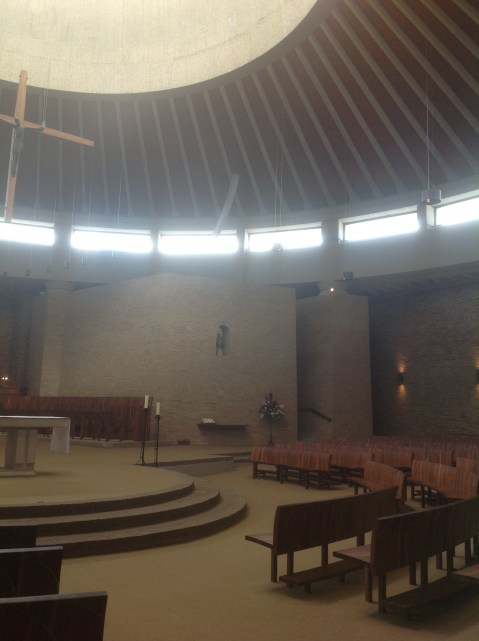
I have just come back from leading a retreat at Worth Abbey about shifting our mental gear from doing to being, from thinking to awareness. The beautiful Abbey Church has a visual parable built within it, that helps illustrate an important aspect of our awareness.
It is a circular church, and has windows running all around the rim of the circle (see photo). Attention is about what we do with our awareness. We can focus our attention, for example, on sounds – allowing whatever sounds are out there to come into our hearing. That is like looking through one window of the many we could look through in the Abbey Church.
Daniel Siegel in his book The Mindful Brain talks about us having a rim of awareness through which things can be attended to. We have our five senses on the rim, five windows if you like on to the world. But Daniel Siegel suggests we have eight senses: in the sixth sense we can become aware of what is going on in our body, in the seventh sense we can become aware of what is going on in our minds – thoughts, feelings, sensations, and in the eighth relational sense we can become aware of what is going on with other people around us.
I would also like to suggest that there is a ninth sense, that works with the other eight senses, which is about becoming aware of the presence of God.
We can focus our attention, just attending to one window, whether it is hearing or sight. But we can also cultivate an open awareness where we are able to allow all our senses to come into awareness. Using the Abbey Church as an example this is where light is coming in through all the windows, and we are aware of all the windows in the circular rim of the church simultaneously.
Often we live through only a few windows, the others blacked out to our awareness and attention. Mindfulness and contemplation open up all the windows of awareness to our awareness and attention. As this happens we begin to experience life in the moment as it truly is, which is whole and full of healthy possibilities, including the possibility of hearing the footsteps of the Invisible One in our life.
 shaunlambert.co.uk