
#mindfulness – inhabiting awareness
How do we enter the doorway of the present moment? One of the ways is by answering a riddle, says contemplative writer Martin Laird.
One of the riddles he sets is this, ‘What do thoughts and feelings appear in?’ (‘Into The Silent Land’, p.80). When I ask people that question, many people can’t answer it. The answer Martin Laird gives, based on his study of Christian contemplative writers is that our thoughts and feelings appear in awareness (p.88).
Now this is affirmed by cognitive psychology and neuroscience. J. Mark G. Williams and Jon Kabat-Zinn summarize this beautifully in their introduction in the book ‘Mindfulness: Diverse Perspectives on its Meaning, Origins and Applications,’ jointly edited by them.
They define mindfulness as awareness, ‘an entirely different and one might say, larger capacity than thought, since any and all thought and emotion can be held in awareness.’ (p.15) This is something we need to become aware of. But as they go on to say, ‘While we get a great deal of training in our education systems in thinking of all kinds, we have almost no exposure to the cultivation of intimacy with that other innate capacity of ours that we call awareness.’ (p.15)
This is why people struggle to answer the riddle, ‘what do thoughts and feelings appear in?’ Williams and Kabat-Zinn go on to say, ‘Awareness is virtually transparent to us. We tend to be unaware of our awareness. We so easily take it for granted.’ (p.15) And yet it is one of our most important innate capacities.
As they conclude, ‘It rarely occurs to us that it is possible to systematically explore and refine our relationship to awareness itself, or that it can be ‘inhabited’.’ (p.15) Mindfulness is awareness but mindful practices can help us systematically ‘explore and refine our relationship to awareness’ so that it can be ‘inhabited.’
How to train your dragon (mind) fully
When I speak to people about mindfulness I find that most are in the position I was before I began researching mindfulness, they don’t have a clear map of understanding of how their mind works or how to train it.
One thing that mindfulness training offers is the best wisdom of cognitive psychology and neuroscience in giving us a clear map of our minds and how to train them.
In their book ‘ Mindfulness, a practical guide to Finding Peace In a Frantic World’ Mark Williams and Danny Penman ask the question, ‘Why do we attack ourselves?’ (15-31). In their book ‘Mindfulness for Health’ Vidyamala Burch and Danny Penman talk about the ‘wild horses’ of the mind (53-75). That’s why I’ve used the title ‘how to train your dragon mind.’
What I’ve found is that helping people have a clear map of understanding how their mind works, and how to train it, is very liberating for people. Whether it is understanding the neuroplasticity of their brains and how they can lay down new neural pathways through mindful awareness or meditative practices; or their capacities for rational critical thinking and the doing mental gear, or the streams of awareness within them and the being mental gear.
Learning about our ability to both focus our attention and open our awareness, the importance of focusing on the present moment and having an attitude of that is compassionate, curious and non-judgemental – helps us put the jigsaw of our minds and bodies together, until finally we see the big picture. Seeing that big picture is often an epiphany moment, a charged moment of insight.
People are interested in mindfulness for health, as developed in secular psychology through treatments like Mindfulness-Based Stress Reduction (MBSR), and Mindfulness-Based Cognitive Therapy (MBCT) – and I talk to many who are intrigued by the Christian idea of mindfulness of God.
Mindfulness is also being used at work, in education and leadership and many other areas including sport, art, writing and music. Very good introductions to mindfulness are the two books I’ve mentioned above.
Having a clear map of understanding how your dragon mind works and how to train it, is, I think, one of the most important things we can do to open up our inner world, and the world around us, in a way that enables us to live life fully.
Deeper Mindfulness: The New Way to Rediscover Calm in a Chaotic World
#mindfully walking anger out of your system
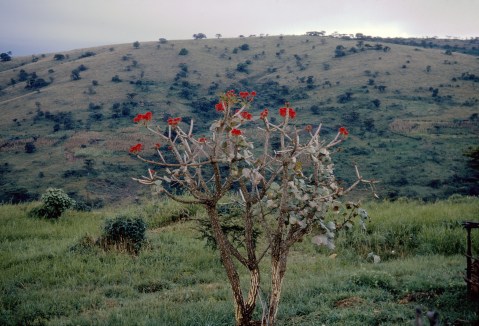
‘An Eskimo custom offers an angry person release by walking the emotion out of his or her system in a straight line across the landscape, the point at which the anger is conquered is marked with a stick, bearing witness to the strength or length of the rage.’
(LUCY LIPPARD, OVERLAY, quoted in Wanderlust by Rebecca Solnit (pp.6-8)).
I think mindful walking enables us to release our afflictive emotions like anger, as we take each step. In formal mindful awareness practices involving walking, you usually take 10-12 steps, stop and then retrace your steps, repeating this for a certain length of time.
The beauty of this wonderful quote above, that caught my eye, is that I think longer walks also have this capacity.
What afflictive emotion could you walk out of your system?
The mindful awareness practice of confessional walking
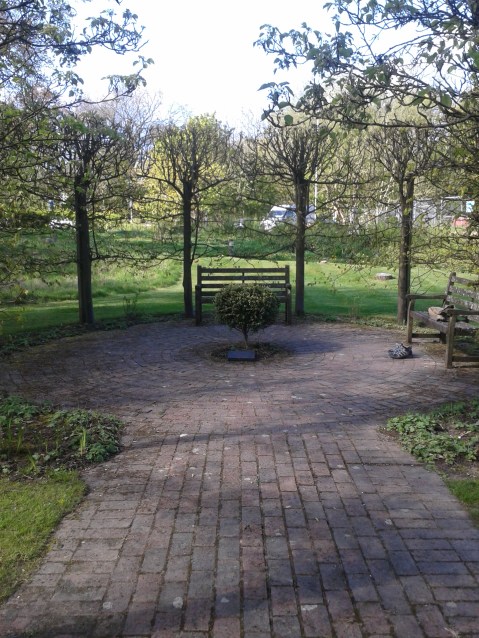
One of my favourite mindful awareness or meditative practices is mindful walking. Within the formal meditation you take a certain number of steps, with your focus of attention on the soles of your feet, the movements that make up a step, and the streams of awareness inside you that are your senses. Along with this focused attention you can cultivate an open awareness to gravity as it acts on your body as you slow your movements down, your balance, sounds around you…
You can of course go on an extended walk as a mindful awareness practice, a walk of being rather than doing. As I’ve practiced the more formal meditation, in places like this little garden in the grounds of the Royal National Orthopedic Hospital (RNOH) in Stanmore I noticed that my mind began to clear and difficult decisions became easier as if in the process of walking the negativity within was trailing out behind me.
I was reminded of a story about Desert Father Moses, which is quoted in Rowan William’s little book ‘Silence and Honey Cakes’ (p.29). In the story Moses is invited to a meeting where a fellow monk is to be judged because he has sinned. First, Moses refuses to go, and then when someone goes to fetch him, Moses takes a leaky jug filled with water with him.
When asked why, Moses replies, ‘My sins run out behind me and I cannot see them, yet here I am coming to sit in judgement on the mistakes of somebody else.’ (Williams, 29)
Moses here is talking about the existence of our sinful trail through life as a negative reality. However, through my experience of mindful walking I’ve realised we can use such a walk in a contemplative way, where we intentionally allow what has been sinful in our life, the mistakes, to run out behind us in confessional awareness – to bring us to a state of forgiveness in our relationship with God.
This active way of contemplating through a walk, may help us to actually let go of our mistakes, and when we have noticed them, asked and received for forgiveness – actually move on, rather than clinging endlessly in negative rumination to those mistakes.
In the process we arrive, not at a place of self-critical judgement, or a projected judgement of others, which Jesus himself asks us to leave behind (Matthew 7:1-5) but a place of clear seeing in which we can take the ‘rain forest’ out of our own eye before we try and take the speck of dust out of someone else’s eye.
Fear and anger, guilt and shame stop us seeing clearly, and silt up our ability to respond wisely to our mistakes. In our contemplative and confessional walking, we can let this silt run out behind us. Usually, then, we can find a place of wisdom and compassion and freedom rather than fear and continued slavery to our sinful habits.
The whispering death of anxiety, stress and burnout – #mentalhealthawarenessweek
The whispering death of anxiety, stress and burnout – #mentalhealthawarenessweek
a link to my article on the whispering death of anxiety, stress and burnout via PREMIER Mind & Soul
Relational perception, mindfulness, kavannah, Levinas and relational ethics

One of the most important insights of mindfulness is that we have relational perception. Daniel Siegel, an interpersonal neurobiologist, is an important theorist in this area. He talks about us having an eighth sense where we can tune in to what other people are thinking and feeling.
Others are also working with this area. Person-centred therapy is working with relationship and its perception in very interesting ways. One of the influences on recent developments in person-centred therapy has been the philosopher Emmanuel Levinas (1906-1995), and especially his theory of relational ethics.
A central aspect of awareness and attention is when it has a relational and ethical scaffolding. An influential development of this was by Levinas.
Roger Simon explains that one of the ways Levinas emphasized being attentive was through the Jewish concept of kavannah, ‘the attentiveness, attunement and intentionality with which one is able to engage in prayer.’[1] This is sometimes called Jewish mindfulness
Simon goes on to talk about two forms of this attentiveness within Levinas’ thought, ‘the spectatorial and the summoned.’[2] These are specifically defined.
A spectatorial kavannah leaves ‘ourselves intact, at a distance, protected from being called into question and altered through our engagement with the stories of others.’[3]
The summoned kavannah ‘establishes proximity, not as a state, a repose, but a restlessless, a movement towards the other in which one paradoxically draws closer when vigilant of one’s infinite distance from the other.’[4] This summoned kavannah involves a different level of responsibility, a vulnerability, towards the other.[5]
These forms of attentiveness can be used in any setting, not just in prayer. In our culture it is a spectatorial attentiveness that dominates.
Jesus also gives attention and awareness central place in a relationally ethical scaffolding. I am grateful to Stephen E. Fowl in his commentary on Philippians for pointing this out.
In Philippians 2: 4 Paul says ‘Do not attend to your own interests but rather to the interests of others.’ (Fowl’s translation)
This is in direct imitation of Christ’s attitude and focus of attention (Philippians 2:5-11). The Greek word here for attend is σκοποῦντες, which means regard attentively, colloquially ‘fix one’s mind’s eye’ on something. Focusing our attention on others in this way helps to form a consistent pattern of helping others in us.[6]
So how we use our eighth relational sense is very significant, as is how we focus our attention and awareness. Within secular mindfulness for health you are encouraged to develop compassion, for yourself and for others and to be non-judgemental.
One can also ask, how else can one relate to one’s own self as well as to others through how we focus our attention and awareness?
[1] Roger I. Simon. ‘Innocence Without Naivete, Uprightness Without Stupidity: The Pedagogical Kavvanah of Emmanuel Levinas.’ Studies in Philosophy and Education 22 (2003), 50.
[2] Simon, 51.
[3] Simon, 52.
[4] Simon, 53.
[5] Simon, 52.
[6] Stephen E. Fowl, Philippians (The Two Horizons NT Commentary), Grand Rapids, Michigan: William B. Eerdmans (2005), 85.
You do not need to take a hammer to clay- #mindful non-judgemental compassionate attention
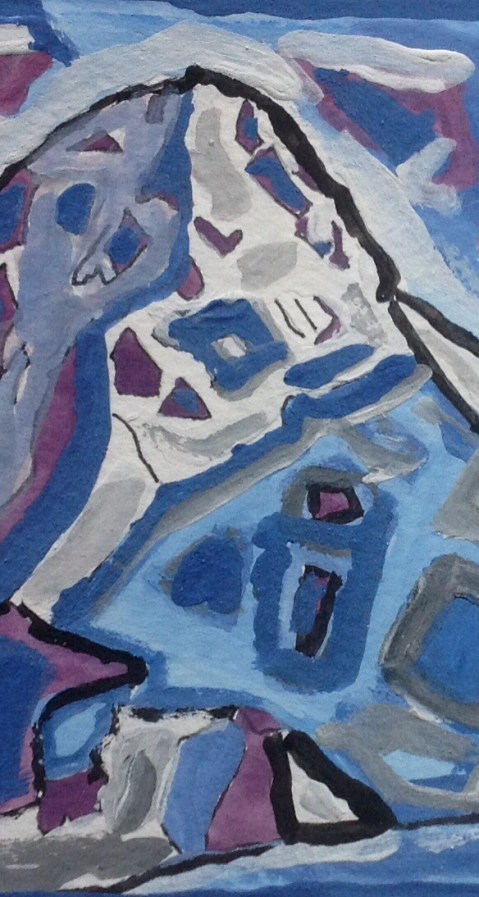
As I look at the mountain and draw it meditatively, as a mindful awareness practice I can find a creative space. In that space little creative seeds emerge.
I saw the stone hammers of time had shaped archetypal triangles and squares that made a larger whole, as one might hammer a hang drum into musical shapes. The colours that emerged were not there visibly, but invisibly, the colour of feelings.
Take 15 minutes out of clock time and with pencil,or pen try to recreate the shapes. Focus your attention. As your mind wanders notice what it wanders to and bring it back to the drawing. This noticing is meta-awareness. If you have time, what colours would you paint the mountain?
Having a collection of water colour tubes that you play with on paper enables you to find your feelings. It’s a worthwhile investment.
When I do a meditative drawing exercise with people it is often the most revealing of all. What often emerges clearly is negative self-judgement…’I can’t draw, I’m not an artist…I’m useless at this.’ In the meditative drawing as you exercise your muscle of attention it is about the process not the outcome, but often we jump straight to negative judgement of the outcome.
We often give these negative thoughts the status of being an accurate readout of reality. And so we take them like stone hammers to our plastic brain. These thoughts are not an accurate readout of reality, they are passing events in the mind, like clouds that need to be noticed compassionately and non-judgementally and let go of. Do this and the stone hammer dissolves.
You do not need to take a hammer to clay.
contemplative seeing, the mindful study of painting…
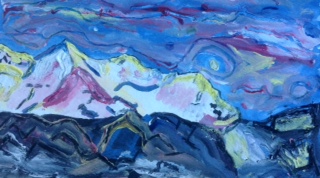
The silent mountain is passionate
Mirabai Bush talks about contemplative seeing, ‘the mindful study of painting and sculpture as ‘beholding” (which involves appreciation, care, the involvement of our senses). We are able in beholding to ‘hold’ something in our attention until something emerges into our awareness.
I called this painting ‘what the mountain was feeling..’ it came out of beholding this particular mountain range. What then came out was ‘the silent mountain was passionate.’ Of course, contemplative seeing is not limited to painting and sculpture, for me it began with the contemplative seeing of the mountain.
Taking time to behold means that time can open up and we can have a moment of clear seeing, an epiphany.
Review of Matthew Hollis’s biography of WW 1 poet Edward Thomas
Review of Matthew Hollis’s biography of WW 1 poet Edward Thomas
Here is a link to my review of Matthew Hollis’s biography of WW 1 poet Edward Thomas, ‘Now All Roads Lead to France: The Last Years of Edward Thomas’, published by Faber & Faber. A must-read in this year, the 100th anniversary of World War 1.
#Mindful in the mountains
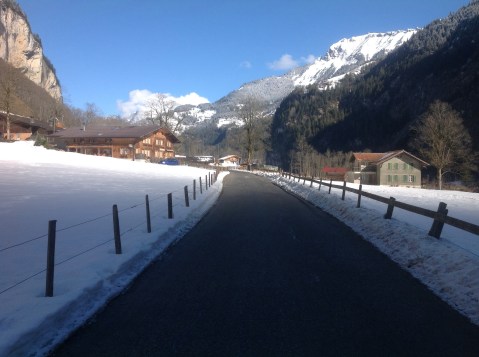
It is easy skiing in the mountains to focus all your attention on the sport itself. But what I am inspired to do by the beauty around is to open my awareness to the landscape in which I am skiing.
Skiing itself requires open awareness, as well as focused attention. How you have to feel the snow and shape of the slope with the soles of your feet when you can’t see because of poor visibility.
The sound of the ski on ice alerts you, the sound of the ski crunching through fresh snow thrills you. It is not just resonating with the panoramic views on a clear day, it is noticing the small things. How silence enfolds you like a blanket as the snow starts to fall.
And when you return home, it is not to despise the different landscape, but to see with new eyes the beauty of the apparently ordinary. Perhaps if you lived in the mountains all the time you would stop seeing them, returning to living in our heads and not our bodies.
 shaunlambert.co.uk