
The therapeutic Lindisfarne dragon emerges #mindfully
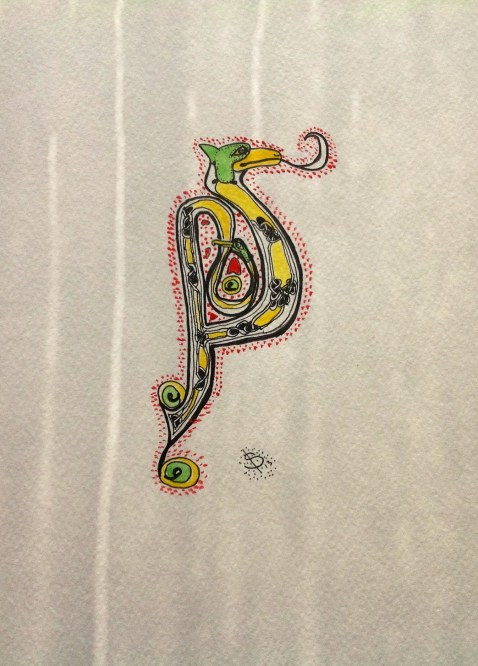
A meditative drawing is an act of discovering our embodiment mindfully.
Therapeutic #Lindisfarne dragon takes shape
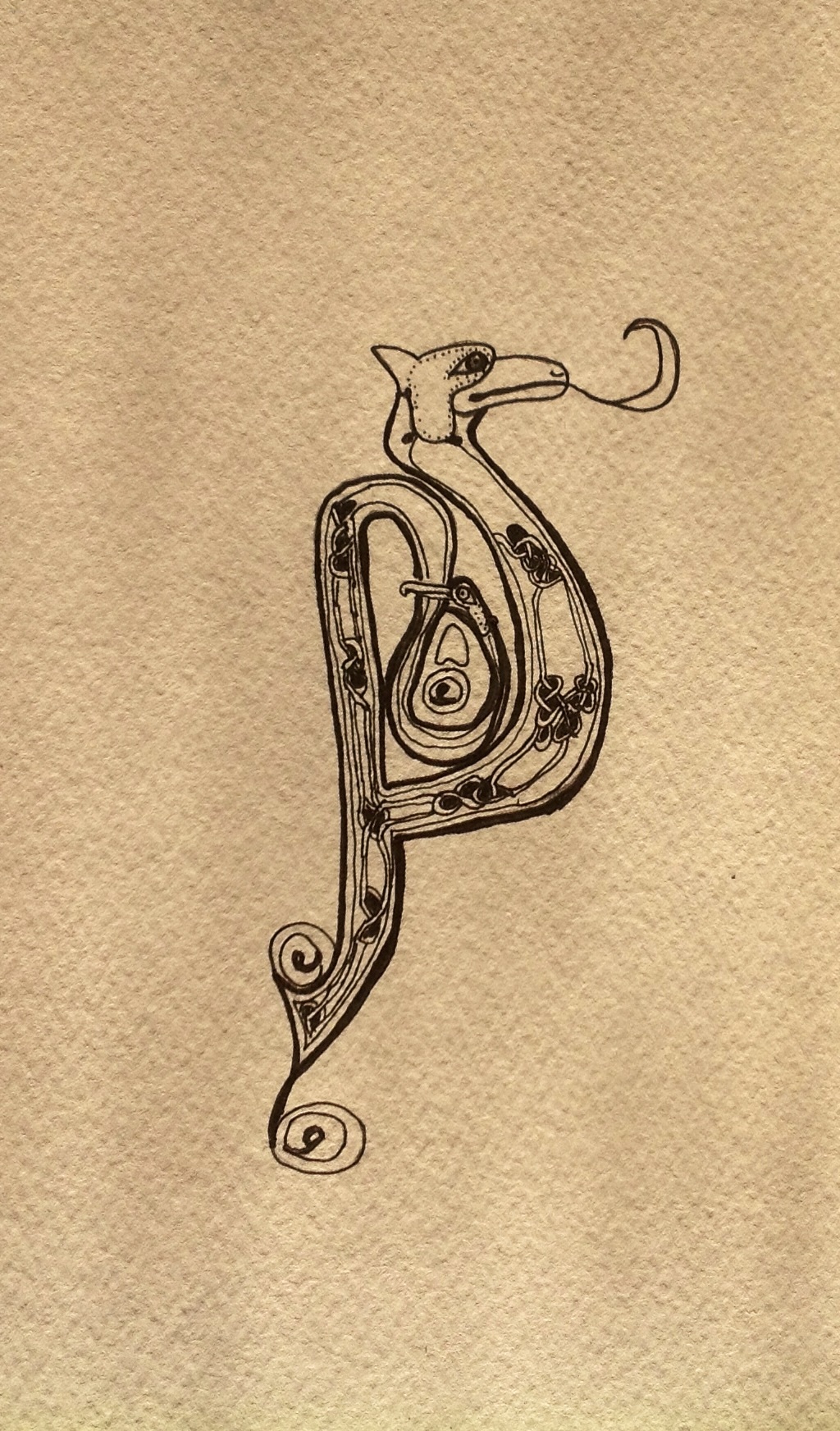
Plaited interlace and spiral work requires sustained attention. Drawing a mindful practice for a wandering mind.
Facing the dragons of difficult emotions #mindfully
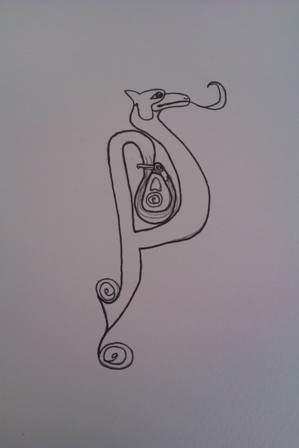 I have been running a course looking at mindfulness from a Christian perspective for a church in Ealing. One of the important questions that has come up is, ‘what do you do when a difficult emotion, thought, sensation emerges?’
I have been looking at the Lindisfarne Gospels over the last few weeks in the British Library, before it goes to its brilliant summer exhibition in Durham. On the page that is open, within its glass case, is a letter ‘P’ shaped like a dragon.
It made me think of difficult emotions I have separated myself from, which I have imagined to be dragons. I have kept myself from experiencing them with a glass wall of separation. Mindfulness helps to bring down that glass wall of separation, whether it is our body, thoughts, or emotions that we have separated ourselves from.
One of the other things that kept me trapped was the thought that I had to be strong, and not show vulnerability and so it was hard for me to tell someone else I was struggling. But as I practiced mindfulness I had to face the difficulties and experiences I was keen to avoid. That can seem overwhelming.
At that moment it is really helpful to let someone else in, a wise friend, a doctor, a counsellor. When I did that I was able to face the difficult thoughts and emotions and begin to name them and draw them accurately. They began to lose their power, and began to dissolve.
I am trying to draw this Lindisfarne dragon. It has such complex plaited interlace, initially I think I can’t recreate it. But the more I pay attention to it, the more its pattern begins to make sense and not seem overwhelming and beyond my mapping.
I believe we can do a lot to help ourselves. But the most important lesson I have learnt is to let others in to help us with our vulnerability. The dragon drawing isn’t finished yet.
Haiku May 9, 2013 Kindness
Kind acts leave real ripples. Emotional drawing…

One simple kind act
Like one pure drop of water
Ripples from center.
Art Prescription: I don’t watch the news much. I think it sensationalizes negatives and leaves people feeling depressed about the world we live in….And that is just NOT the whole picture! People are good and generous, and acts of kindness occur daily all around us, they just don’t make the evening news! Be the water!

Mind shift from doing to being at Worth Abbey 6-8 September
I will be drawing on my experience in the banking world, counselling and psychotherapy and the world of ministry to help those in the workplace explore and understand their own stress levels, the archetypal relationships that exist in work with others, the importance of releasing creativity through contemplative practices that enable a ‘mind shift’ into inner freedom and flow.
The first five days of a book of sparks

I am finding my journey with a book of sparks to be a real encouragement. For a start, it doesn’t have a to do list at the end of each chapter, which to begin with unnerved me a little, but I have found it has caused me to engage with what is being said for longer,rather than going tick tick tick, done… and forgetting it all.
There have been a few highlights for me over the past few days, and I thought I would share them with you:
The memory verse. When I read Mark 1:35, I thought, oh ok, Jesus spent time in prayer, yes, its another reminder that prayer is important. But then I stopped and read it slowly. That was when my mind opened, I could see Jesus getting up in the dark, suddenly awake with purpose, slipping out the house and receiving the solitude full of his Father…
View original post 203 more words
The scribe of The Lindisfarne Gospels and his historian via @BaptistTimes
The scribe of The Lindisfarne Gospels and his historian via @BaptistTimes
Click on the link above:
My interview with Michelle Brown, FSA, who is Professor Emerita of Medieval Manuscript Studies at the School of Advanced Study, University of London. She was formerly Curator of Illuminated Manuscripts at the British Library and a Lay Canon and member of Chapter at St Paul’s Cathedral, London. She has published, lectured and broadcast widely on medieval culture. She is currently a Visiting Professor at University College London and Baylor University, Texas, and is a writer and freelance researcher, living, praying and praising in West Penwith, Cornwall. Published this week in the Baptist Times.
the #befriending prayer of Ananias of Damascus
In various mindfulness approaches there are befriending or compassion meditations. These again have their roots in Buddhist tradition of metta or loving kindness meditations. These would include compassion for oneself, a stranger and even someone we find difficult.
Of course loving-kindness and compassion play a central part in Christianity as well. As I looked at these metta meditations I was struck by their similarity to the prayer of Ananias of Damascus for Saul of Tarsus.
In the Book of Acts in the New Testament in chapter nine Saul has his famous Damascus Road experience. He is on his way to Damascus to arrest followers of The Way (Christians) when he is arrested by the risen Lord Jesus Christ.
Temporarily blind Saul is led into Damascus. A man there called Ananias has a vision from God who asks him to go and pray a prayer of blessing on Saul which will restore his sight and fill him with the compassionate presence of God, the Holy Spirit.
Ananias questions the wisdom of praying for a stranger and an enemy, but God encourages him out of the way of fear into the way of love. It is clear that the prayer of Ananias has a significant impact on Saul. When Saul talks about his encounter with Jesus, which includes the prayer of Ananias when scales fell from his eyes, and he is filled with the Holy Spirit, he says he has had three important experiences.
‘Not that I have already obtained all this, or have already been made perfect, but I press on to take hold of that for which Christ Jesus took hold of me.’ (Philippians 3:12)
The word here for ‘took hold’ is literally ‘arrested.’ On the road to Damascus the love of Christ took hold of him.
When the scales fell from his eyes he ‘saw the light’. In 2 Corinthians 4:6 he says, ‘For God, who said, ‘Let light shine out of darkness,’ made his light shine in our hearts to give us the light of the knowledge of the glory of God in the face of Christ.’ This reference to light shining out of darkness goes back to Genesis 1:3 where God said ‘Let there be light.’
So Saul was taken hold of by the love of Christ, and the light of the love of God shone in his heart.
He then says in 1 Timothy 1:13-14, ‘Even though I was once a blasphemer and a persecutor and a violent man, I was shown mercy because I acted in ignorance and unbelief. The grace of our Lord was poured out on me abundantly, along with the faith and love that are in Christ Jesus.’
The compassionate mercy, grace and love of God were poured into Paul like an overwhelming river.
I felt in part these experiences were because of Ananias’ prayer of befriending and compassion. So I have put them in prayer form that we can pray first for ourselves, then a stranger, then an enemy, and finally back for ourselves. In the words of one of Jesus’ most important statements ‘Love your neighbour as yourself’ (Matthew 22:39).
These are the prayers:
May the love of Christ take hold of me
May the light of Christ shine in my heart
May the love of Christ flow through me like a river
and then
May the love of Christ take hold of him/her
May the light of Christ shine in his/her heart
May the love of Christ flow through him/her like a river
We pray it for our own self, then a stranger, then an enemy and finally for our own self again. Change is laid down by a succession of fresh experiences of love. In our prayer of blessing and befriending something real happens.
the ego – a concretization of God-forgetfulness and a #mindful remedy
Dorothee Soelle has a beautiful phrase, ‘the ego is a concretization of God-forgetfulness.’ Not only that the ego is a concretization of other-forgetfulness, of creation-forgetfulness. We live in an ego-dominated world.
Whether it is what Manfred Kets de Vries calls the destructive egotism of narcissism characterized by ‘self-centredness, grandiosity, lack of empathy, exploitation, exaggerated self-love, and failure to acknowledge boundaries.’ (The Leader On The Couch, p. 25)
Or whether it is the ego-driven quest of the empty consumer self, seeking to fill its emptiness with ever more possessions that are completely unnecessary, and serve only to feed the ego.
About seven years ago when I was stressed and anxious a little book called ‘The Jesus Prayer’ by Simon Barrington Ward lept off the shelf at me. The Jesus Prayer, Lord Jesus Christ Son of God have mercy on me a sinner helps us learn to sustain and switch our capacity for attention, as well as become aware of the presence of God.
At the same time as practicing this prayer I was doing some counselling and psychotherapy training at Roehampton and came across mindfulness within psychology. I felt these two different strands were related.
I then started researching one of the pioneers of the Jesus Prayer, a 5th century Bishop Diadochus of Photike – and came across an idea of his about ‘mindfulness of God.’ That phrase range me like a bell and I have been fascinated with researching it ever since.
The Greek phrase Diadochus uses which was translated mindfulness of God was mneme theou, literally the memory of God, or the remembrance of God – a living memory. This of course is the antidote to the ego as concretisation of God-forgetfulness, other-forgetfulness and creation-forgetfulness.
The practice of the memory of God helps us to remember God, remember others, remember creation, and remember our true self – made in the image and likeness of God. It releases us from the prison of the ego into a new freedom.
 shaunlambert.co.uk