
#mindful experiment with #poetry #autumn
poem-of-the-week-john-clare (click on this link)
This is a watchful, noticing, self-aware reflection on a watchful, noticing self-aware poet. Read both John Clare’s Autumn, but also Carol Rumens’s reflections on it.
Daniel Siegel says of poetry…’Hearing poetry feels integrative. The science of language and the brain reveals that while the left hemisphere specializes in linguistic language, the right takes a dominant role in words with ambiguous meaning. Also, the imagery evoked by poetry seems to more directly activate the primary visuospatial processes of our brains…’ (The Mindful Brain, p. 161)…poetry creates a mindful state.
Now speak the poem out loud, or get someone to read it to you…hearing may be different to reading…is there a new receptive awareness?
#ash trees, coracles and #otters in their sleep-knots
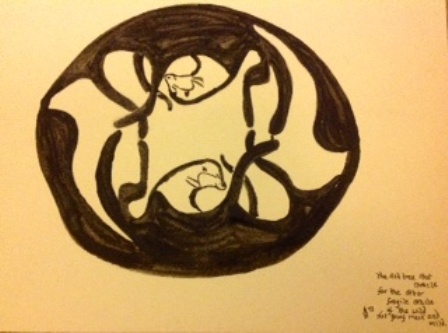
the otter sleeps in the coracle of the ash-tree roots
‘The wild otter I saw would no doubt be out of the water and making tracks to its own musky holt, to curl belly upward, in a home of roots, peat and rocks. I imagine him enfolded in his fur, dreaming of water; a tight sleep-knot, enjoying the deep sleep of one who exists totally in the moment.’ ( Miriam Darlington, Otter Country, pp.40-41)
‘Up and down the banks are the complex root systems of ash trees, which otters particularly love to use as holts as they provide hidden shelter and easy access to water.’ (Otter Country, p.175)
As I read these words I imagined the roots of the ash tree making a coracle, floating the otter to sleep in its hidden shelter. So I drew this as a coracle sleep-knot.
The ash tree root
coracle
for the otter
fragile oracle
of the wild
not going meek and mild.
Maps to mindfulness – some definitions of #mindfulness in psychology
The tree of mindfulness research and therapies is growing rapidly. It is hard to keep up-to-date with all the developments as they happen. But we can start somewhere. Important work is being done to arrive at consensus on such matters as defining mindfulness, and I’ll come back to that another time. In the meantime here are some definitions.
Mindfulness means different things. It is only fully understood by examining its historical situatedness. Mindfulness within most Western clinical practice has Buddhist roots, although it is not exclusive to Buddhist thought. Mindfulness in Dialectical Behaviour Therapy (DBT) has a different topography deriving from Christian contemplative practices and Zen Buddhism (Lynch & Bronner, 2006).
Kabat-Zinn pioneered the use of mindfulness through Mindfulness-based Stress Reduction (MBSR) defining it as “the way of awareness” (2008, p. 19). Brantley, also an MBSR practitioner, calls mindfulness a “basic human quality” (2007, p. 4). It is a human quality based on inner capacities for relaxation, paying attention, awareness, and insight (Brantley, 2007). Brantley further defines mindfulness as “paying attention on purpose, nonjudgmentally, and with a welcoming and allowing attitude. It means turning towards present-moment experience rather than away from it” (2007, p. 5).
Mindfulness meditation is different from other meditative techniques (Brantley, 2007). Brantley states that “Mindfulness is an awareness that is not thinking” (2007, p. 52). This is underlined by meditation teacher Larry Rosenberg who says “Mindfulness is often likened to a mirror; it simply reflects what is there. It is not a process of thinking; it is preconceptual, before thought”.
Mindfulness-Based Cognitive Therapy (MBCT) talks about shifting mental gears from Doing to Being: ‘Mindful awareness -or mindfulness – spontaneously arises out of this Being mode when we learn to pay attention, on purpose, in the present moment, without judgment, to things as they actually are’ (Mark Williams & Danny Penman, Mindfulness: a practical guide to Finding Peace in a Frantic World (p.35).
Mindfulness in Acceptance & Commitment Therapy (ACT) is defined as “learning to see your thoughts in a new way” (Hayes, 2005, p. 6). Mindfulness in DBT is defined as “a state or quality of awareness that involves keeping one’s consciousness alive to the present reality” (Lynch & Bronner, 2006, p. 218).
Mindfulness as a universal human capacity needs to be distinguished from the meditative or mindful awareness practices that cultivate mindfulness, like paying attention to your breath, eating a raisin (or chocolate) mindfully etc. Most of these mindful awareness practices are ‘reality-focused’, they have no religous or spiritual component.
In the Being mode we learn to see differently, ‘It’s a different way of knowing that allows you to see how your mind tends to distort ‘reality’ ‘ (Williams & Penman, p. 35). These four treatments, MBSR, MBCT, ACT and DBT are the four main therapies out of many that are now incorporating mindfulness or are based on mindfulness.
I am also interested in mindfulness as it appears in Christianity, as well as in Buddhism. A very good introduction to mindfulness within psychology is Finding Peace in a Frantic World by Mark Williams and Danny Penman. This is especially true because if mindfulness is to be truly understood, I think it needs to be practiced – and this book helps you do that, as well as understand your mind.
Mindfulness needs to be understood and practiced and reflected upon. Christians need to engage with it as they have some important distinctives to talk about, including mindfulness of God.
Here are some other books that I have referred to, or will refer to.
Baer, R. A., (2006). Mindfulness-based treatment approaches. Burlington: Academic Press.
Baer, R. A., & Krietemeyer, J. (2006). Overview of mindfulness and acceptance-based treatment approaches. In R. A. Baer (Ed.), Mindfulness-based treatment approaches (pp. 3–27). Burlington: Academic Press.
Brantley, J. (2007). Calming your anxious mind. California: Harbinger Publications Inc.
Dahl, J., & Lundgren, T. (2006). Acceptance and commitment therapy (ACT) in the treatment of chronic pain. In R. A. Baer (Ed.), Mindfulness-based treatment approaches (pp. 285–305). Burlington: Academic Press.
Hayes, S.C. (2005) Get out of your mind and into your life: The new acceptance and commitment therapy. Oakland: Harbinger Publications Inc.
Kabat-Zinn, J. (2008). Full catastrophe living. London: Piatkus Books.
Lynch, T. R., & Bronner, L. L. (2006). Mindfulness and dialectical behaviour therapy (DBT): application with depressed older adults with personality disorders. In R. A. Baer (Ed.), Mindfulness-based treatment approaches (pp. 217–236). Burlington: Academic Press.
Segal, Z., Williams, M., & Teasdale, J., (2002). Mindfulness-based cognitive therapy for depression. London, The Guilford Press.
One-Minute Icon – the owls in our head #fear

Are the owls in our mind that we hide from real?
Step out of clocktime for one minute. Take a good look at this owl. What does it bring to mind?
This owl is not real. It is a fake owl at a tube station there to scare the pigeons. We too have fake owls in our minds, that we take for real. We might imagine them in our own head, or imagine them out there somewhere waiting to pounce.
Maybe each time we see on our phone that we have an email, we fear it might be a critical one. Whenever the phone rings our first thought is it must be bad news.
We need to notice these owls in our heads, name them for the fears they are, and let them go. Perhaps it is the owl of rejection. What else might they be?
These owls keep us from taking risks, or believing in , or seeing the good things around us. Just try to identify the main one that keeps you in fearful watching. When you name the owl and its unreal nature, it begins to fade and lose its power.
Stop hiding, and come out into the light.
One-Minute Icon: The sad garden and the happy tree #epiphany

the happy tree can lead us out of the sad garden
I came across these words of Michael Katakis, a photographer who puts words and pictures together.
I thought it to be a sad garden whose only harvest was regret.
Those words made me think of our minds which can become a sad garden, when we become totally identified with our self-preoccupied narratives which are often negative and automatic. However, things outside of ourselves can spring us out of our minds and into life.
In his book Holiness Donald Nicholl tells the story of how a face saved the life of Olivier Clement, the Orthodox theologian.
Olivier was at the time an atheist, although so unhappy he was considering suicide. As he walked along depressed, ‘his attention was riveted by the face of someone who was passing by. The person’s face was so radiant with meaning, full of such goodness as can only come from years of cultivating a loving heart. In a twinkling Clement’s suicidal thoughts were dispelled and a seed sown in his heart that was eventually to transform him into an ardent believer…’ (p.49)
This photo is of an ordinary humble tree. But whenever I see it it always glows with colour. If I am in the sad garden, this happy tree pulls me out of it. It has been an epiphany.
It doesn’t shout, or clap its hands, but it radiates joy. But in a twinkling it takes me out of myself.
Step out of clocktime for one minute. Look at the tree and notice your feelings. Are you in the sad garden or with the happy tree? What is the theology of your face today? Olivier Clement says there is a ‘theology of faces’.
#mindful skiing – feeling #flow and #contemplation

mindful skiing, feeling flow
Skiing is a doorway into the present moment and present-moment awareness. When you stand on top of that mountain with the sun in your face, the wind tugging at your jacket, the sound of silence following you, the smell of Alpine clean air, able to see the valley below you, and feeling the snow beneath your skiis, you are taken out of auto-pilot, out of ruminating about the past or the future.
You ski into the present moment, out of thinking and into awareness. It is like a wardrobe into a beautiful new land that has always been there, but we just couldn’t find the door.
There might be no visibility one day and you have to feel your way down the mountain with the soles (souls) of your feet – you are skiing on pure awareness. This is a mindful awareness practice. Your soul can express itself and feel through the soles of your feet.
I was talking about this to a group of skiers who also believe in God, and believe skiing brings them closer to God. Skiing is gloriously reality-focused like most mindful awareness practices (attending to your breath, your walking, what you eat). It enables us to experience what Mihaly Csikszentmihalyi calls ‘flow’, ‘the sense of gratification that we enter when we feel completely engaged in what we are doing.’ (Martin E.P. Seligman, Authentic Happiness, p.113)
Flow as a concept is related to mindfulness. Apparently Mihaly’s surname is pronounced ‘cheeks sent me high.’ Flow involves ‘deep, effortless involvement…our sense of self vanishes…time stops…'(Martin E.P. Seligman, Authentic Happiness, p.116) It sends us naturally high.
Skiing is intensely physical as is truly incarnated Christianity. Both pay attention to the body. Mindfulness also pays attention to the body.
The body is intelligent. The latest thinking is cognitive science of an embodied mind (Andy Clark, Being There: Putting Brain, Body, and World Together Again, MIT Press). As Christians we would agree with that, we would just want to put Brain, Body, World and God together again.
It was Pope John Paul II who said, ‘The body, in fact, and it alone, is capable of making visible what is invisible: the spiritual and divine…'(quoted in Christopher West, Theology of the Body for Beginners). As we ski in embodied minds in the mountains we begin to see the invisible, the spiritual and divine. We are present to a deeper Presence that has always been there.
One-Minute Icon – Windows of tolerance #mindfulness #compassion

how big are your windows of tolerance?
Take a look at this window which I have made as small as possible. Daniel Siegel in his book ‘The Mindful Therapist’ talks about ‘a window of tolerance’. We have limits to the things we can tolerate.
I was challenged recently talking to someone whose wife had died. How much of his pain could I tolerate? I was challenged recently by somebody’s book about their experience of depression, which was beyond anything I could imagine. My windows of tolerance were challenged and stretched.
Sometimes it is our own pain that we cannot tolerate.
What comes to mind for you as you look at this window? What comes into your awareness? Who can come and inhabit the tree of your life and who do you exclude? What bird-thoughts and bird-feelings can come to your tree for shelter? Step out of clock-time for one minute and allow whatever is deep within to come into your awareness.
‘In that day each of you will invite his neighbour to sit under his vine and fig-tree,’ declares the Lord Almighty (Zechariah 3:1o)
Can we listen to this ancient, open window to our neighbour?
redeeming the ordinary #poetry #mindfulwriter

road sign that inspired a Haiku
Though autumn wind blows/spring lake in me is greening/fear not winter snows
This is a Haiku inspired by a road sign.
Frank Cottrell Boyce is a children’s writer who said this in an article in The Daily Telegraph recently, ‘I believe my job is not to dazzle with new wonders, but to scrub off the patina of familiarity so that my readers can see again how dazzling things already are.’
He is a mindful writer.
The ordinary is dazzling. An ordinary road sign can be seen in a new light. Why don’t you look out for road signs that catch your eye and write a Haiku or some other reflection on it? Our eyes are smeared with the lard of familiarity. Seeing with new eyes requires us to access the streams of awareness in us, moving out of ruminative and automatic thinking. We often dismiss people in the way we dismiss road signs. Mindfulness is seeing the extraordinary in the ordinary.
One-Minute Icon -repairing our relationship with #learning

I know many people who have no confidence in themselves as learners
Take one minute to step out of clock -time and just look at the picture with open awareness.If your mind wanders bring it back to the picture. Allow the picture to move you from thinking to awareness.What comes into your awareness? I know many people who have no confidence in themselves as learners. Who carry around the idea that they cannot learn like a giant ball and chain. One of the damaging simplifications in the world of education is the dominant concept of the fixed nature of ability. Professor Guy Claxton argues that we all have a learning capacity that can be stretched. The future belongs to the learners… Here is a link to an article by Guy Claxton and Sara Meadows,’Brightening Up: How Children learn to be gifted.’ http://www.guyclaxton.com/documents/GT%20chapter%20final%20_3_.pdf Become like a child again, and relearn your giftedness.
 shaunlambert.co.uk