
Maps to #mindfulness – #Mindfulness-Based Cognitive Therapy #MBCT
If you examine the ever growing tree of mindfulness therapies, one of the main branches is Mindfulness-Based Cognitive Therapy (MBCT). Here is a little map of MBCT to start you on your way.
Another key mindfulness-based approach is Mindfulness-based Cognitive Therapy (MBCT), based on MBSR (Baer & Krietemeyer, 2006). The aim of the MBCT programme is “to help individuals make a radical shift in their relationship to the thoughts, feelings, and bodily sensations that contribute to depressive relapse, and to do so through changes in understanding at a deep level”(Segal, Williams, & Teasdale, 2002, p. 65). The way to do this is through mindfulness, learning “how to pay attention, on purpose, in each moment, and without judgment” (Segal et al, 2002, p. 87).
Having started off believing that cognitive therapy made improvements in a person’s depressed condition through “changes in the content of depressive thinking” (Segal et al, 2002, p. 38), new research showed that more central was a change in the relationship between the client and their thoughts (Segal et al, 2002), and specifically a decentering or distancing (Segal et al, 2002). Out of an Randomized controlled trial (RCT) carried out by Teasdale and others came an awareness of important differences between the technology of mindfulness, with its emphasis on insight meditation, and other meditative techniques which focus more on concentration which increases access to the relaxation response (Teasdale & Associates, 2000, quoted in Segal et al, 2002). In the wider awareness of insight meditation “the focus of a person’s attention is opened to admit whatever enters experience, while at the same time, a stance of kindly curiosity allows the person to investigate whatever appears, without falling prey to automatic judgments or re-activity” (Segal et al, 2002, pp. 322–323).
MBCT is scientifically and research-based. MBCT was developed for depression, and especially those clients prone to relapse (Segal et al, 2002). Segal et al developed a Randomized controlled trial (RCT) for MBCT (Teasdale & Associates, 2000, quoted in Segal et al, 2002). The question asked in their clinical trial was “Does MBCT reduce rates of relapse and recurrence in patients who have recovered from major depression?” (Segal et al, 2002, p. 315). The most important finding was that “participants with three or more previous episodes of depression (who made up more than 75% of the patients we studied), MBCT almost halved relapse/recurrence rates over the follow-up period compared to treatment as usual” (Segal et al, 2002, p. 318). Coelho, Canter, & Ernst stated that “there has been no critical systematic evaluation of the evidence” for MBCT (2007, p. 1000). MBCT research is still in its early stages and they concluded that further research is warranted (Coelho, Canter, & Ernst, 2007). Williams, Russell, & Russell, in response to the Coelho, Canter, & Ernst report, reanalysed the two main MBCT trials, and argue these analyses “reinforce the original findings” (2008, p. 524). There may well be further research now building on these foundations, do let me know if you have come across it.
If you want to read one book in order to understand MBCT then look at the very clearly written Mindfulness: a practical guide to finding peace in a frantic world, by Mark Williams and Danny Penman, published by Piatkus in 2011.
If you have come across any other good books, or research do let me know. MBCT is recommended by the UK’s National Institute for Health and Clinical Excellence and the Mental Health Foundation.
Baer, R. A., (2006). Mindfulness-based treatment approaches. Burlington: Academic Press.
Baer, R. A., & Krietemeyer, J. (2006). Overview of mindfulness and acceptance-based treatment approaches. In R. A. Baer (Ed.), Mindfulness-based treatment approaches (pp. 3–27). Burlington: Academic Press.
Brantley, J. (2007). Calming your anxious mind. California: Harbinger Publications Inc.
Chaskalson, (2011). The Mindful Workplace. Wiley-Blackwell.
Coelho, H. F., Canter, P. H., & Ernst, E. (2007). Mindfulness-based cognitive therapy: Evaluating current evidence and informing future research. Journal of Consulting and Clinical Psychology, 75(6), 1000-1005. Retrieved April 7, 2010, from PsycARTICLES database.
Dahl, J., & Lundgren, T. (2006). Acceptance and commitment therapy (ACT) in the treatment of chronic pain. In R. A. Baer (Ed.), Mindfulness-based treatment approaches (pp. 285–305). Burlington: Academic Press.
Hayes, S.C. (2005) Get out of your mind and into your life: The new acceptance and commitment therapy. Oakland: Harbinger Publications Inc.
Kabat-Zinn, J. (2008). Full catastrophe living. London: Piatkus Books.
Lynch, T. R., & Bronner, L. L. (2006). Mindfulness and dialectical behaviour therapy (DBT): application with depressed older adults with personality disorders. In R. A. Baer (Ed.), Mindfulness-based treatment approaches (pp. 217–236). Burlington: Academic Press.
Mental Health Foundation, Mindfulness Report 2010
Roth, B.,& Calle-Messa, L. (2006). Mindfulness-based stress reduction (MBSR) with Spanish and English-speaking inner-city medical patients. In R. A. Baer (Ed.), Mindfulness-based treatment approaches (pp. 263–284). Burlington: Academic Press.
Segal, Z., Williams, M., & Teasdale, J., (2002). Mindfulness-based cognitive therapy for depression. London, The Guilford Press.
Semple, R. J., Lee, J., & Miller, L. F. (2006). Mindfulness-based cognitive therapy for children. In R. A. Baer (Ed.), Mindfulness-based treatment approaches (pp. 143-166). Burlington: Academic Press.
Speca, M., Carlson, L.E., Mackenzie, M.J., & Angen, M. (2006). Mindfulness-based stress reduction (MBSR) as an intervention for cancer patients. In R. A. Baer (Ed.), Mindfulness-based treatment approaches (pp. 239-261). Burlington: Academic Press.
Teasdale, J. D., Moore, R. G., Hayhurst, H., Pope, M., Williams, S., & Segal, Z. V. (2002). Metacognitive awareness and prevention of relapse in depression: Empirical evidence. Journal of Consulting and Clinical Psychology, 70(2), 275–287. Retrieved April 8, 2010, from PsycARTICLES database.
Williams, M., Russell, I., & Russell, D. (2008). Mindfulness-based cognitive therapy: Further issues in current evidence and future research. Journal of Consulting and Clinical Psychology, 76(3), 524–529. Retrieved April 7, 2010, from PsycARTICLES database.
Williams, M., Teasdale, J., Segal, Z., & Kabat-Zinn, J. (2007). The mindful way through depression. London, The Guilford Press.
One-minute Icon – #play as important as sleep
 Take a minute out of clock-time. Look at the painting. When your mind wanders, note what it is wandering to, and switch your attention back to the painting. Try to find a place of open awareness rather than thinking (which paintings and poetry enable). What came to mind?
I was reading about the importance of play in one of the late Howard Clinebell’s books. Then in Miriam Darlington’s playful Otter Country I read about the ability of otters to take on the colour and texture of the water around them, ‘the water on the fur produces a blur effect, reflecting light and giving a strange soft focus. It’s not just the otter’s colour that keeps it hidden; it also uses the water and light to its advantage.’ (p.248)
I decided to play around with the colours of otters and the water they live in. What about snow otters? You don’t have to be an artist to play around with colours on a piece of paper, it can be a meditative or revealing act. The colours we instinctively chose might tell us something about our mood.
When was the last time you played?
In a book called ecotherapy – healing ourselves, healing the earth, the late Howard Clinebell quotes from a psychiatrist Stuart L. Brown on the ‘playful behaviour of both young and adult wild animals from the Arctic to Africa. He discovered how remarkably playful animals are, including creatures as diverse as polar bears, elephants, wolves, zebras, leopards, dolphins, cranes, and chimpanzees.’ (p.230) I have no doubt this includes otters. He concludes that ‘exciting studies of the brain, evolution, and ethnology or animal behaviour, suggest that play may be as important to life – for us and other animals – as sleeping and dreaming.’ (p.230)
Brown went on to study what happens when human beings are deprived of play….’Brown studied 26 convicted murderers in Texas and found that 90 percent of these men had largely playless childhoods or played only in destructive ways like bullying and cruelty to aniimals.’ (p.230)
How God Changes Your Brain for the better audio seminar at New Wine LSE #contemplate
You can get the audio for a seminar I did at New Wine LSE this summer on the latest neuroscientific evidence for contemplative practices changing your brain for the better from www.essentialchristian.com .
How God changes your brain for the better audio seminar (click on this link)
Honey cakes of thanks to #Rowan Williams
Rowan Williams is due to step down as Archbishop of Canterbury at the end of the year. I don’t think he has been fully understood or appreciated during his 10 years in office.
I read his biography Rowan’s Rule by Rupert Shortt a while back. I understand that during his time at Canterbury he was sent faeces through the Royal Mail, by evangelical Christians. As Iconoclasts we seem to have lost the icon of dialogue and grace.
However, he also seems to have been seriously misrepresented on a number of issues. One of the problems is that theologically he is not easily put in any camp. But there is much in his thinking and writing that makes him a friend of evangelicals. He encouraged fresh expressions of church, is orthodox by conviction and has a high view of Scripture.
Although many comment on how hard some of his writing is to understand, because of the complexity of his theological language, it is because he is dealing with difficult questions in what he calls ‘critical’ theology. He tackles apologetic issues, questions our culture raises, in a subtle, poetic and highly intelligent manner – and speaks to people outside the church that black and white thinkers repulse. He sent a beautifully clear and charming letter to a six year old called Lulu, who had asked the question of God, ‘how did you get invented?’
In particular many find his spiritual writings like Silence and Honey Cakes, an exploration of the wisdom of the Desert Fathers and Mothers, luminous and helpful. Someone I know who has met the Archbishop says that he is a deeply spiritual man and has a charismatic presence with other people. Surely this is the real mark of a Christian – how they are face to face with real people, not how they are in the virtual world of the media?
I was at Worth Abbey a while back and a phrase of the Archbishop’s leapt off the page I was reading and shook me spiritually – it seemed to be no coincidence that just outside lightning and thunder were shaking the building.
He said that ‘Jesus Christ was a person in whom the freedom of God was completely at work.’ I asked myself, what would it mean for me, to be a person in whom the freedom of God was completely at work? I was left shaken by the implications. But at a smaller but no less important level, I think it would mean this for evangelicals.
We need to dissent and dialogue with grace and love. One thing Rowan Williams is renowned for is the way he listens to every side of a debate. Even as a Bishop in Wales he found time to pastor and counsel ordinary members of his flock, people that others dismissed as unimportant.
I think it means in the present that each one of us should write to him affirming many of the good things he has done since being in office, and to say thank you for doing an impossible and thankless role. Perhaps some of us could even send him some honey cakes. I know that he acknowledges the letters and expressions of support more than counteract the hate mail.
He is also someone who tries to live out this idea of being someone who allows the freedom of God to work without obstacle within. This has led him to be accused of holy naivety. But it also means that in a genuine crisis, the courage of Christ comes out. If you are not sure about this, read the account of how he nearly died in the September 11 bombings of the World Trade Centre in Rupert Shortt’s biography. It is deeply moving.
Being mindful means seeing beneath the stereotypes, and seeing through the eyes of God. I for one am going to find some honey cakes to send him. Perhaps you will join me?
Maps to #Mindfulness – #Mindfulness-Based Stress Reduction #MBSR
If you want to create a roadmap to help people understand mindfulness within Western psychology you need to start with the pioneer Jon Kabat-Zinn and his Mindfulness-based Stress Reduction treatment (MBSR). This is just a map to get you started.
MBSR treatment was developed in a behavioural medicine setting for people suffering with stress-related conditions and chronic pain (Baer & Krietemeyer, 2006). MBSR is built around an eight-week course (Kabat-Zinn, 2008). Course providers and clients must practice the meditations (Kabat-Zinn, 2008). During the eight weeks the clients are introduced to formal meditative techniques which they have to practise for forty-five minutes each day (Kabat-Zinn, 2008).
These include paying attention to one’s breathing, and Kabat-Zinn suggests this is the most important meditative practice that people take away with them (2008). Mindfulness of breathing is used in “the sitting meditation, the body scan, the yoga, and the walking meditation, which are all formal meditation practices” (Kabat-Zinn,2008, p. 57). One of the primary occurrences during meditation is the unending flow of our thoughts. As we pay attention to our breathing, “we see that we live immersed in a seemingly never-ending stream of thoughts” (Kabat-Zinn, 2008, p. 67). A key insight for clients within MBSR is the realisation that they are not their thoughts (Kabat-Zinn, 2008). During meditation, the clients “intentionally practice letting go of each thought that attracts our attention” (Kabat-Zinn, 2008, p. 68). After defining mindfulness, Kabat-Zinn outlines seven attitudinal factors that are at the heart of MBSR mindfulness practice: “non-judging, patience, a beginner’s mind, trust, non-striving, acceptance and letting go” (2008, p. 32).
There are many illnesses treated by mindfulness within MBSR. These come under the general categories of stress, pain and illness (Kabat-Zinn, 2008). Kabat-Zinn’s MBSR treatment is a paradigm shift – one that recognizes that “we can no longer think about health as being solely a characteristic of the body or the mind because body and mind are interconnected” (Kabat-Zinn, 2008, p. 151). The popular name for what Kabat-Zinn calls the “full catastrophe” of life is stress (2008).
Stress acts on different levels and so can be analysed biopsychosocially (Kabat-Zinn, 2008). Kabat-Zinn underlines that “it is not the potential stressor itself but how you perceive it and then how you handle it that will determine whether or not it will lead to stress” (2008, p. 237). This insight developed by earlier work on stress is accessible through the practice of mindfulness – suggesting that mindfulness practice helps with many conditions by changing our perspective.
Kabat-Zinn’s work is research-based. In his book Full catastrophe living he quotes research supportive of his mindfulness-based approach MBSR (2008). Generally MBSR groups are made up of participants with a wide range of disorders, but it has also been applied to specific disorders, including cancer, heart disease and relationship work with couples (Baer & Krietemeyer, 2006). A randomized controlled trial (RCT) was carried out with cancer patients (Speca, Carlson, Goodey & Angen, 2000, quoted in Speca, Carlson, Mackenzie & Angen, 2006, p. 254). Speca et al state that “participants in the intervention group had significantly less overall mood disturbance, tension, depression, anger…fewer symptoms of stress compared with those still waiting for the program” (2006, p.
254). Other research also shows promising benefits, but further research needs to be done (Speca et al, 2006). There is also empirical support for MBSR in worksite programmes including an RCT by the West Virginia University Wellness programme between 1994 and 1996 which showed that significant health and stress reduction benefits were obtained (Williams, 1996).
There is a very helpful book by Michael Chaskalson called The Mindful Workplace if you want to explore that dimension more closely.
Here are some important books:
Baer, R. A., (2006). Mindfulness-based treatment approaches. Burlington: Academic Press.
Baer, R. A., & Krietemeyer, J. (2006). Overview of mindfulness and acceptance-based treatment approaches. In R. A. Baer (Ed.), Mindfulness-based treatment approaches (pp. 3–27). Burlington: Academic Press.
Brantley, J. (2007). Calming your anxious mind. California: Harbinger Publications Inc.
Chaskalson, (2011). The Mindful Workplace. Wiley-Blackwell.
Dahl, J., & Lundgren, T. (2006). Acceptance and commitment therapy (ACT) in the treatment of chronic pain. In R. A. Baer (Ed.), Mindfulness-based treatment approaches (pp. 285–305). Burlington: Academic Press.
Hayes, S.C. (2005) Get out of your mind and into your life: The new acceptance and commitment therapy. Oakland: Harbinger Publications Inc.
Kabat-Zinn, J. (2008). Full catastrophe living. London: Piatkus Books.
Lynch, T. R., & Bronner, L. L. (2006). Mindfulness and dialectical behaviour therapy (DBT): application with depressed older adults with personality disorders. In R. A. Baer (Ed.), Mindfulness-based treatment approaches (pp. 217–236). Burlington: Academic Press.
Roth, B.,& Calle-Messa, L. (2006). Mindfulness-based stress reduction (MBSR) with Spanish and English-speaking inner-city medical patients. In R. A. Baer (Ed.), Mindfulness-based treatment approaches (pp. 263–284). Burlington: Academic Press.
Segal, Z., Williams, M., & Teasdale, J., (2002). Mindfulness-based cognitive therapy for depression. London, The Guilford Press.
Speca, M., Carlson, L.E., Mackenzie, M.J., & Angen, M. (2006). Mindfulness-based stress reduction (MBSR) as an intervention for cancer patients. In R. A. Baer (Ed.), Mindfulness-based treatment approaches (pp. 239-261). Burlington: Academic Press.
One-Minute Icon – losing our get up and go #timeout
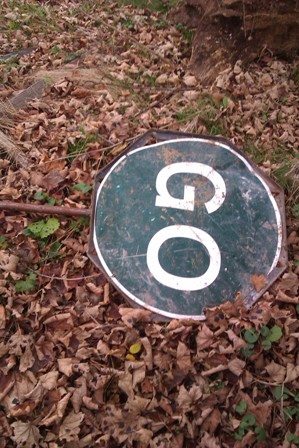
Have you lost your Go sign?
Walking back from the gym the other day I saw this Go sign that had been thrown into a field.
Take a minute out of clock-time and just observe it. If your mind wanders, notice where it goes and bring it back to the picture. Allow whatever comes into your awareness to be noticed, and then come back to the picture. What comes to mind for you? Have you lost your Go sign?
What struck me is that often we lose our Go sign, we simply cannot get up and go. I think that is because often we have first lost our amber ‘Slow down’ sign. Our ‘Stop’ sign is not even in our awareness or consciousness, it is buried deep within.
Advent tells us to slow down. Sometimes it is our bodies that shout ‘stop!’ We need all three signs working well.
When was the last time you consciously slowed down, or simply stopped?
What is this life if full of care
We have no time to stand and stare?
William Henry Davies
For the full poem here is the link: http://www.poemhunter.com/poem/leisure/
One-Minute Icon – the owls in our head #fear

Are the owls in our mind that we hide from real?
Step out of clocktime for one minute. Take a good look at this owl. What does it bring to mind?
This owl is not real. It is a fake owl at a tube station there to scare the pigeons. We too have fake owls in our minds, that we take for real. We might imagine them in our own head, or imagine them out there somewhere waiting to pounce.
Maybe each time we see on our phone that we have an email, we fear it might be a critical one. Whenever the phone rings our first thought is it must be bad news.
We need to notice these owls in our heads, name them for the fears they are, and let them go. Perhaps it is the owl of rejection. What else might they be?
These owls keep us from taking risks, or believing in , or seeing the good things around us. Just try to identify the main one that keeps you in fearful watching. When you name the owl and its unreal nature, it begins to fade and lose its power.
Stop hiding, and come out into the light.
One-Minute Icon: The sad garden and the happy tree #epiphany

the happy tree can lead us out of the sad garden
I came across these words of Michael Katakis, a photographer who puts words and pictures together.
I thought it to be a sad garden whose only harvest was regret.
Those words made me think of our minds which can become a sad garden, when we become totally identified with our self-preoccupied narratives which are often negative and automatic. However, things outside of ourselves can spring us out of our minds and into life.
In his book Holiness Donald Nicholl tells the story of how a face saved the life of Olivier Clement, the Orthodox theologian.
Olivier was at the time an atheist, although so unhappy he was considering suicide. As he walked along depressed, ‘his attention was riveted by the face of someone who was passing by. The person’s face was so radiant with meaning, full of such goodness as can only come from years of cultivating a loving heart. In a twinkling Clement’s suicidal thoughts were dispelled and a seed sown in his heart that was eventually to transform him into an ardent believer…’ (p.49)
This photo is of an ordinary humble tree. But whenever I see it it always glows with colour. If I am in the sad garden, this happy tree pulls me out of it. It has been an epiphany.
It doesn’t shout, or clap its hands, but it radiates joy. But in a twinkling it takes me out of myself.
Step out of clocktime for one minute. Look at the tree and notice your feelings. Are you in the sad garden or with the happy tree? What is the theology of your face today? Olivier Clement says there is a ‘theology of faces’.
#mindful skiing – feeling #flow and #contemplation

mindful skiing, feeling flow
Skiing is a doorway into the present moment and present-moment awareness. When you stand on top of that mountain with the sun in your face, the wind tugging at your jacket, the sound of silence following you, the smell of Alpine clean air, able to see the valley below you, and feeling the snow beneath your skiis, you are taken out of auto-pilot, out of ruminating about the past or the future.
You ski into the present moment, out of thinking and into awareness. It is like a wardrobe into a beautiful new land that has always been there, but we just couldn’t find the door.
There might be no visibility one day and you have to feel your way down the mountain with the soles (souls) of your feet – you are skiing on pure awareness. This is a mindful awareness practice. Your soul can express itself and feel through the soles of your feet.
I was talking about this to a group of skiers who also believe in God, and believe skiing brings them closer to God. Skiing is gloriously reality-focused like most mindful awareness practices (attending to your breath, your walking, what you eat). It enables us to experience what Mihaly Csikszentmihalyi calls ‘flow’, ‘the sense of gratification that we enter when we feel completely engaged in what we are doing.’ (Martin E.P. Seligman, Authentic Happiness, p.113)
Flow as a concept is related to mindfulness. Apparently Mihaly’s surname is pronounced ‘cheeks sent me high.’ Flow involves ‘deep, effortless involvement…our sense of self vanishes…time stops…'(Martin E.P. Seligman, Authentic Happiness, p.116) It sends us naturally high.
Skiing is intensely physical as is truly incarnated Christianity. Both pay attention to the body. Mindfulness also pays attention to the body.
The body is intelligent. The latest thinking is cognitive science of an embodied mind (Andy Clark, Being There: Putting Brain, Body, and World Together Again, MIT Press). As Christians we would agree with that, we would just want to put Brain, Body, World and God together again.
It was Pope John Paul II who said, ‘The body, in fact, and it alone, is capable of making visible what is invisible: the spiritual and divine…'(quoted in Christopher West, Theology of the Body for Beginners). As we ski in embodied minds in the mountains we begin to see the invisible, the spiritual and divine. We are present to a deeper Presence that has always been there.
 shaunlambert.co.uk